
Guides/Products Education
Hexa Plywood Explained: Anti-Slip Film Faces and Where They Belong
Hexa plywood is film-faced plywood with a raised hexagonal anti-slip face. Learn what the name leaves out and why hexa is a floor panel, not a form face.
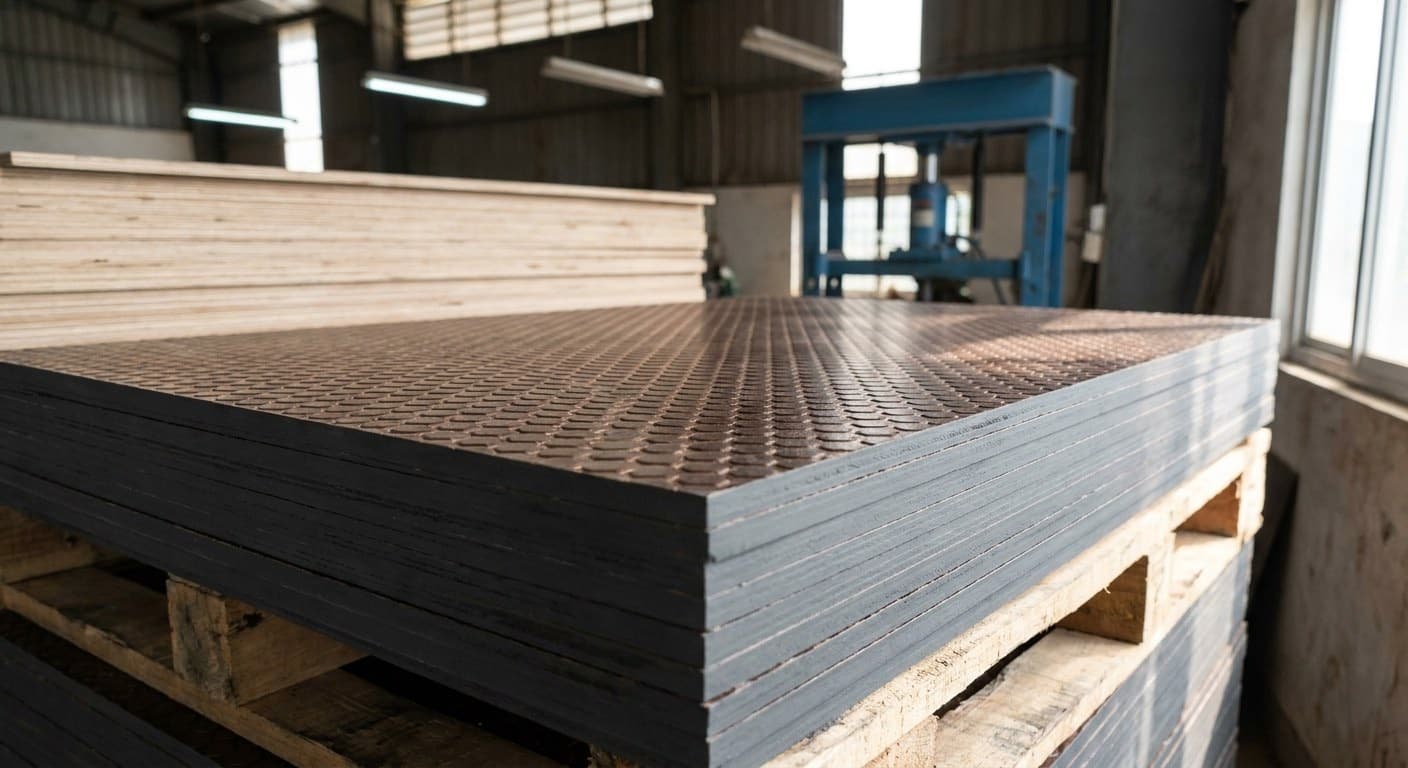
Hexa plywood is film-faced plywood with a grip pattern of small raised hexagons pressed into its phenolic film, usually on one face, with plain smooth film on the back. The word describes that surface and stops there, so it won't tell you what species went into the core, what glue holds the veneers together or how heavy the film is. In practice two panels sold as "hexa" in the same week can behave quite differently once they're screwed down on a trailer that gets hosed out every Friday. Since concrete copies any texture it's poured against, you'll find hexa on trailer floors, stage and scaffold decks and the walkways beside formwork, and almost never against the pour itself.
How a formwork film turned into a floor surface
The product grew out of the film-faced formwork trade, and that history explains why the questions you need to ask about it look so familiar. Mills were already pressing dark phenolic film onto plywood for concrete forms, and that film wears well and sheds water, but anyone who has crossed a smooth film deck after a shower of rain knows how slippery it becomes underfoot. Somebody worked out that pressing a texture into the very same film would give trailer builders and staging crews a hard-wearing floor with real grip, and the panel underneath hardly needed to change at all.
As the product travelled it collected local names. Australian buyers mostly say hex or hexa, UK and European price lists tend toward anti-slip or wire mesh, and in North America a truck-body shop may simply ask for anti-skid panels. On top of that, some distributors sell the idea under their own grip brand names. None of these labels is a standard designation, so when two quotes land on your desk the first thing to settle is whether they're even describing the same face. Our phenolic plywood explainer covers the smooth film that every one of these variants starts from.
What the hexagonal pattern is and how it gets there
Up close, a hexa face is a regular field of small raised hexagons, rather like a honeycomb seen from above, and the pattern is part of the film rather than something glued or painted on afterwards. It's formed during hot pressing. Where a glossy formwork face is pressed against a polished plate, a hexa face meets a patterned plate or screen instead, and the resin in the film cures around that pattern; the back of the sheet usually meets a smooth plate and comes out as ordinary film.
Price lists like to compress all of this into a couple of letters. F/W is a common example, used for a sheet with smooth film on one side and a wire-mesh texture on the other, and some suppliers use similar shorthand for hexa faces too. Mills don't work from one shared code book, though, so it's safer to read those letters as a prompt for questions than as a specification, because a line that reads "F/W 18mm" and nothing more still leaves most of the important fields empty.
Hexa, wire mesh and smooth film side by side
| Face | Surface | Typical job | Cleaning | Concrete contact? |
|---|---|---|---|---|
| Hexa | Raised, regular hexagonal relief | Trailer and van floors, stage and scaffold decks, walkways | Brush or wash out of the pattern | No, the pattern prints into the concrete |
| Wire mesh | Fine woven-grid impression | Similar floors and platforms, often lighter foot traffic | Brush or wash; fine grid holds dust | No, for the same reason |
| Smooth film | Flat, glossy or semi-matte phenolic | Wall and slab formwork faces | Wipes clean, takes release agent | Yes, this is the forming face |
Keep in mind that the table compares surfaces and nothing else. How long the grip holds up depends on the film and the kind of traffic it sees, while the load a floor can carry depends on thickness and core, and neither can be read off the pattern name.
What the name does not tell you
The glue line is the gap that causes the most grief, so it's the place to start. An identical hexa face can sit on a panel bonded to EN 314-2 Class 3 for exterior service or on one glued for humid but sheltered conditions, and looking at the face won't tell you which one you've got. On a trailer that's rained on and washed out every week, that invisible difference is often what separates a floor that lasts for years from one that begins lifting at the edges after a season or two. Our guide to EN 314-2 bonding classes sets out the classes, and the WBP explainer deals with the trade shorthand that often stands in for them.
The core deserves the same attention. Vietnam-origin panels are usually built from plantation-grown species, and the atlas pages on eucalyptus plywood and acacia plywood explain what each one brings to a finished sheet. Film weight is a further blank: heavier films generally stand up to foot and wheel traffic for longer, but that's a figure to request from the mill rather than something the word hexa implies. Then come the edges, which matter because water usually finds its way into a floor panel through cut edges and screw holes long before it gets through the face.
Where hexa belongs, and where it does not
Hexa makes sense on any surface people walk across, drive over or push trolleys along. Trailer and truck-body floors are the classic case, with van linings, scaffold boards and stage platforms close behind, and so are the walkways and working platforms crews rig around a formwork deck. When those surfaces are wet or dusty the texture keeps feet planted, and the film takes scuffing much better than bare veneer ever would.
What it shouldn't do is face the concrete. Wet concrete records every detail of whatever it's poured against, so a hex face would leave a honeycomb print across a wall or soffit, and very few engineers will sign that off. Forming faces stay smooth, and the atlas guides to formply and concrete forming plywood cover the faces that forming specs actually call for. Floors come with their own trade-off, too, since the texture that provides grip also traps mud and grease, which means a hexa deck needs washing more often than a smooth one if it's going to keep gripping.
Questions that make hexa quotes comparable
Because the name carries so little information, the RFQ has to carry the rest of it. If we could add only one line to every hexa enquiry we see, it would be the bond class together with the test report behind it. The four questions below are usually enough to turn two vague offers into quotes you can lay side by side.
- Which pattern, on which side? Get a close photo of the face and confirm whether the back is smooth film, textured or bare veneer.
- Which film, and how heavy? Ask for the film type and the weight the mill states, so you're not comparing offers on pattern alone.
- What bond class, and what proves it? Request the EN 314-2 class or its equivalent plus a recent test report. Our test certificate guide shows what a usable one looks like.
- What's in the core, and are the edges sealed? Name the core you expect and ask how edges are treated once panels are cut to size.
For a commercial read on specific panels, Vinawood's mill blog has a separate piece on anti-slip plywood and its application categories, aimed at buyers who already know the terms.
Frequently asked
What is hexa plywood?
Hexa plywood is film-faced plywood whose phenolic film carries a raised hexagonal texture for grip, usually on one face with smooth film on the back. The name only describes the surface pattern. Core species, glue bond class and film weight still have to be specified separately.
Is hexa plywood the same as wire mesh plywood?
They are close relatives but not the same face. Hexa has a pattern of raised hexagons, while wire mesh carries a finer woven-grid impression, and both are pressed into a phenolic film for grip. Suppliers sometimes use the names loosely, so ask for a close photo of the face before comparing quotes.
Can hexa plywood be used for concrete formwork?
Not as the face that touches concrete, because wet concrete takes an exact impression of the hex pattern. Hexa is used on walkways, working platforms and decks around formwork, where grip matters. The forming face itself should be smooth film or another overlay that forming specs name.
Is hexa plywood water-resistant enough for trailer floors and outdoor decks?
The phenolic film resists water on the face, but long-term wet performance depends on the glue line and on edge sealing. Ask for the EN 314-2 bond class with a test report, and make sure cut edges and fixing holes are sealed. A hexa face on a panel bonded for protected conditions will not last on an open trailer deck.
What should I ask a supplier before comparing hexa plywood quotes?
Ask which pattern sits on which face, what film is used and at what stated weight, and which bond class the panel meets with what evidence. Add the core species and how edges are sealed after cutting. With those answers two hexa offers can be compared on more than the pattern name.
Related in the atlas
Continue reading
Same topic first, then what others on the atlas read most.
Grades
Plywood Standards Cross-Reference Matrix (EN, BS, IS, JAS, AS/NZS, ASTM)
A side-by-side reference that lines up plywood bond, durability and formaldehyde classes across EN, BS 1088, IS 710/303, JAS, AS/NZS and US PS 1, so a foreign spec can be translated into what a Vietnamese mill can build and certify.
Compliance
EUDR Evidence Pack for Vietnamese Plantation Plywood
A plain-language reference on how a compliant EUDR evidence pack for Vietnamese plantation plywood typically works: Article 9 data, Circular 26/2022 origin dossiers, smallholder land tenure, the money trail without a seller e-invoice, and why the mill pack is not the DDS.
Overview
The Vietnam Plywood Industry: A Complete Overview
A plain-English overview of Vietnam's plywood industry: its scale and growth, the plantation species base, the main export product types, certification, and where Vietnam sits among global plywood origins.

Compliance
REACH and Vietnam Plywood: The EU Formaldehyde Restriction
How REACH's Annex XVII entry 77 formaldehyde restriction (Regulation (EU) 2023/1464) affects Vietnamese plywood sold in the EU, and what a mill must show to meet the 0.062 mg/m³ limit from 6 August 2026.