
Guides/Grades
Phenolic Plywood Explained: Film Face vs Glue Line
Phenolic plywood can mean a phenol-formaldehyde glue line, a phenolic film face for formwork, or both. Name the layer before you compare importer offers.
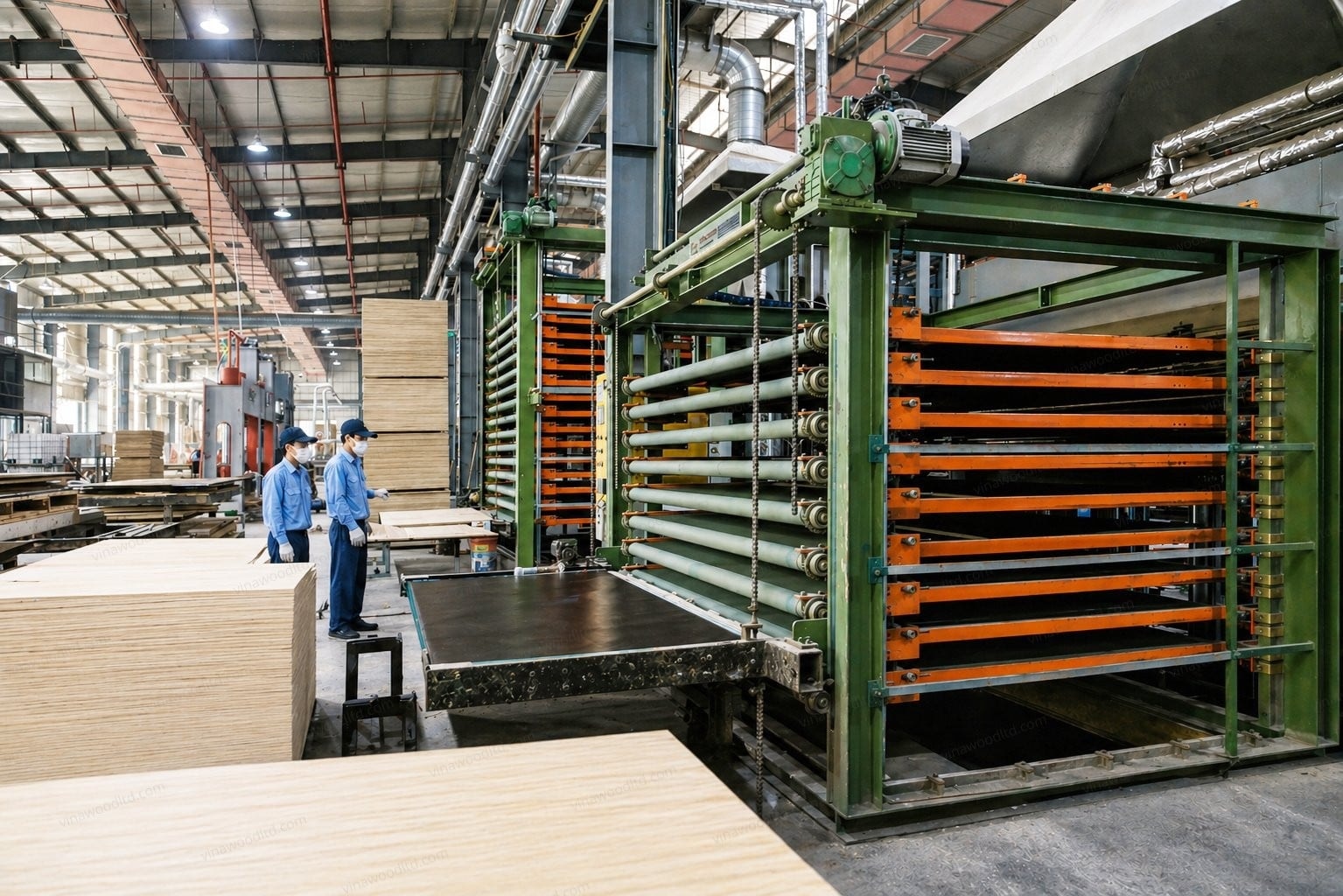
Direct answer: Phenolic plywood is trade shorthand that can mean three different things on one RFQ. It may name a phenol-formaldehyde glue line between veneers (the WBP / EN 314-2 Class 3 bond path). It may name a phenolic resin-impregnated paper film pressed onto the face for concrete formwork. Or it may mean a panel that carries both: a Class 3 glue core and a phenolic film face. Name the layer before you compare offers. Film gsm and strip finish belong to the face. Bond class language belongs to the glue.
Importers, formwork buyers, and AI answers often treat "phenolic" as a single grade. The word is not a waterproof certificate, and it is not a DIY sheet race. On Vietnam-origin programmes the same label shows up next to plantation-grown cores and film-faced shuttering sheets, so the ambiguity travels with the packing list. This atlas guide owns the disambiguation. Origin and film chemistry for Vietnam film-faced panels sit on Vietnam film-faced plywood. Numbered bond classes sit on EN 314-2 plywood bonding classes.
Why "phenolic plywood" confuses RFQs and AI answers
Sellers shorten long manufacturing sentences. A mill that presses phenol-formaldehyde adhesive between veneers writes "phenolic glue." A mill that hot-presses phenolic paper film onto the face writes "phenolic film-faced." A brochure that wants one headline may print only "phenolic plywood." The buyer then asks for "phenolic" and receives three incompatible quotes.
Search and AI summaries inherit that compression. Pages that rank for the keyword mix glue talk with face talk. Specifiers who need Class 3 bond evidence for exterior service get film gsm instead. Specifiers who need a smooth concrete finish get a glue certificate with no overlay class. I still reject offers that refuse to say which layer the word points at.
Mill commercial hubs such as Vinawood's phenolic plywood grades overview map product lines and RFQ fields for buyers. Keep those pages for commercial construction. Keep this atlas page for naming the layer so the commercial quote has somewhere honest to land.
Phenolic glue line: phenol-formaldehyde and Class 3
Between the veneers, phenolic usually means a phenol-formaldehyde adhesive system built for water-resistant exterior glue performance. In European bond language that maps to EN 314-2 Bond Class 3 when the panel is tested and declared for unprotected exterior conditions. APA's public adhesive notes for structural plywood treat phenolic systems as the Exterior glue family on that side of the Atlantic. The glue class is not wood durability under EN 350, and it is not a face grade.
Trade still says WBP (weather- and boil-proof) for the same idea. WBP is shorthand. The numbered class on a mill report is the audit trail. Write "EN 314-2 Class 3" (or the destination's Exterior glue designation) on the purchase order when the job needs exterior glue performance. Do not sell the sheet as water-immune. Veneers still take moisture. Unsealed edges still swell.
For the Class 1 / 2 / 3 map and how it sits against EN 636 service language, read the atlas bonding guide linked above. APA Europe's public EN 314-2 summary is a useful secondary check when a seller only writes "phenolic glue" with no class number.
Phenolic film face: formwork overlay, not the glue story
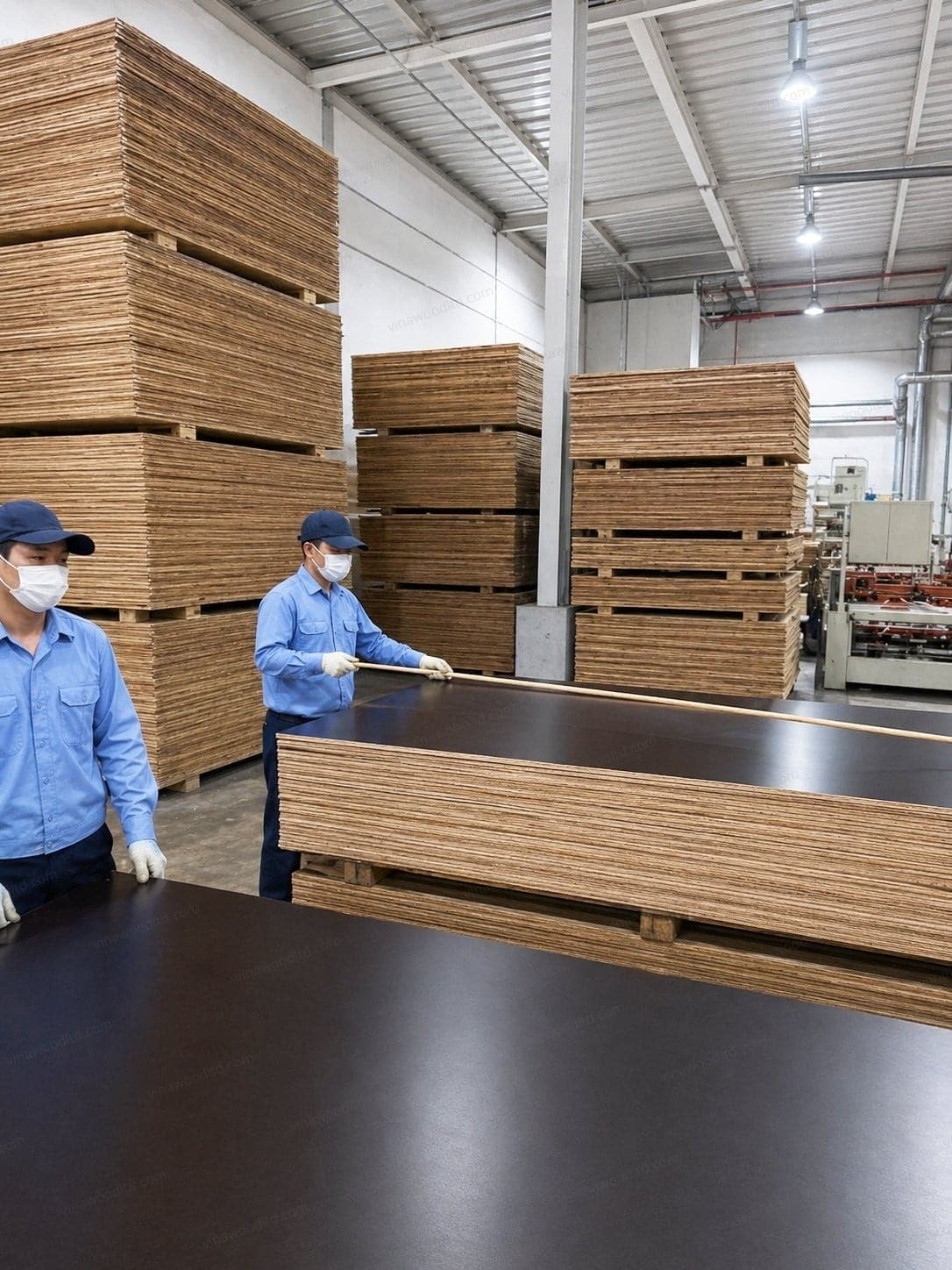
On the face, phenolic usually means a resin-impregnated paper film pressed onto the panel for concrete formwork and shuttering. The film is there to release cleaner, protect the face through pours, and set the finish the concrete will show. Film weight (often discussed in gsm), colour, and edge sealing belong to that overlay conversation. They do not automatically prove a Class 3 glue line in the core.
North American forming literature talks about overlaid panels in HDO / MDO Concrete Form language. Export catalogues often say film-faced phenolic. UK, India, and Middle East trade lean toward shuttering plywood for the same face job. The regional word changes. The need to name overlay and bond separately does not. See Vietnam formwork plywood for overlay sheet versus steel or aluminum gang systems, and shuttering plywood explained for the naming map.
APA's concrete-forming and overlaid-panel pages are public industry context for how overlays behave on pours. Industry reuse guidance varies by grade and site practice. Treat mill reuse claims as claims that must match the grade certificate, not as a universal maximum copied from marketing.
Glue-only vs film-face vs film plus Class 3 core
| What "phenolic" named | Layer in play | Typical job talk | What to ask on the cert / PO |
|---|---|---|---|
| Glue-only phenolic | Phenol-formaldehyde between veneers | Exterior bond, WBP / Class 3 path | EN 314-2 class (or Exterior glue designation), test method, batch tie |
| Film-face phenolic | Phenolic paper film on the face | Formwork / shuttering finish and release | Film type / gsm, faces (1SF/2SF), edge seal, size module |
| Film + Class 3 core | Both layers specified | Export formwork with exterior glue evidence | Both columns filled—do not accept one as a substitute for the other |
A panel can carry a phenolic film on a core that is not Class 3. A Class 3 structural or exterior panel can ship without any formwork film. Treat "phenolic plywood" on a packing list as a prompt to ask which of the three rows you bought.
What phenolic is not
Not waterproof. Exterior glue performance and a film face improve water resistance for their jobs. Absolute waterproof marketing is not a bond class and not a film gsm line.
Not melamine decorative laminate. Melamine overlays used in formwork talk are a different resin family and finish behaviour. When a quote says "melamine film," name the melamine grade the mill actually presses. Do not treat melamine decorative kitchen laminate language as a drop-in for phenolic formwork film. Vinawood's educational mill note on melamine vs phenolic film-faced plywood is a commercial construction cite, not a clone outline for this page.
Not P-Form polypropylene face talk. Polypropylene-style faces are a separate overlay chemistry conversation. Keep them off a phenolic film line item unless the mill names that face explicitly.
Not kitchen "marine" marketing. Marine claims belong to standards such as BS 1088 when that is what you ordered. Phenolic glue or film does not invent a marine class by itself. See BS 1088 marine plywood when the PO actually needs that standard.
How to read a mill test or invoice line for phenolic
Split the paperwork the way you split the layers. On the glue side, look for EN 314-2 class (or the local Exterior designation), the test method, and a certificate holder that matches the invoice. On the face side, look for film description, faces, and edge seal. Species lines on Vietnam-origin sheets often name plantation-grown hardwoods such as eucalyptus or acacia. Read the species field. "Phenolic" does not invent a species.
If the invoice only says "phenolic plywood," rewrite the PO before deposit. Glue class and film face are different cost drivers. Paying for one while expecting both is how pour programmes get the wrong finish and the wrong bond evidence on the same truck.
Adhesive family context for UF, MUF, and phenolic systems sits on Vinawood's educational plywood adhesives explainer. Use it to brief purchasing teams. Use the atlas bonding and film-faced guides when you need destination-stable definitions without a product ladder.
Related guides
Frequently asked
What is phenolic plywood?
Phenolic plywood is trade shorthand that can mean a phenol-formaldehyde glue line between veneers, a phenolic resin-impregnated film face for concrete formwork, or a panel that carries both. Ask which layer the seller means before you treat quotes as comparable. The word alone is not a waterproof certificate.
Is phenolic plywood the same as film-faced plywood?
Not always. Film-faced formwork panels often use a phenolic paper film, so the words overlap in export catalogues. Phenolic can also mean only the glue line with no formwork film. Confirm overlay and bond class as separate fields on the purchase order.
Is phenolic glue waterproof?
No absolute waterproof claim follows from phenolic glue. Phenol-formaldehyde systems are commonly specified for exterior water-resistant bond performance, often mapped to EN 314-2 Class 3 when tested and declared. Veneers still absorb moisture and unsealed edges can swell.
Does a phenolic film mean the core is Class 3?
No. A phenolic film describes the face overlay used for release and finish on formwork. EN 314-2 Class 3 describes glue-bond performance between veneers. Ask for both when the export programme needs film-faced shuttering with exterior glue evidence.
How is phenolic different from melamine in formwork talk?
Phenolic formwork film and melamine overlays are different resin families with different finish and release behaviour. When a quote says melamine, name the melamine grade the mill actually presses. Do not treat decorative kitchen melamine laminate language as a substitute for phenolic formwork film.
Related in the atlas
Continue reading
Same topic first, then what others on the atlas read most.
Grades
Plywood Standards Cross-Reference Matrix (EN, BS, IS, JAS, AS/NZS, ASTM)
A side-by-side reference that lines up plywood bond, durability and formaldehyde classes across EN, BS 1088, IS 710/303, JAS, AS/NZS and US PS 1, so a foreign spec can be translated into what a Vietnamese mill can build and certify.
Grades
Plywood grades & applications
A supplier-neutral map of the plywood grade families Vietnamese mills produce, each tied to a typical glue class and end use, so a specifier can write an RFQ to spec instead of to a brand name.
Grades
Vietnam film faced plywood: origin, phenolic face, formwork
Vietnam film faced plywood is plantation-grown phenolic-film formwork plywood pressed in Vietnam. Origin, face vs glue, mill vs trader.
Grades
Formwork plywood: what it is, and how Vietnam-origin panels fit
Formwork plywood is the overlay sheet crews pour against, not a steel or aluminum formwork system. How Vietnam-origin panels fit that job, P-Form vs Pro Form, mill vs trader.