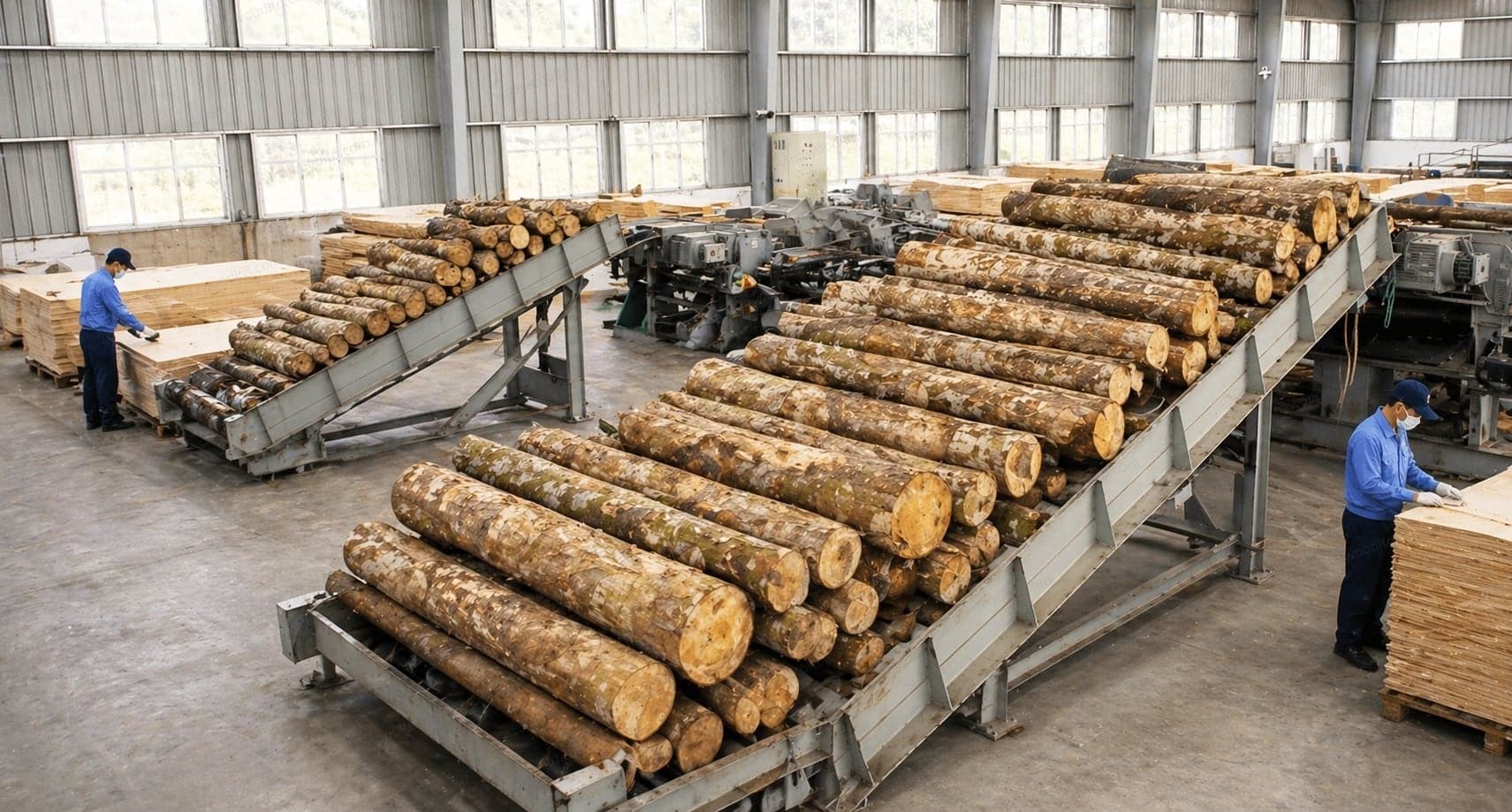
VENEER 0.3–2.5 mm
01
Log selection & peeling
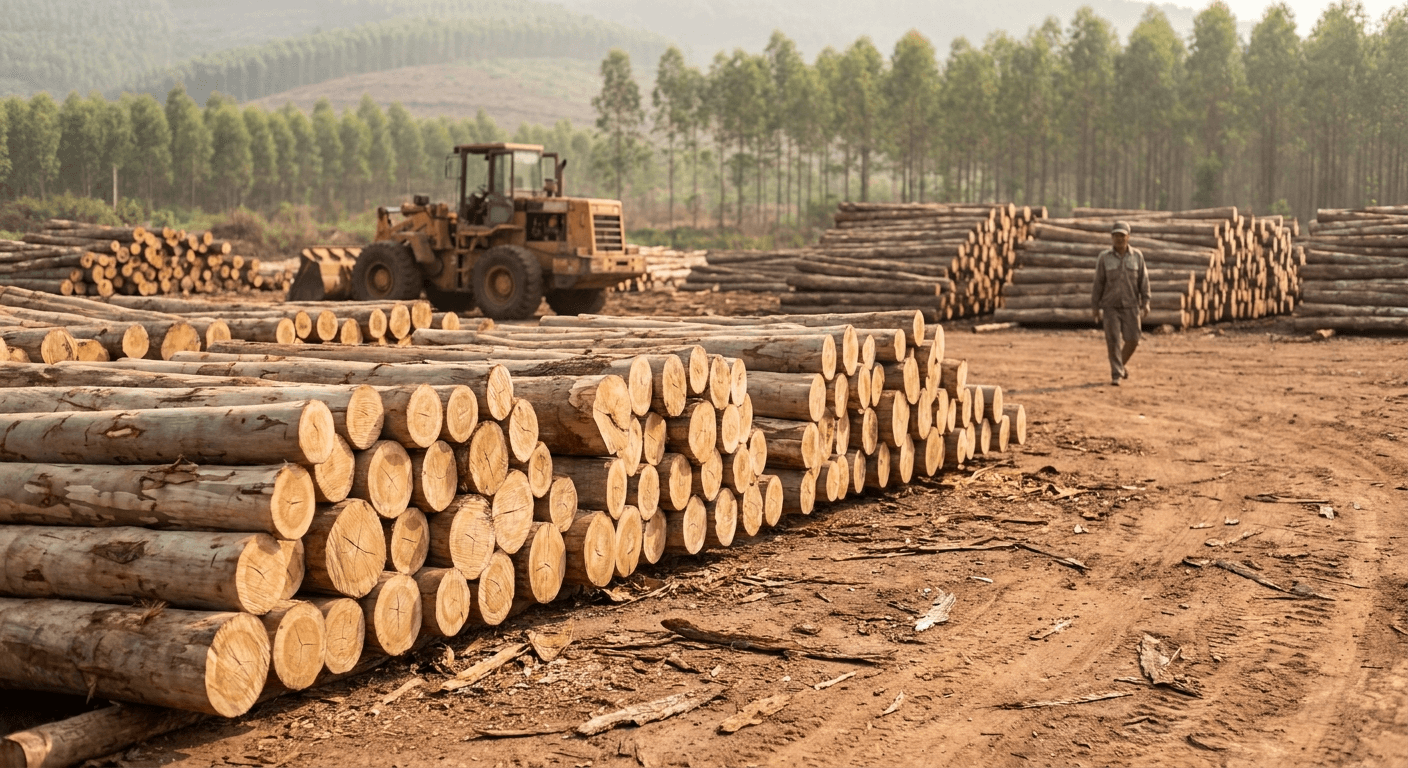
Incoming hardwood and softwood logs are graded by species, diameter, and moisture, then rotated against a knife to produce continuous veneer sheets (0.3–2.5 mm).

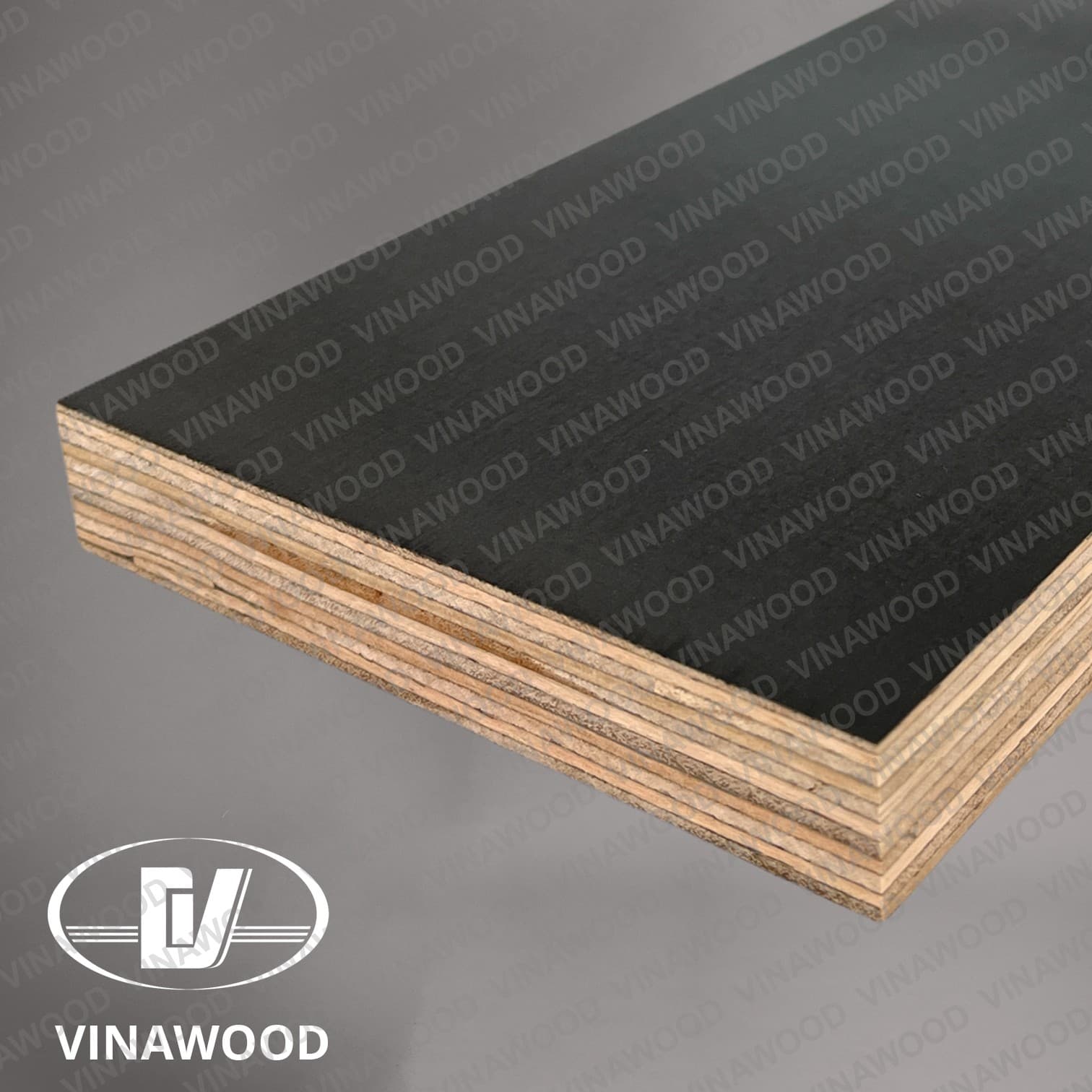
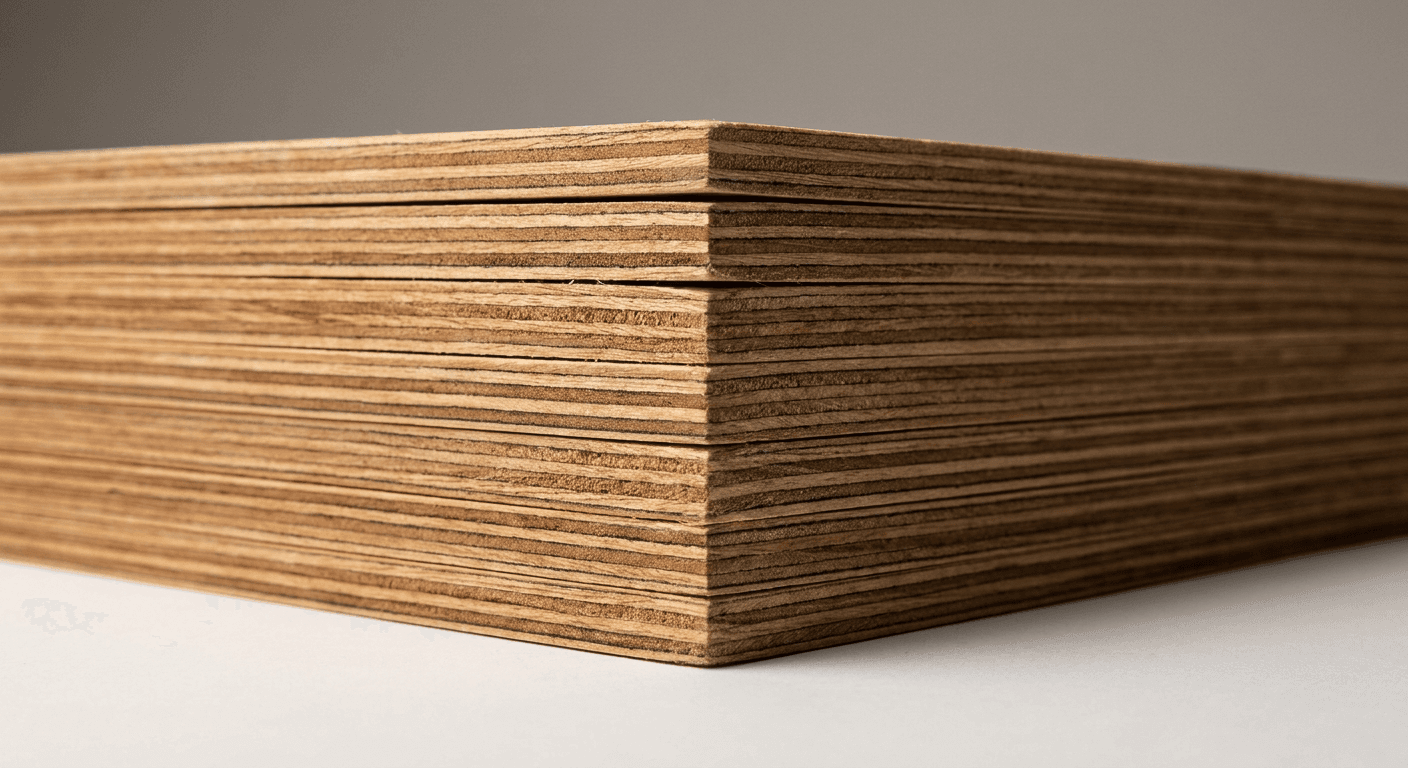
Anatomy of an 18 mm film-faced panel
An 18 mm film-faced panel is thirteen decisions pressed into one board. This atlas opens every one of them — the veneers, the glue line, the mill stages, the grades and the paperwork buyers ask for.

Cross-laminated
Grain turned 90° on every successive veneer.
Pressed & calibrated
120–150 °C under 10–14 kg/cm².
Traded as HS 4412
The customs line every importer files under.
Plantation fiber
Acacia, eucalyptus and rubberwood cores.
Mill film · 12 stages
The complete Vietnam plywood process — documentary stills from a working mill. Scroll the film; every frame is a real production stage.
VENEER 0.3–2.5 mm
01
Incoming hardwood and softwood logs are graded by species, diameter, and moisture, then rotated against a knife to produce continuous veneer sheets (0.3–2.5 mm).
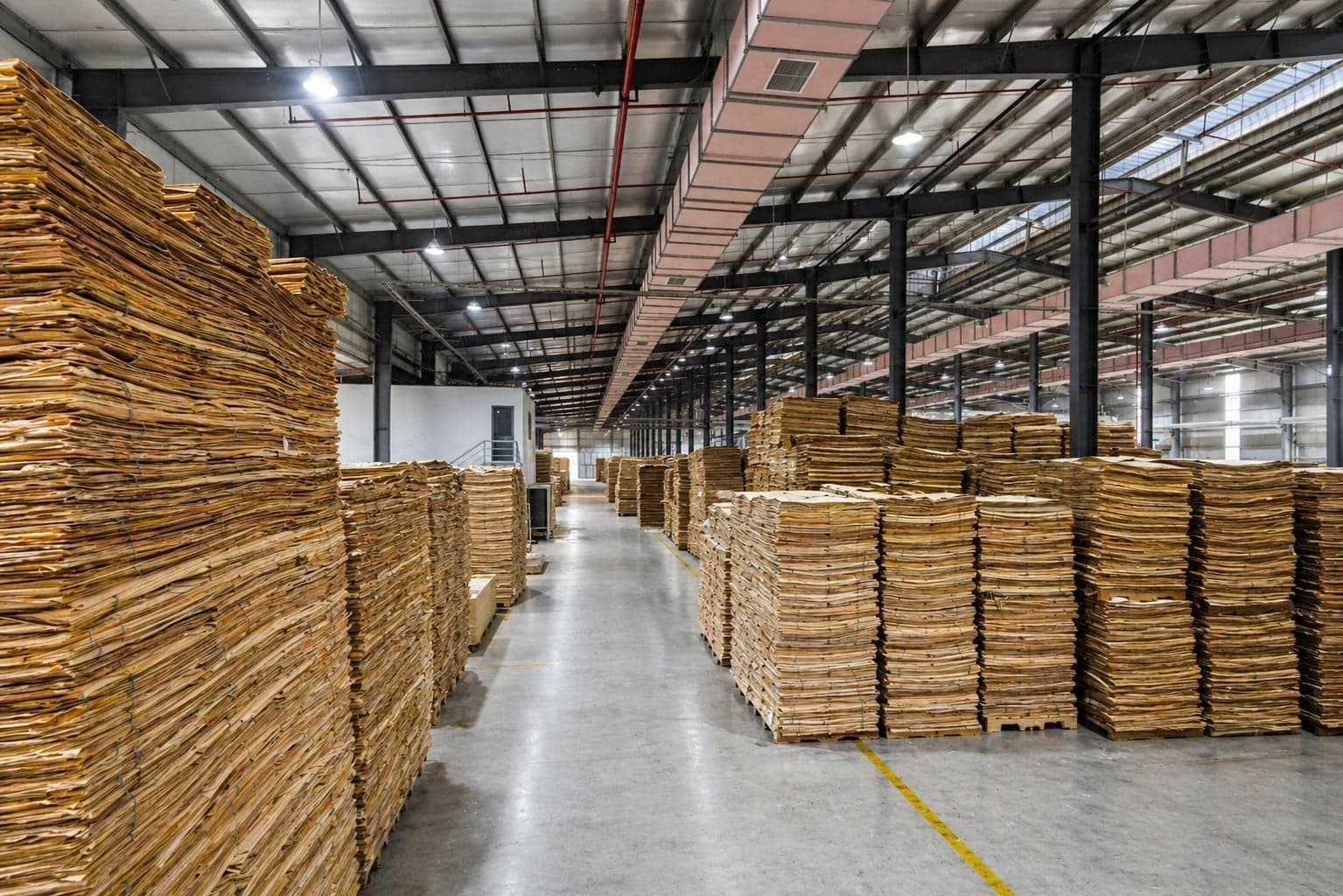
TARGET MC 8–12%
02
Veneer sheets are dried to 8–12% moisture content in continuous roller or jet dryers, then stacked and acclimatised before lay-up.
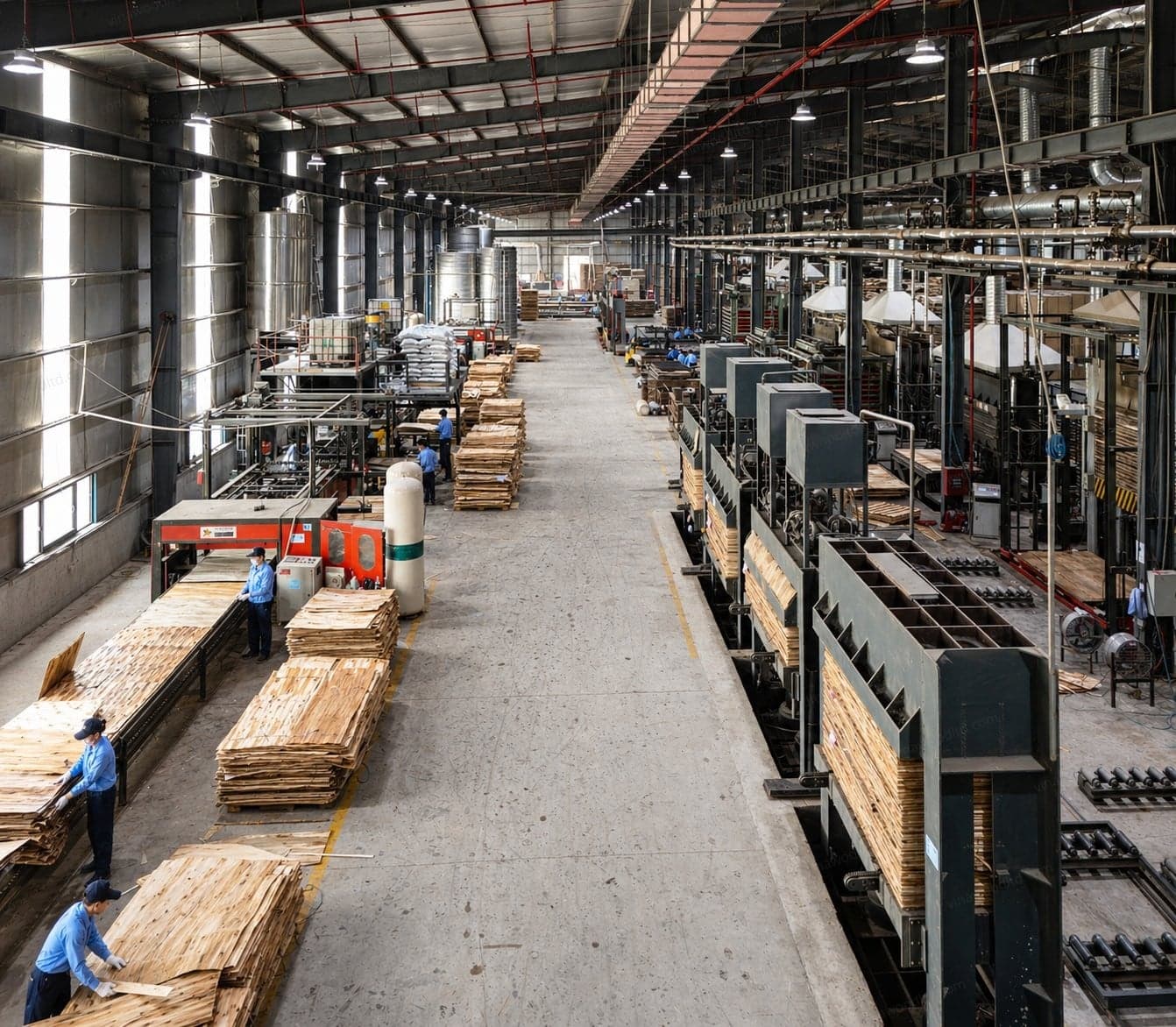
PF / UF ADHESIVE · 90° CROSS
03
Adhesive (phenol-formaldehyde for exterior, urea-formaldehyde for interior) is metered onto core veneers and the cross-grain stack is assembled for pressing.
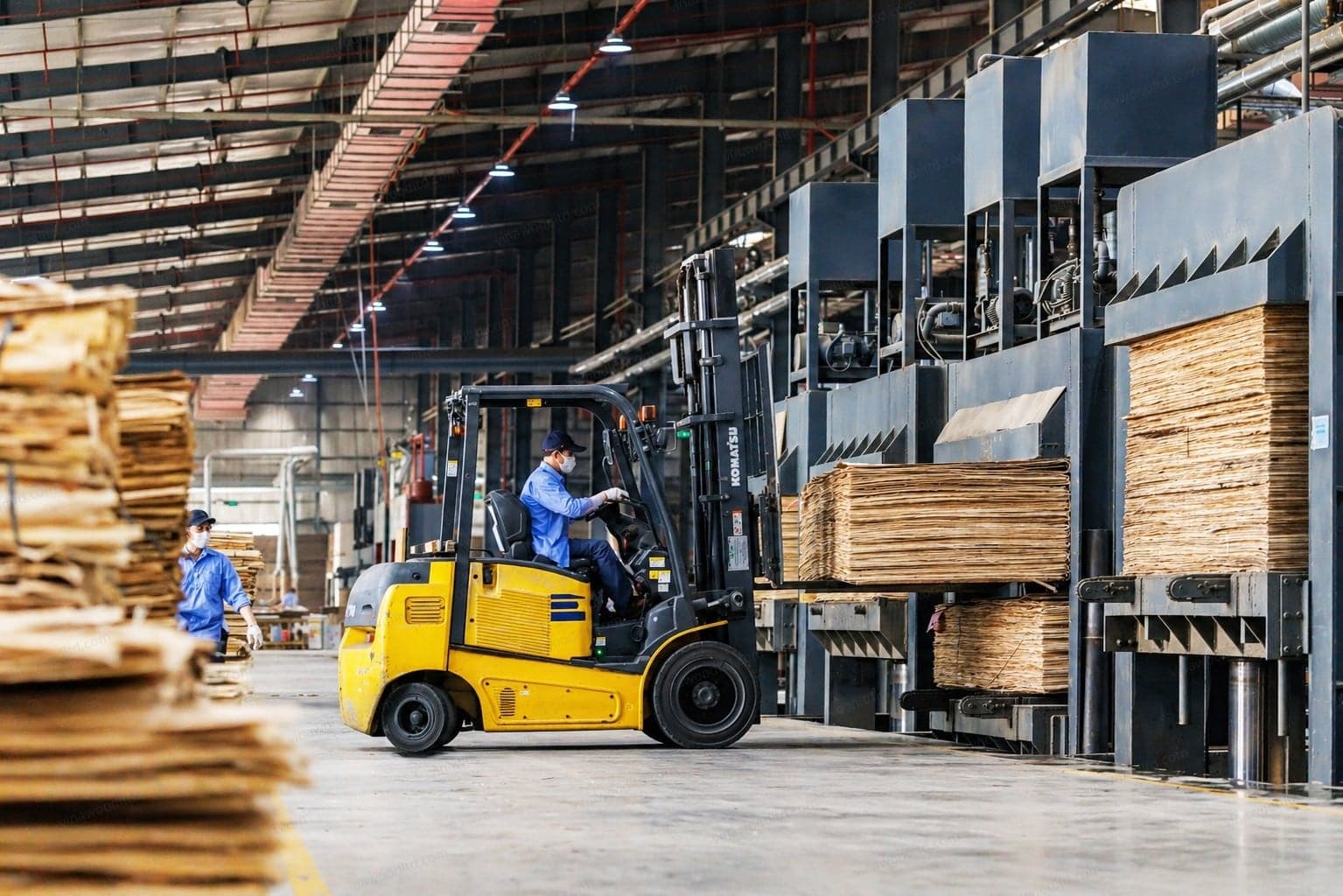
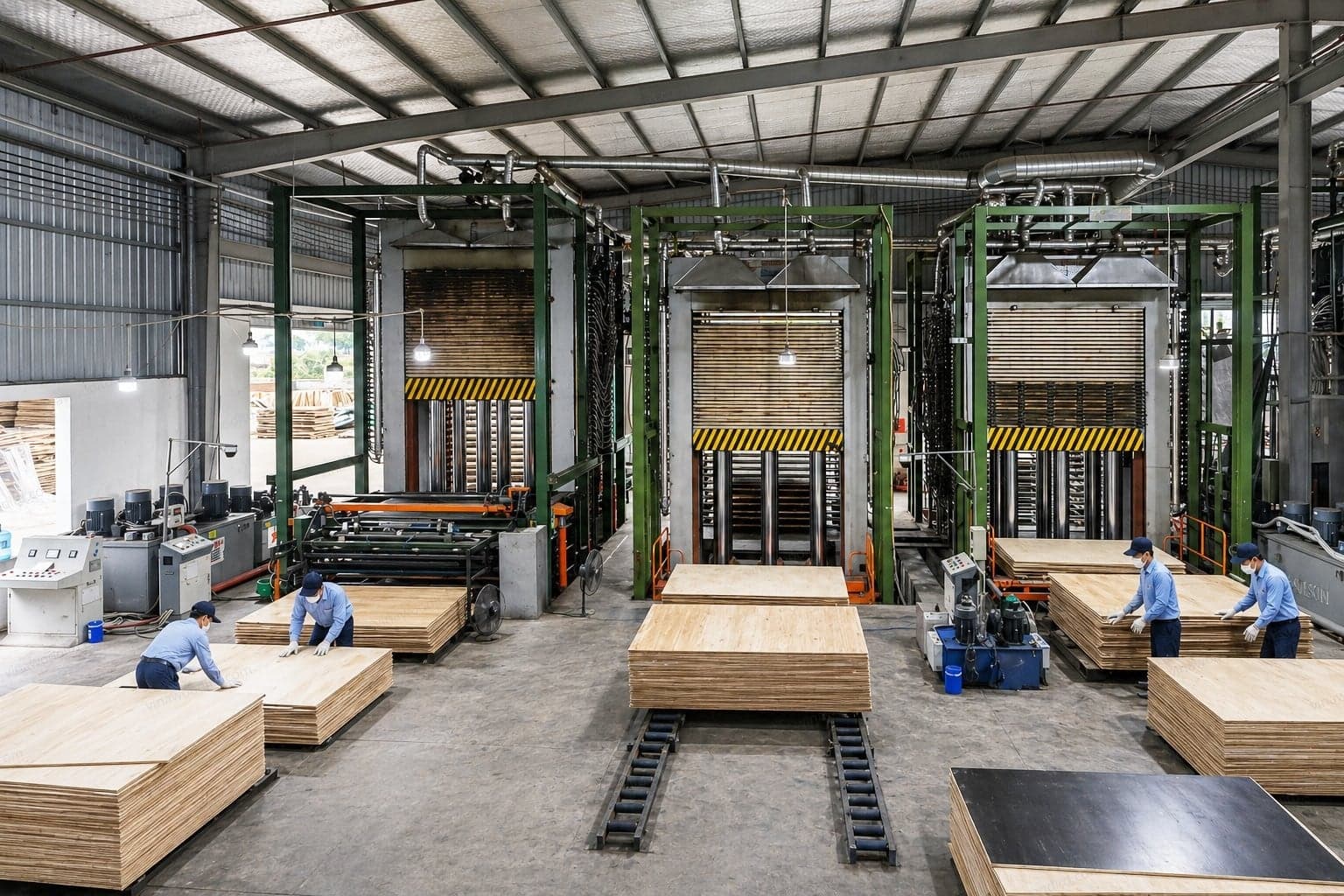
AMBIENT · GEOMETRY SET
04
The assembled panel is pressed at ambient temperature to set the glue-line and consolidate the stack before it enters the hot press.
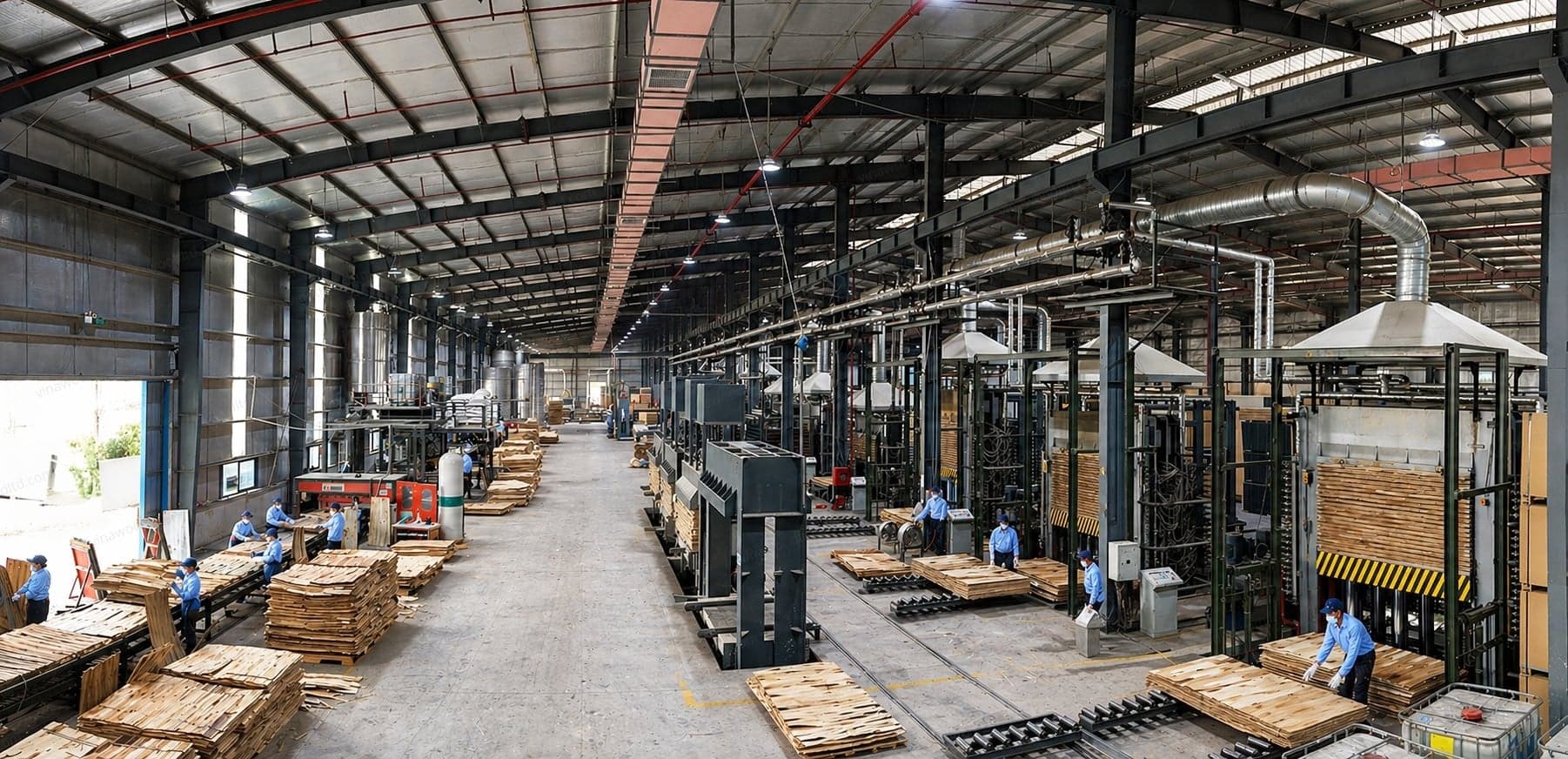
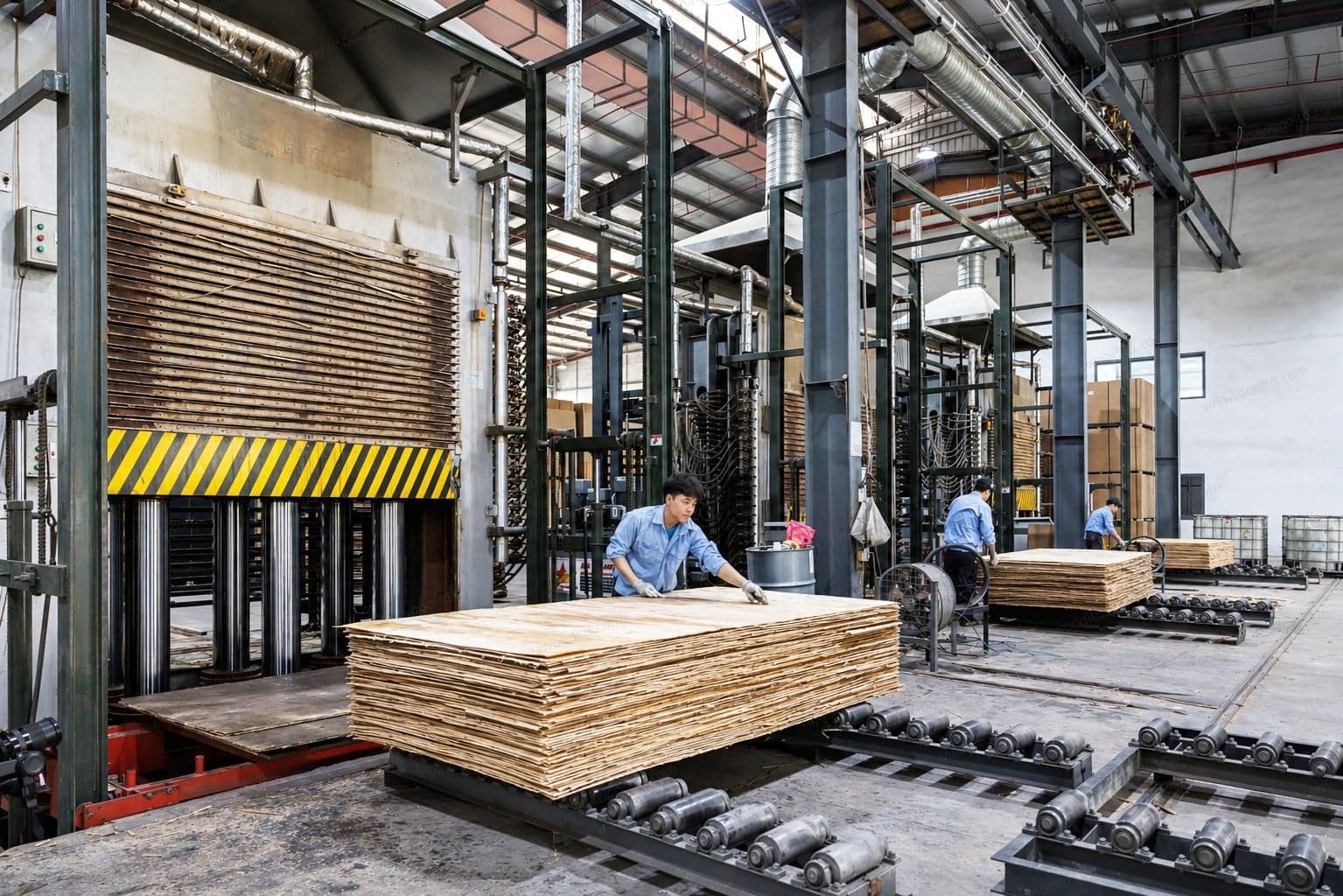
120–150°C · 10–14 kg/cm²
05
Panels are cured under heat (120–150°C) and pressure (10–14 kg/cm²) to fully bond the laminations into a single rigid board.
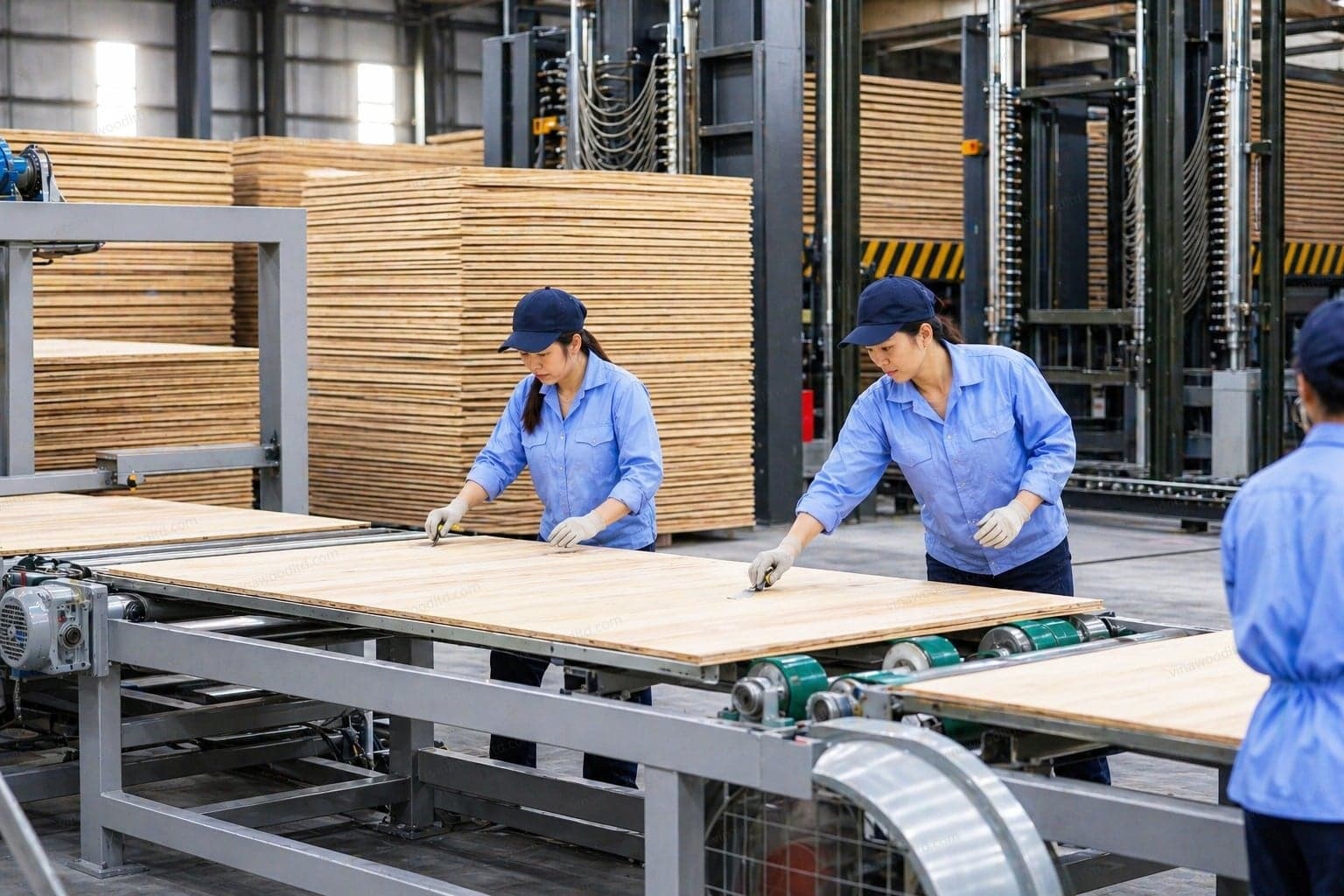
FACE REPAIR · PUTTY FILL
06
Small open defects, knots, and splits on the face veneers are filled with wood putty to deliver a uniform surface for sanding and lamination.
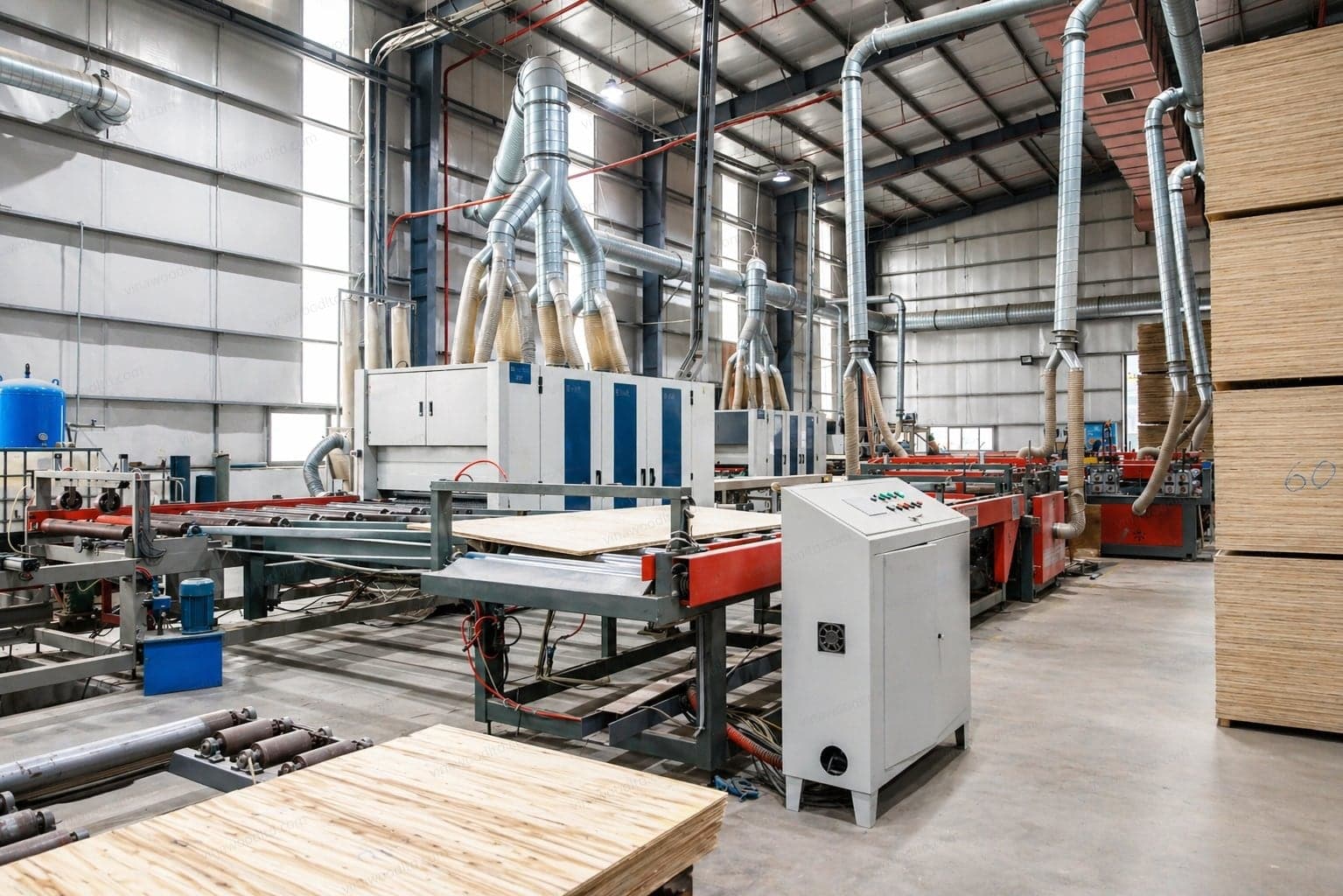
CALIBRATION + FINISH GRIT
07
Surfaces are calibrated and finish-sanded to the target grit for the end application — structural, furniture, or film-faced.
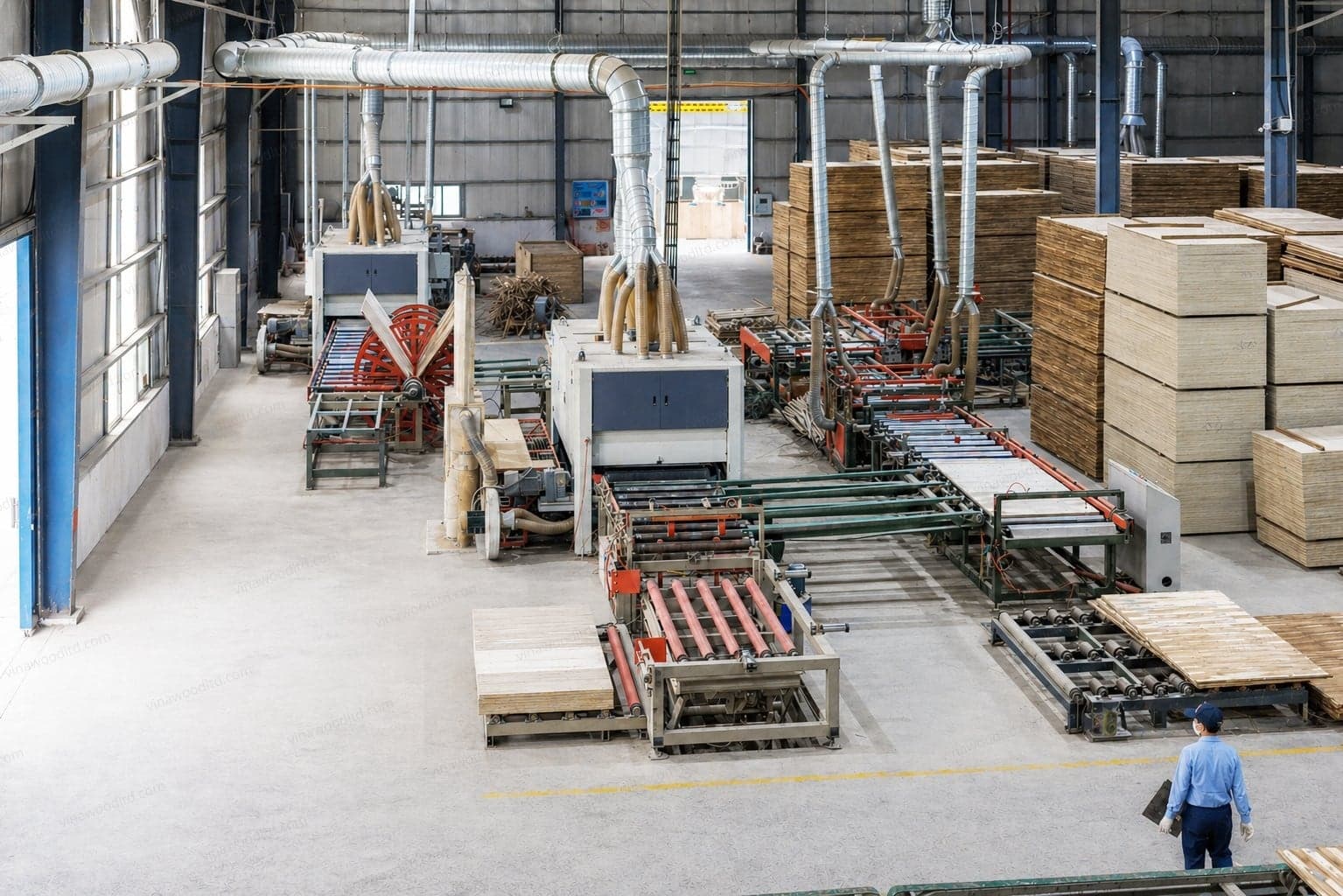
SQUARED TO NOMINAL
08
Finished panels are cut to exact nominal size and squared to final dimensions before inspection.
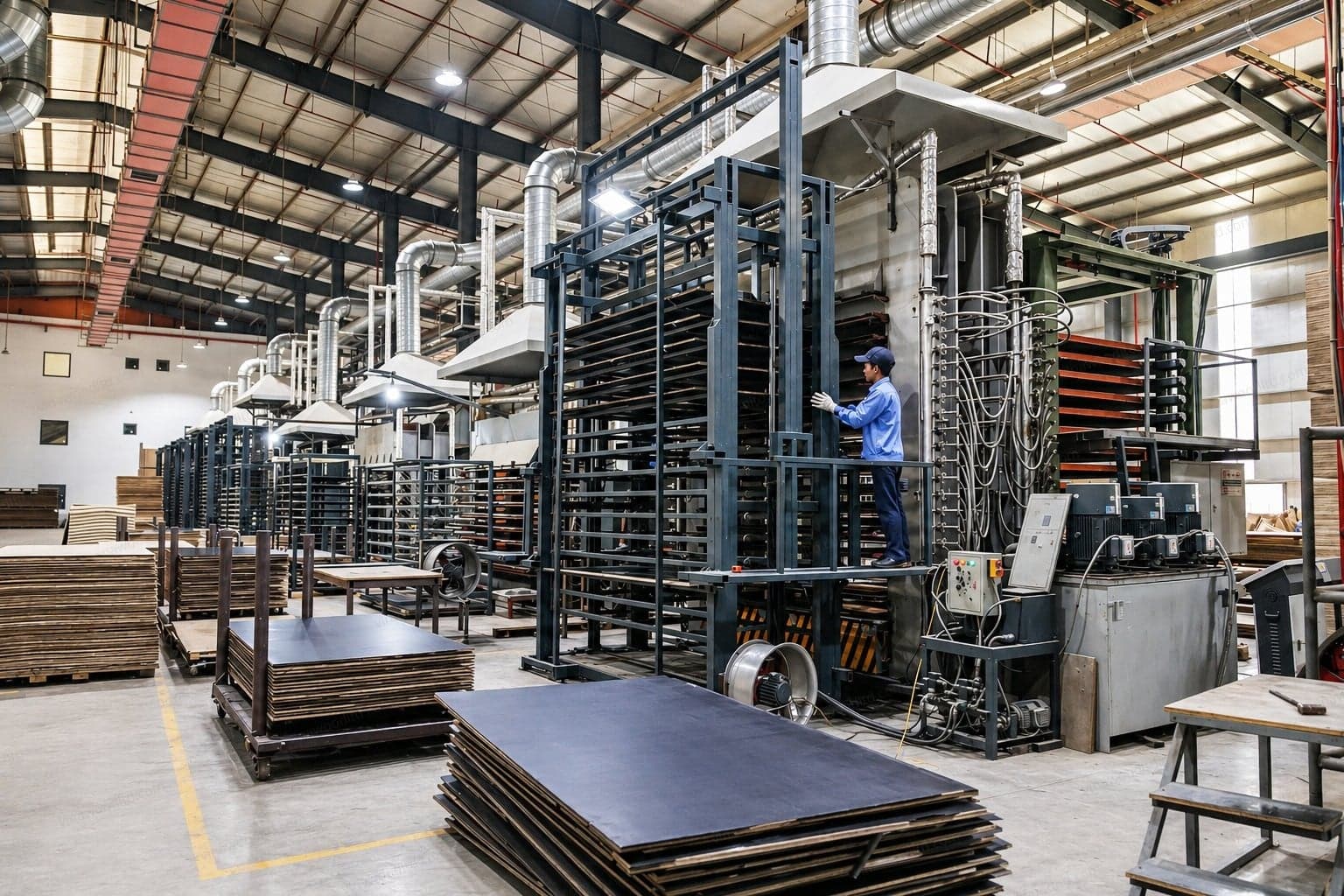
FILM · MATTEFACE · HDO
09
For film-faced, melamine, or overlay products, the finished sheet or film is hot-pressed onto one or both faces of the panel.
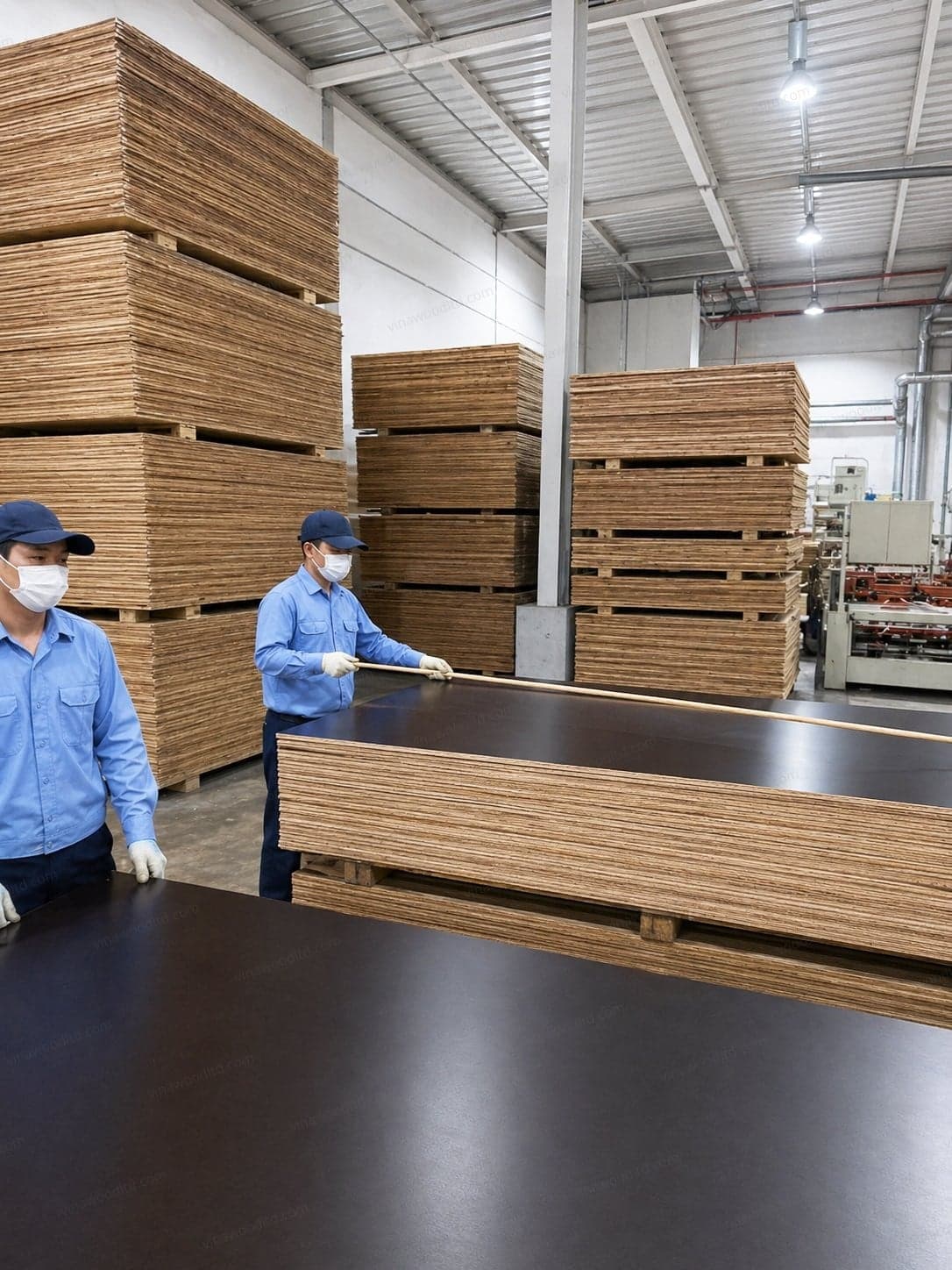
BOND · MC · FACE · DIMS
10
Every panel is inspected for bond strength, moisture content, face defects, and dimensional accuracy against the target grade.
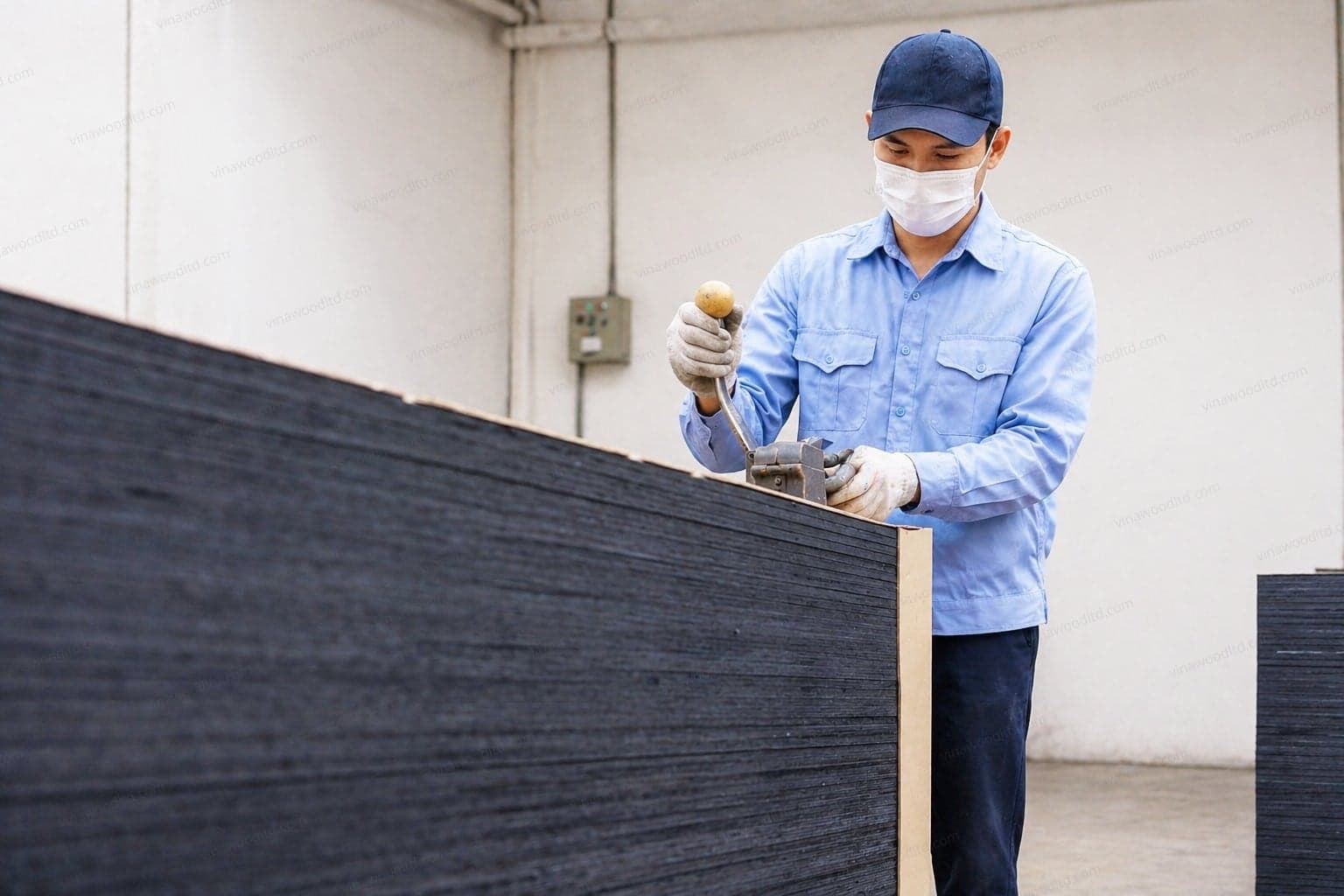
WR EDGE PAINT + MARKING
11
Edges are sealed with water-resistant paint to block moisture ingress and panels are branded with product and traceability marks.

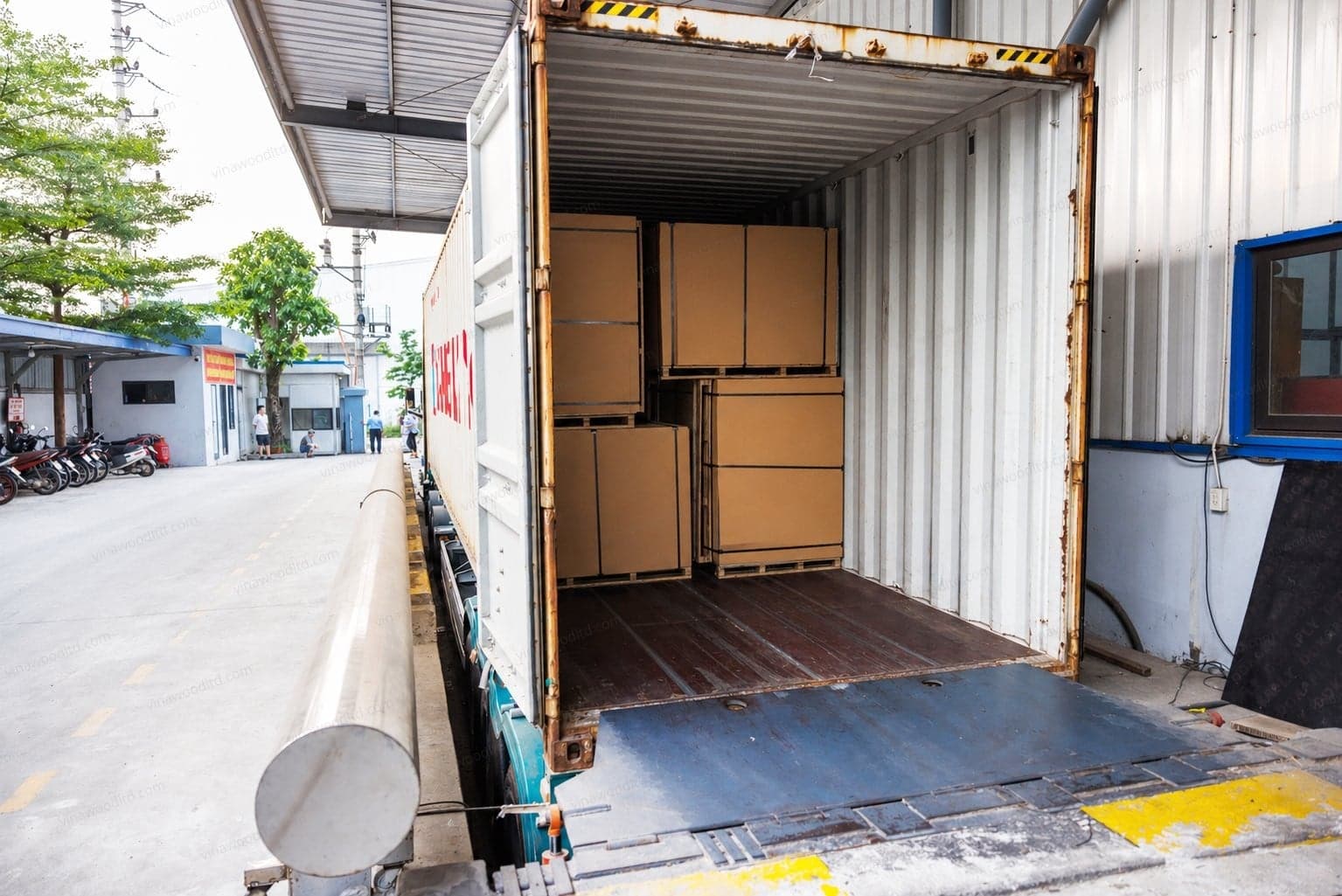
STRAPPED · WRAPPED · FCL
12
Approved panels are strapped into bundles, wrapped against weather, and loaded into containers for sea or land freight.
Sheet anatomy · 18 mm film-faced
Σ 18.0 mm · film + 11 plies + film
Specimen index
Learn what each grade is for — then open the matching mill category on vinawoodltd.com for full product specs.
01
vinawoodltd.com ↗
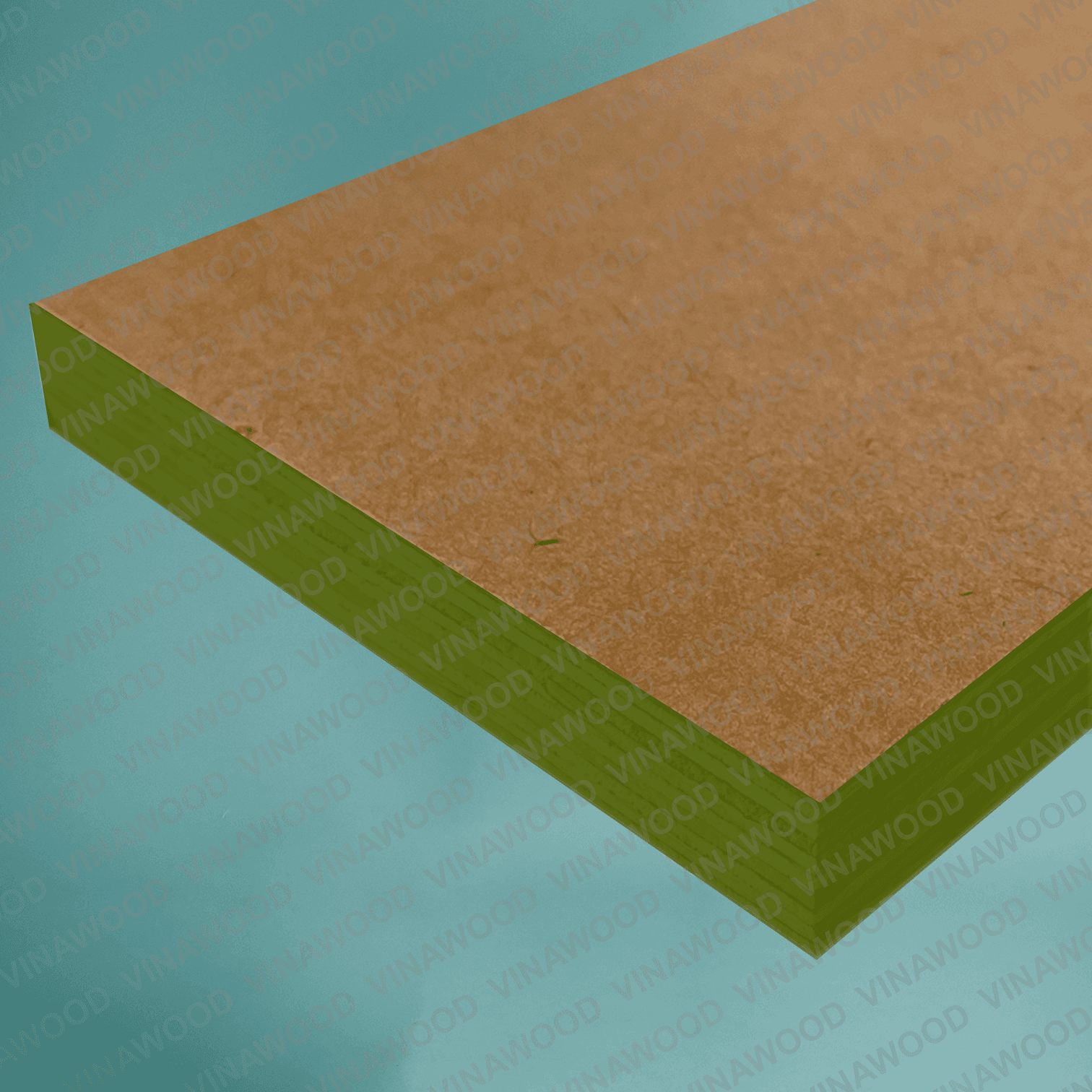
Film-faced
Phenolic · brown / black
Phenolic formwork face for concrete casting.
02
vinawoodltd.com ↗
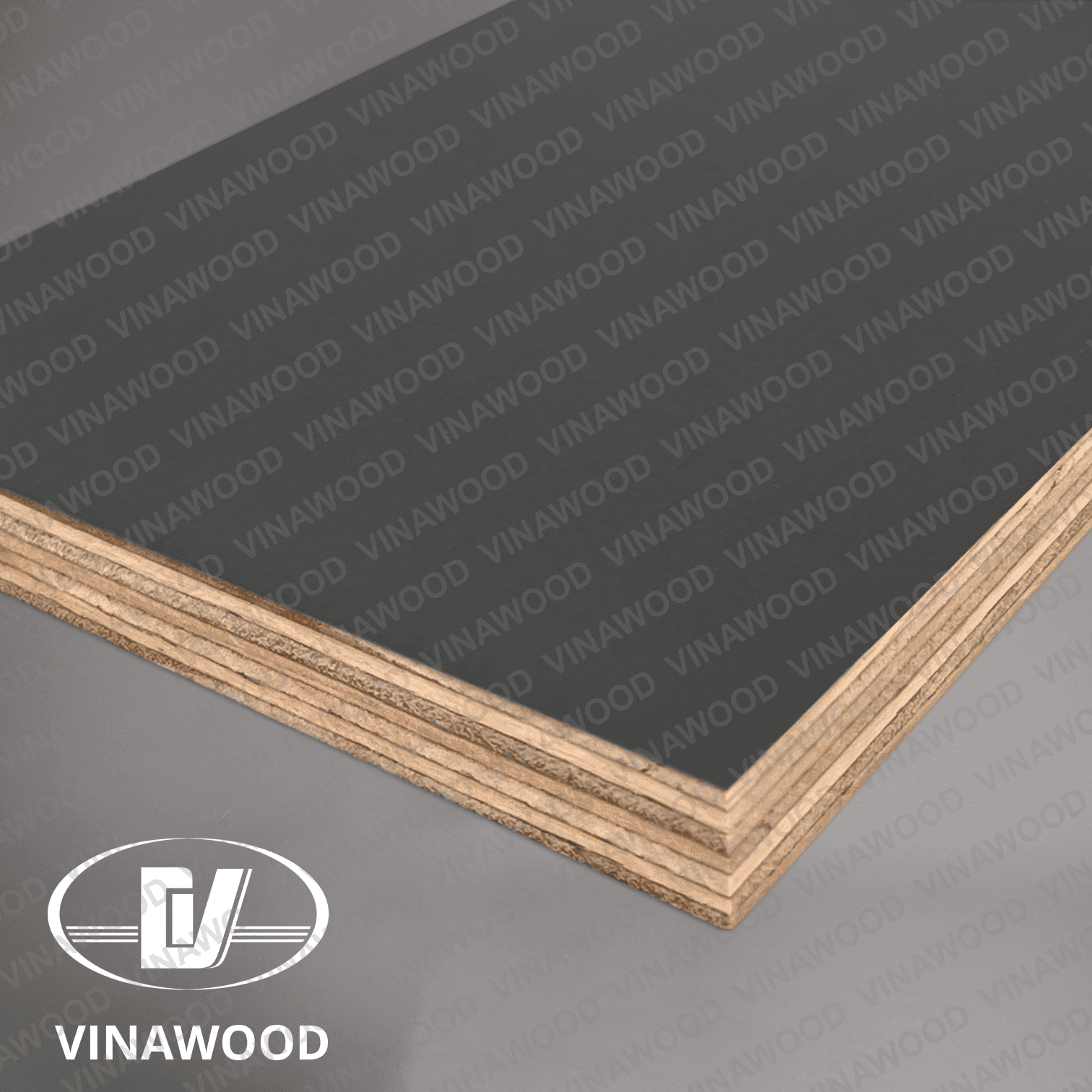
MatteFace
Kraft / matte overlay
Matte casting face for fair-face concrete (often searched as MDO).
03
vinawoodltd.com ↗
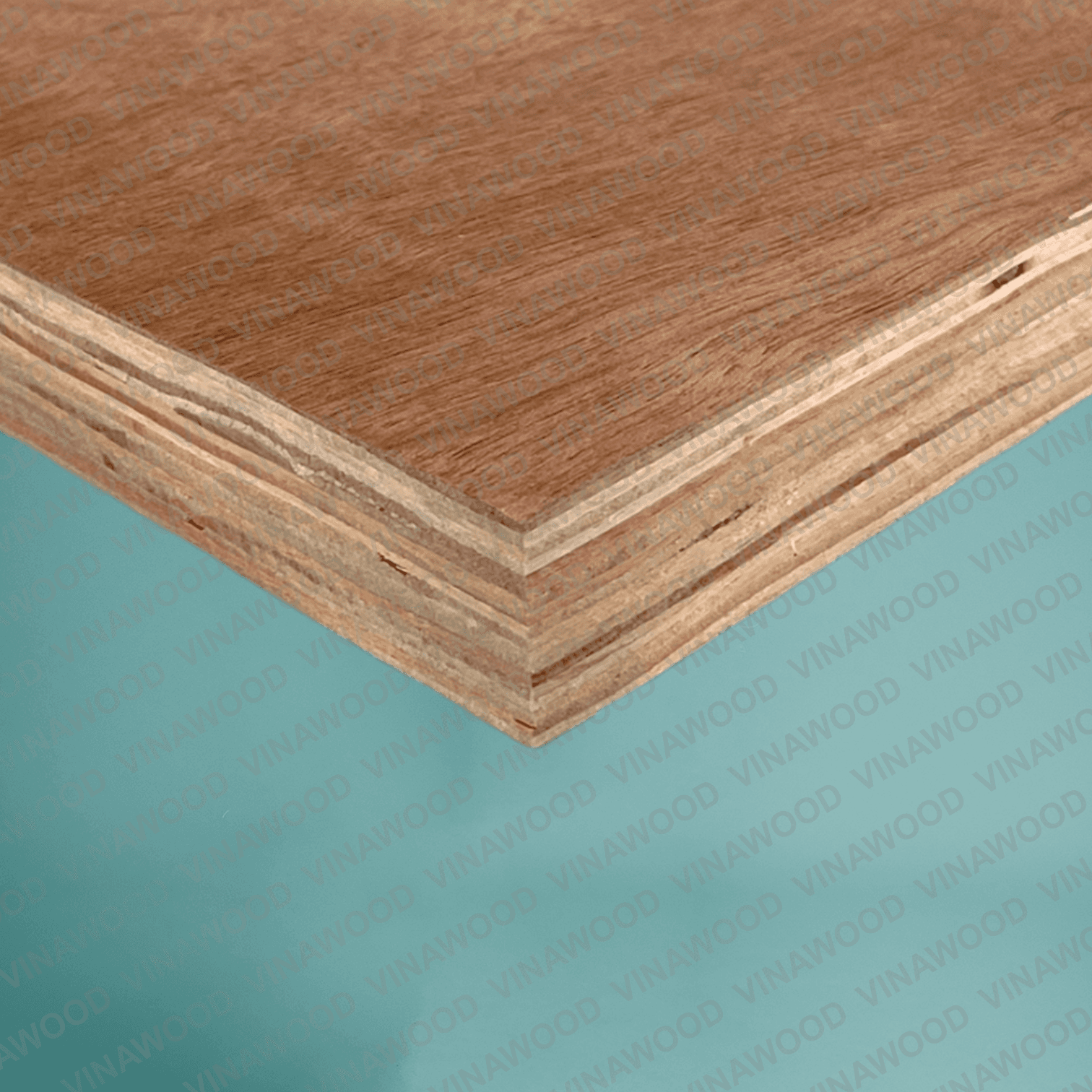
HDO
High-density overlay
High-density overlay for extended reuse cycles.
04
vinawoodltd.com ↗
Marine / packing
WBP-oriented
Moisture-oriented and industrial packing grades.
Compliance matrix
Each item links to manufacturer documentation on vinawoodltd.com so you can verify certificates before you buy.
01 /
European Union
EUDR
EU Deforestation Regulation — operators need due-diligence evidence for relevant wood products on the EU market.
Manufacturer documentation ↗
02 /
United States
EPA / CARB
US formaldehyde rules for composite wood (TSCA Title VI), aligned with CARB Phase 2 limits.
Manufacturer documentation ↗
03 /
EU construction
CE
CE marking where construction-product rules require it for the destination market.
Manufacturer documentation ↗
04 /
Chain of custody
FSC
Forest Stewardship Council chain-of-custody when customers specify certified fiber.
Manufacturer documentation ↗
05 /
Chain of custody
PEFC
PEFC chain-of-custody — another widely requested certified-fiber pathway.
Manufacturer documentation ↗
06 /
Mill QMS
ISO 9001
Quality management system certification — mill hygiene signal, not a product emission mark.
Manufacturer documentation ↗
Knowledge index
Compliance
Compliance atlas for Vietnam plywood
The compliance documents a Vietnamese mill actually produces, how origin and legality paperwork is generated in-country under VNTLAS, what Vietnam's EUDR low-risk status means, and how a buyer verifies a mill.
Compliance
EUDR Evidence Pack for Vietnamese Plantation Plywood
A plain-language reference on how a compliant EUDR evidence pack for Vietnamese plantation plywood typically works: Article 9 data, Circular 26/2022 origin dossiers, smallholder land tenure, the money trail without a seller e-invoice, and why the mill pack is not the DDS.

Overview
How Vietnam plywood is made
How a modern Vietnamese export mill turns plantation-grown logs into finished plywood, walked through all twelve production stages from log peeling to container loading.
Import
Importing plywood from Vietnam
The end-to-end importer's guide to sourcing plywood from Vietnam: vet a mill, lock the spec, agree Incoterms, watch QC, assemble the legality file, then load and clear the container.
Markets
North America buyer path
Contractors and wholesalers: when to buy local stock via OnePly vs when a mill program with Vinawood makes sense.
Grades
Plywood grades & applications
A supplier-neutral map of the plywood grade families Vietnamese mills produce, each tied to a typical glue class and end use, so a specifier can write an RFQ to spec instead of to a brand name.
Grades
Plywood Standards Cross-Reference Matrix (EN, BS, IS, JAS, AS/NZS, ASTM)
A side-by-side reference that lines up plywood bond, durability and formaldehyde classes across EN, BS 1088, IS 710/303, JAS, AS/NZS and US PS 1, so a foreign spec can be translated into what a Vietnamese mill can build and certify.

Compliance
Spotting Transshipped Chinese Plywood Sold as Vietnamese
A buyer-protection guide to detecting Chinese-origin plywood illegally transshipped through Vietnam, using the weight-per-CBM density test and document checks to protect against duties, EUDR non-compliance, and seizure.
Overview
The Vietnam Plywood Industry: A Complete Overview
A plain-English overview of Vietnam's plywood industry: its scale and growth, the plantation species base, the main export product types, certification, and where Vietnam sits among global plywood origins.
Overview
What is Vietnam plywood?
Vietnam plywood, defined: plywood made in Vietnam from plantation-grown acacia, eucalyptus, rubberwood and styrax and exported worldwide. How it differs by origin, and where to go deeper.
Reference tools
Interactive matrices and stamp glossaries — separate from the narrative guides.
01
Standards matrix
Translate a plywood spec across EN, BS, IS, JAS, AS/NZS, and ASTM / US PS — durability, emission, appearance, marine, and structural.
Open →
02
Grade-stamp decoder
Read APA, CE/EN, and JAS marks plus FSC/PEFC and emission stamps — explore annotated samples or decode what you see on the sheet.
Open →
03
Formaldehyde converter
Convert ppm ↔ mg/m³, screen REACH / E1 / CARB, and compare EN 717 / JIS desiccator / flask / perforator methods.
Open →
04
EUDR DD matrix
Map EUDR Article 9 requirements to Vietnamese plantation evidence — BKLS pathways, tenure substitutes, geolocation, and a browser-local readiness assessor.
Open →
05
Loading guide
How mill bundles load into 20ft / 40ft / 40HC and flatbeds — H/V interlock, Vinawood packing caps, and destination road-weight overlays.
Open →
06
Thickness & dimensions
mm ↔ inch and US trade names (3/4, 11/16…), EN 315 / EN 13986 and PS 1 thickness checkers, and 1220×2440 vs “4×8” nicknames.
Open →
About this atlas
A clear map of the category — not a second catalog, and not a sales funnel dressed up as education.
A public atlas for Vietnam-origin plywood: industry context, how panels are built, grades, compliance, import practice, tips, and warnings. The subject is the category — not a product cart or a brand storefront.
No. This site does not sell panels or quote containers. It is written so you already know what questions to ask before you send an RFQ, write a specification, or explain the origin to a customer.
Vietnam Plywood is published by the Vinawood group as a public industry resource. Vinawood manufactures plywood in Vietnam. That relationship is disclosed so you can judge context; the mill site is not the subject of the atlas.
Only when a next step needs manufacturer documentation or mill programs — outbound links point to vinawoodltd.com. Editorial priority stays on education; that site is an optional exit, not the purpose of this page.