
Guides/Overview
How Vietnam plywood is made
How a modern Vietnamese mill turns plantation logs into plywood, from veneer peeling to edge sealing. The full 12-stage production process, explained.
A Vietnamese plywood mill turns plantation-grown logs into finished panels through twelve controlled stages, starting with peeling the log into thin veneer and ending with sealed, packed panels loaded into a container. The core idea is simple. Thin wood layers are cross-laminated at 90 degrees and bonded under heat and pressure, so the finished board is stronger and more stable than the timber it came from. What separates one mill from another is how tightly each stage is controlled.
This page walks the full process as a modern export mill in Vietnam actually runs it. It is written as a production reference, not a spec sheet. For panel sizes, thicknesses, grades and species density figures, see the manufacturer spec pages on vinawoodltd.com rather than repeating them here.
What are the 12 stages of plywood manufacturing?
The sequence below is the standard order at an integrated Vietnamese mill, from log yard to loading bay. Grouping varies between factories, but every stage shown here happens somewhere on the line.
| Stage | What happens | Why it matters |
|---|---|---|
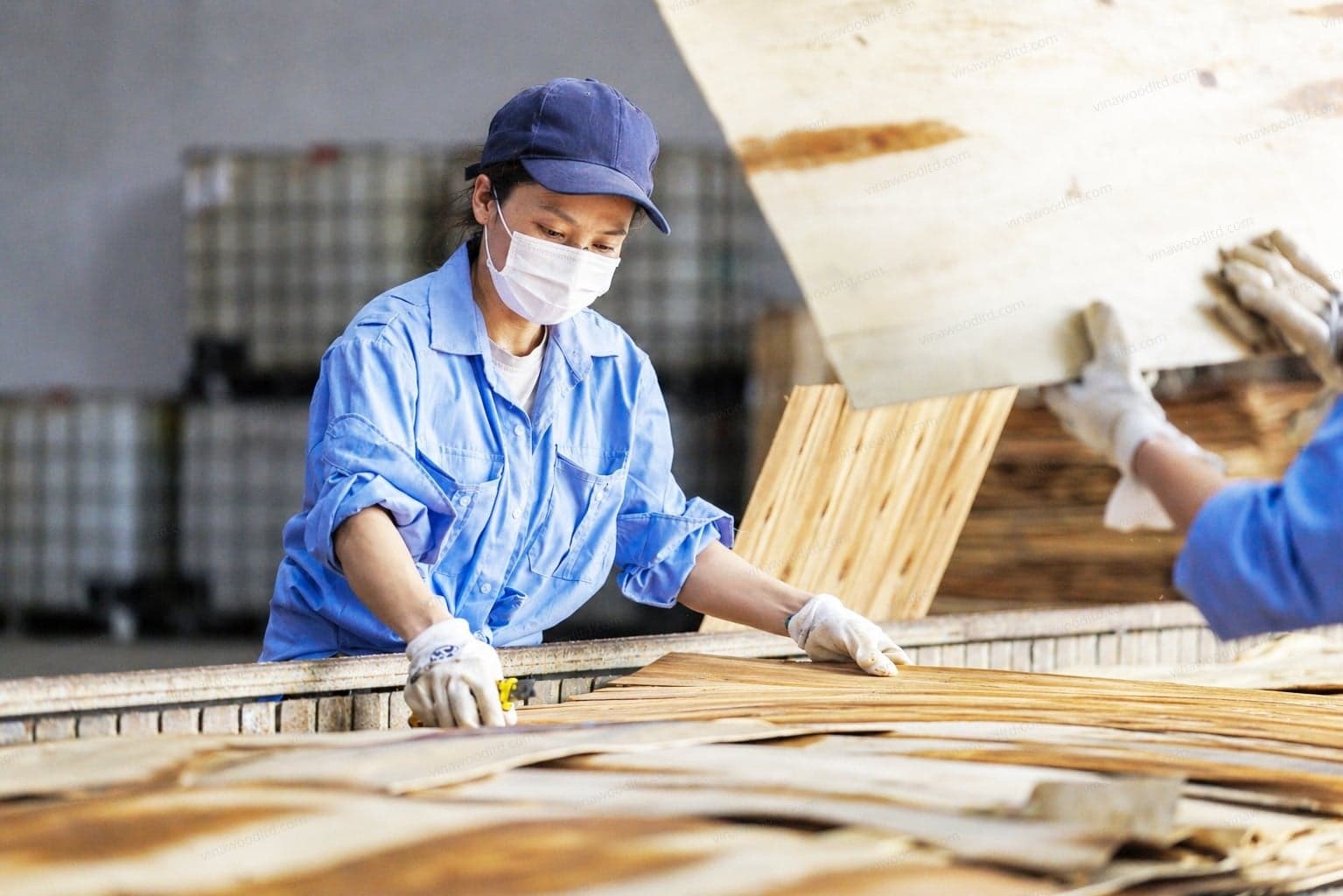
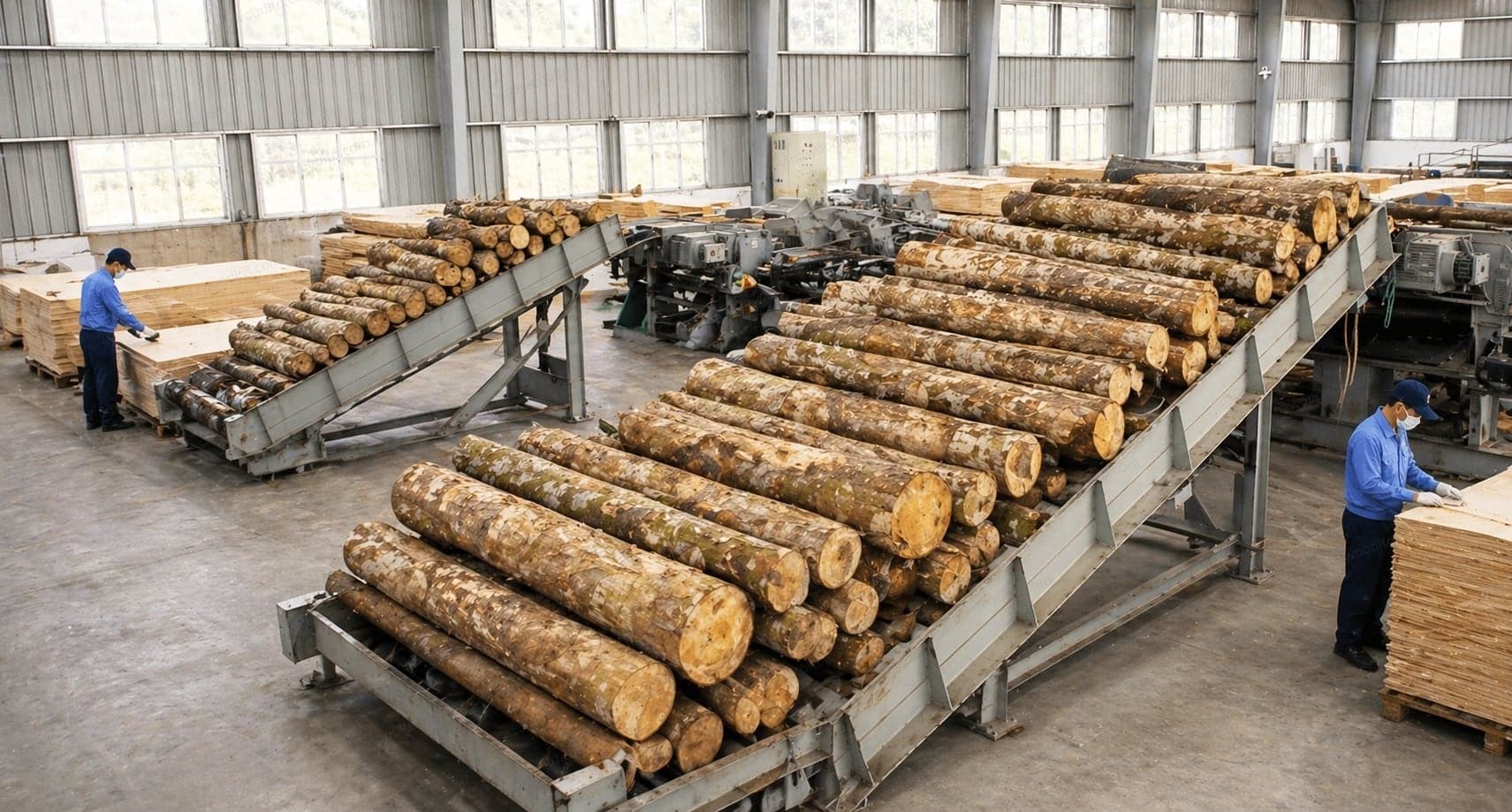
| 1. Log selection & peeling | Plantation logs (acacia, eucalyptus, rubberwood, styrax) are graded by species, diameter and moisture, then rotary-cut against a lathe knife into continuous veneer roughly 0.3 to 2.5 mm thick. | Rotary peeling suits Vietnam's small-diameter plantation logs. Species and log quality set the ceiling for everything downstream. |
| 2. Veneer drying & storage | Green veneer is dried to about 8 to 12% moisture in roller or jet dryers, then stacked and acclimatised before lay-up. | Drying is the biggest energy step in the whole plant and controls whether the glue-line will hold. Veneer that is too wet bonds poorly. |
| 3. Gluing & lay-up | Adhesive is metered onto core veneers and the stack is assembled cross-grain, each layer turned 90 degrees to its neighbour. | Cross-lamination is what gives plywood its dimensional stability. Glue choice here sets the bond class of the finished panel. |
| 4. Cold press | The assembled billet is pressed at ambient temperature to squeeze out air and consolidate the stack. | A square, tight billet lets the hot press cure evenly instead of trapping voids. |
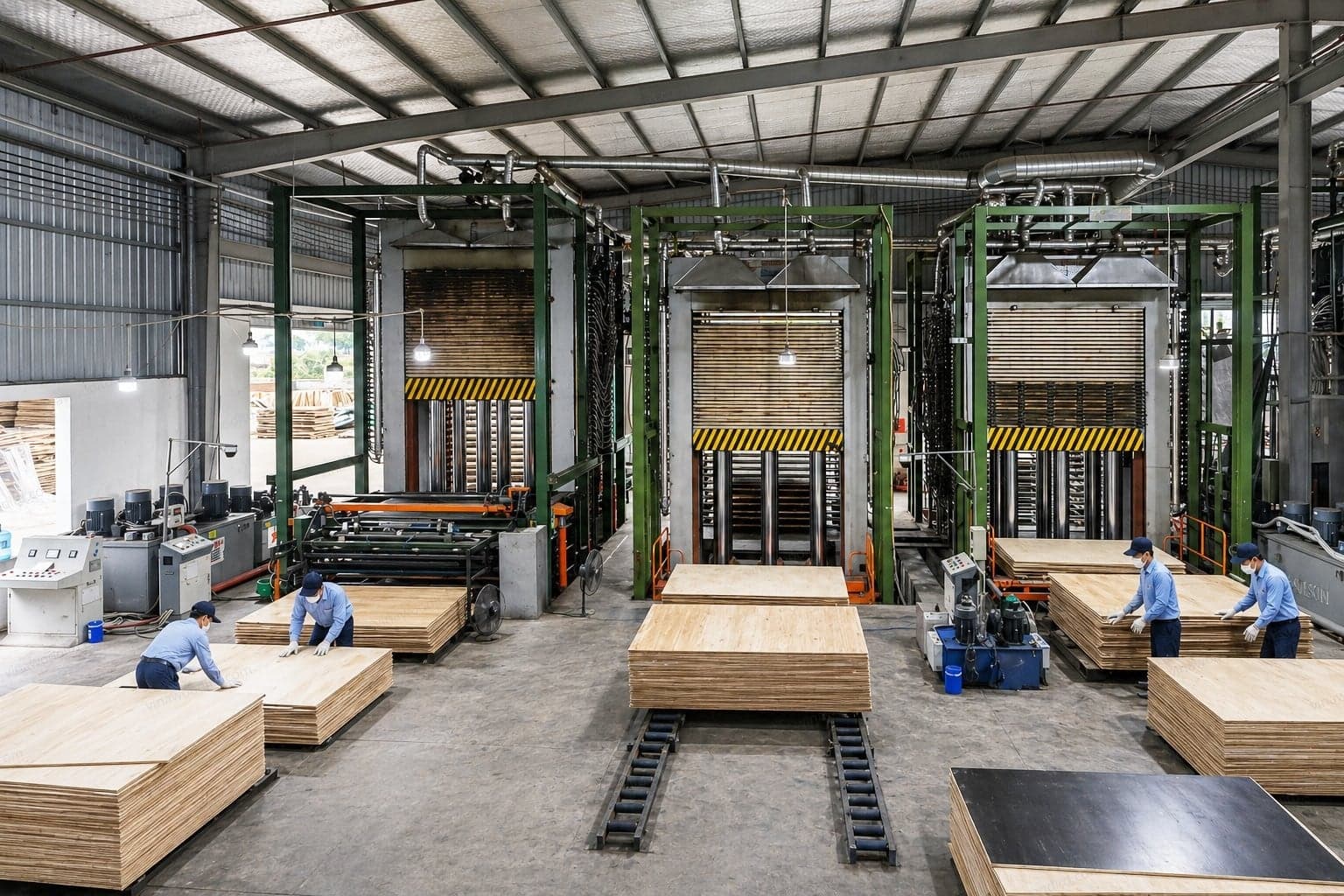
| 5. Hot press | Panels cure under heat, commonly around 110 to 150°C, and high pressure, fusing the layers into one rigid board. | This is where the bond is actually made. Press time and temperature decide the panel's strength. |
| 6. Surfacing with putty | Open knots, splits and small defects on the face veneers are filled. | A flat, closed face is needed before sanding or before any film or overlay will lie true. |
| 7. Sanding | Wide-belt sanders calibrate the panel to target thickness and finish the faces to grade. | Thickness tolerance and surface quality both come from this stage. |
| 8. Trimming | Panels are squared and cut to nominal size, typically 1220 x 2440 mm (4 x 8 ft). | Dimensional accuracy against the buyer's cut list starts here. |
| 9. Surface lamination | For film-faced, melamine or overlay grades, film or paper is hot-pressed onto one or both faces. | This step sets reuse cycles for concrete formwork and the finished appearance for commercial grades. |
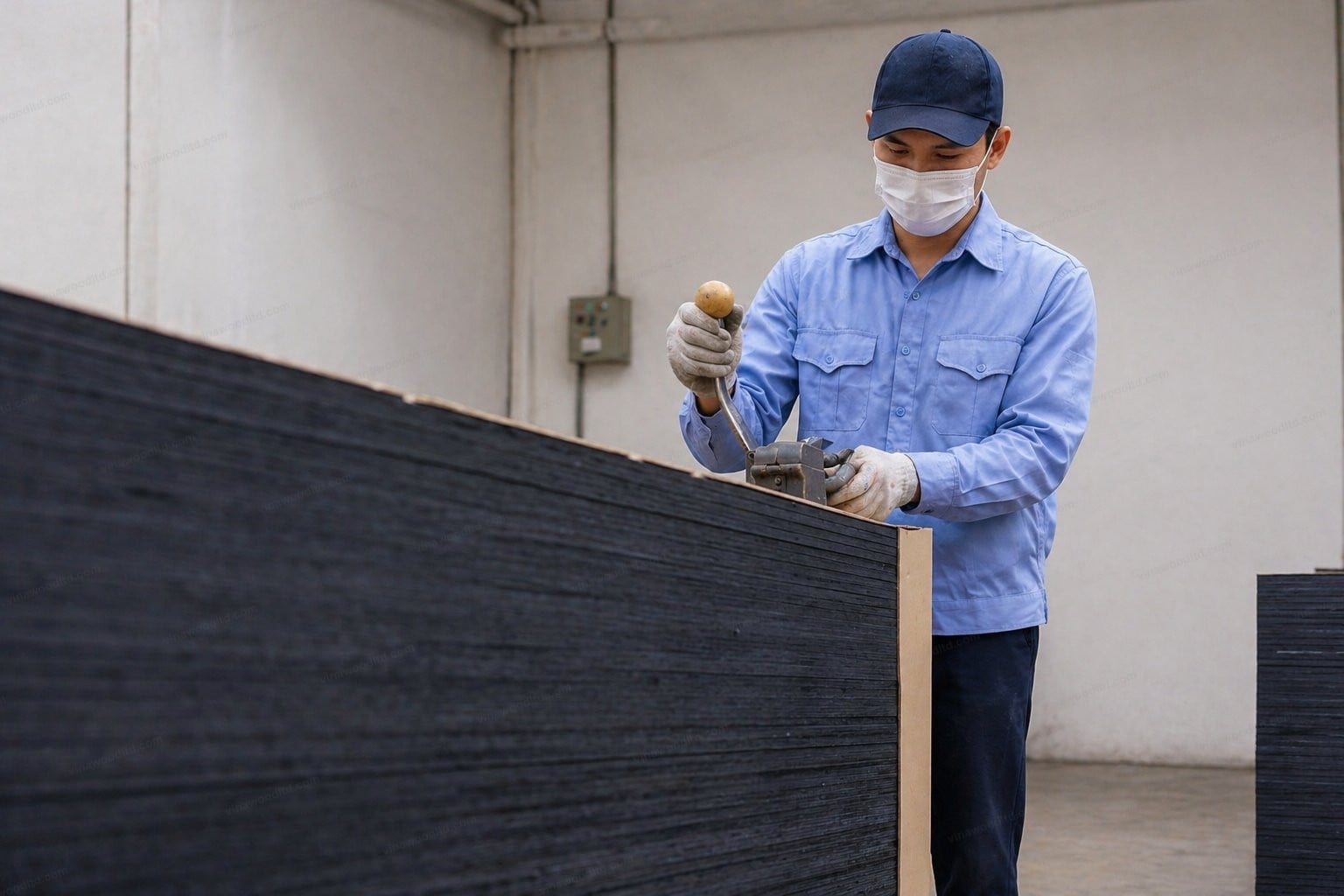
| 10. QC inspection | Every panel is checked for bond, moisture, face defects and dimension against the target grade. | The last catch-point before a panel is committed to a shipment. Export mills inspect each individual sheet. |
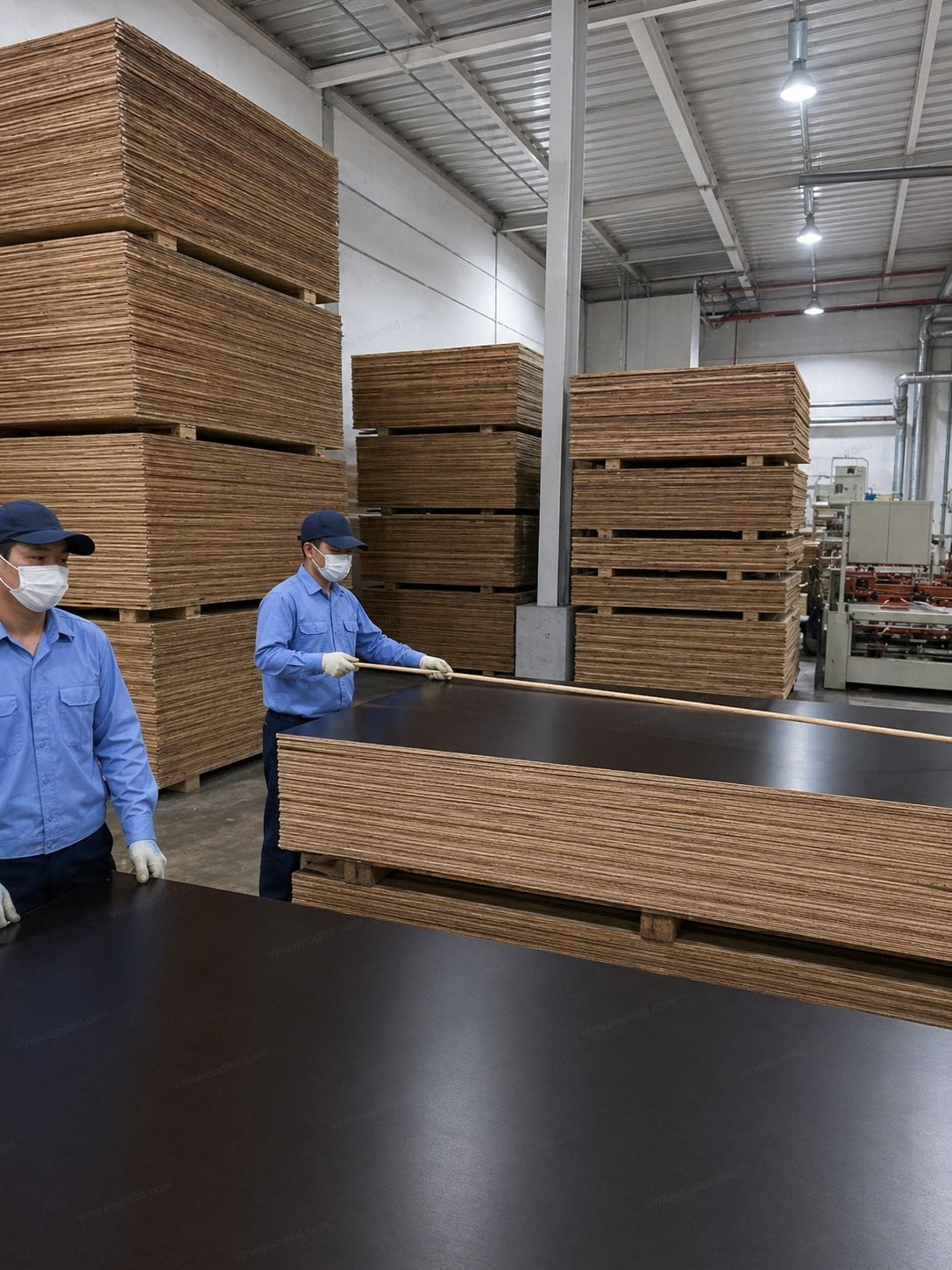
| 11. Edge sealing | Panel edges are sealed with water-resistant paint and marked with product and traceability codes. | Edges are the most exposed part of a panel. Sealing blocks moisture ingress in transit and on site. |
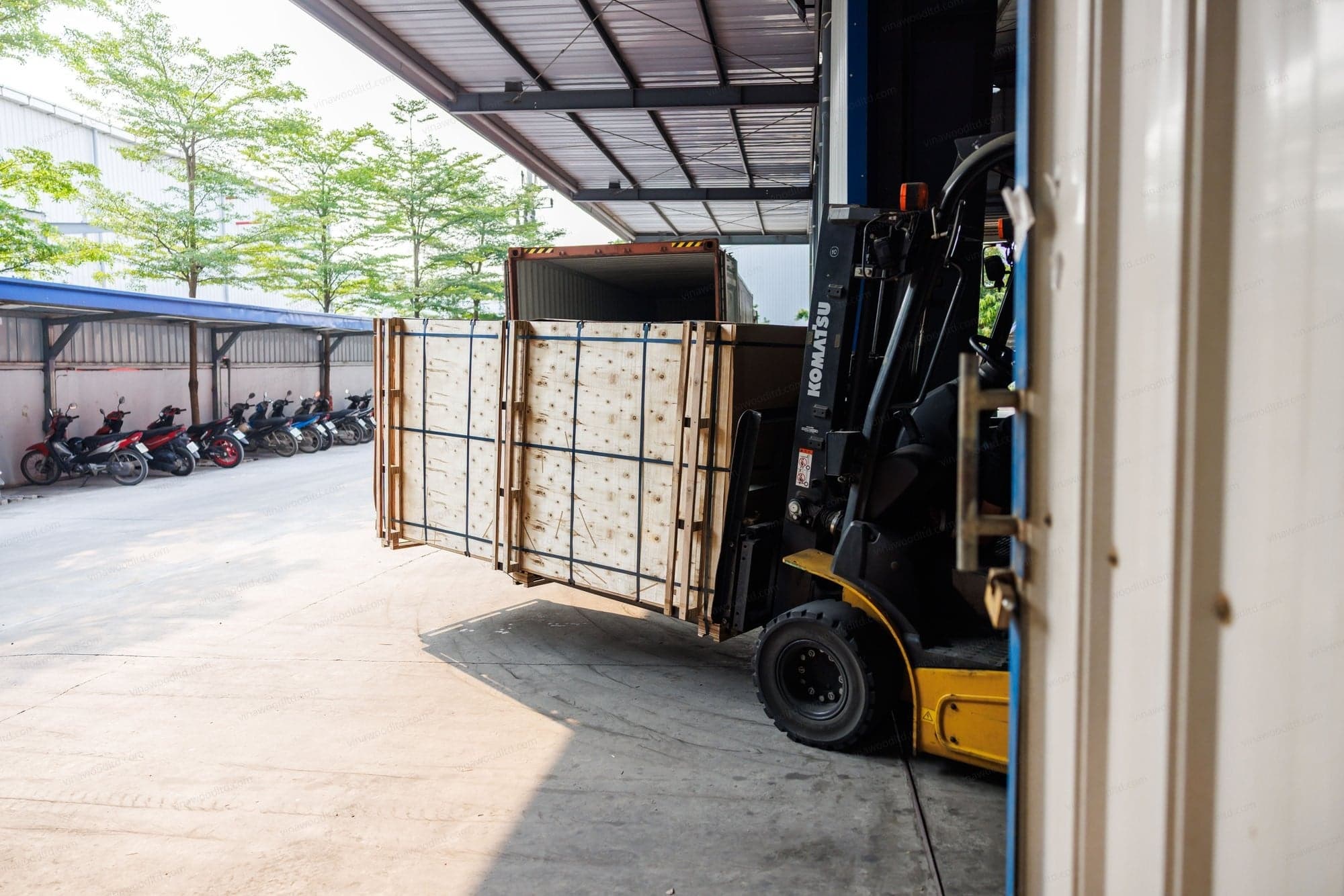
| 12. Packaging & shipping | Approved panels are strapped into bundles, wrapped against weather and loaded into 20 ft or 40 ft containers. | Protects panels through weeks of sea freight before they reach the importer. |
From plantation log to peeled veneer
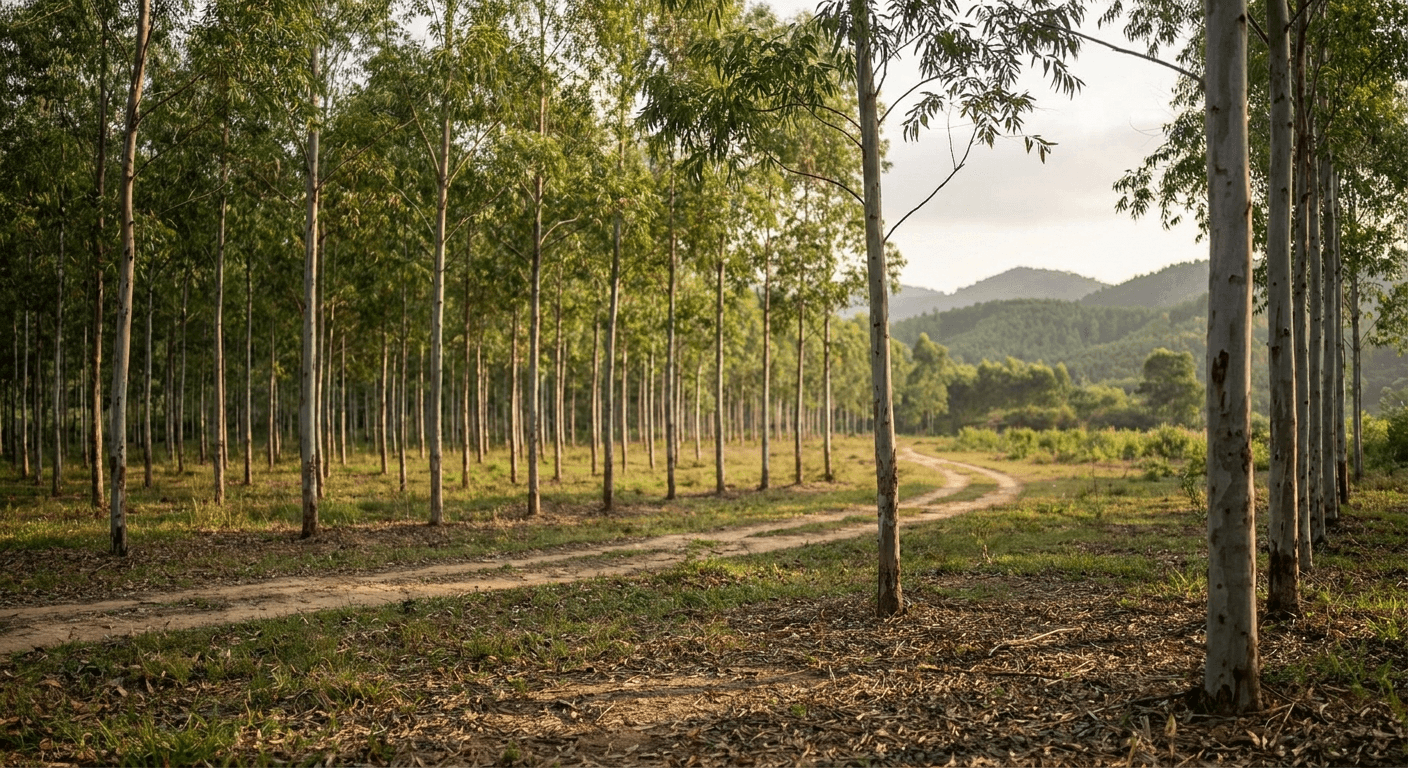
The raw material is not jungle timber. Vietnamese mills run on plantation-grown species, mainly acacia and eucalyptus, with rubberwood (hevea) and styrax used for specific core recipes. These logs are small in diameter, which is exactly why rotary peeling is the standard method. The log spins against a fixed knife and unrolls into a continuous ribbon of veneer, the same principle used across the industry and documented by the FAO. Clipped, graded and dried, that veneer becomes the raw stock for every panel the mill will build that week.
Drying deserves more attention than it usually gets. It swallows most of the plant's thermal energy, and it sets moisture content before glue ever touches the wood. Get it wrong and the bond fails later. Get it right and the rest of the line has something to work with.
Why the press stage decides the panel
Two things happen at the press that a buyer cannot see later but definitely feels in service: the glue is chosen, and the glue is cured. Interior-grade panels typically use urea-formaldehyde resin, while exterior and structural grades use phenol-formaldehyde, which holds up under moisture. The US EPA's technical profile of plywood manufacturing describes the same split, with hardwood panels pressed at lower platen temperatures than softwood.
Bonding performance is graded, not assumed. In Europe, EN 314-2 sorts plywood into three bond classes: Class 1 for dry interior use, Class 2 for humid conditions, and Class 3 for unprotected exterior exposure. The test method behind those classes sits in EN 314-1. A panel cannot claim a higher EN 636 use class than its bond quality supports, so the resin picked at lay-up quietly caps what the panel is allowed to be sold as. This is engineered wood behaving like an engineered product, a point the APA has made about plywood for decades.
Where quality is actually caught
Most of the twelve stages are shared across the industry. The difference between mills shows up at inspection. At an export-oriented Vietnamese mill, every individual sheet is inspected rather than a sample pulled per batch, and that 100% check is the practical reason grade claims hold up in the container. Bond, moisture, face and dimension are all read against the target grade before a panel is cleared.
In-house testing is the other marker. A mill with its own lab can pull a panel and run bond-strength, moisture and formaldehyde-emission tests tied to the producing line, not a certificate borrowed from a trading house. That traceability is what lets an importer connect a test result to the panel in front of them. Small logs peel into thin veneer; disciplined pressing and honest inspection are what turn that veneer into a panel a specifier will accept.
How should a buyer read a mill's process claim?
Use the twelve stages as a checklist on a mill tour or in a supplier's documentation. If a producer cannot show peeling, drying to a stated moisture target, glue-class discipline, controlled press parameters, calibration sanding, edge sealing and a QC lab whose results trace back to the mill, treat the marketing copy as incomplete. Neutral standards do the arguing for you. Ask which EN 314-2 bond class the panel meets and how it was tested.
For manufacturer-direct programmes and full spec sheets, see vinawoodltd.com/quality or request a mill visit. To buy finished panels from stock in North America, Vinawood's official distribution partner lists them at .
Related guides
Frequently asked
How many stages are in plywood manufacturing?
An integrated Vietnamese mill runs twelve stages: log selection and peeling, veneer drying and storage, gluing and lay-up, cold press, hot press, putty surfacing, sanding, trimming, surface lamination, QC inspection, edge sealing, and packaging and shipping. Factories may group steps differently, but peeling, drying, lay-up, pressing, finishing, inspection and packing are always present.
What wood is Vietnamese plywood made from?
Mainly plantation-grown species: acacia and eucalyptus, with rubberwood (hevea) and styrax used for specific core recipes. These are small-diameter plantation logs, not jungle hardwood, which is why rotary peeling is the standard method for producing veneer.
What decides how strong a plywood panel is?
The press stage. The adhesive chosen at lay-up sets the bond class, and the heat and pressure of the hot press cure that bond. Exterior and structural grades use phenol-formaldehyde resin; interior grades typically use urea-formaldehyde. EN 314-2 grades the result into bond Class 1 (dry), Class 2 (humid) or Class 3 (exterior).
How is plywood quality checked at a Vietnamese mill?
Export mills inspect every individual sheet for bond, moisture, face defects and dimension, rather than sampling per batch. Mills with an in-house lab also run bond-strength, moisture and formaldehyde-emission tests tied to the producing line, so results trace back to the panel.
What should importers look for on a mill tour?
Peeling and drying to a stated moisture target, glue-class discipline, controlled hot-press parameters, calibration sanding, film or overlay application, edge sealing, and a QC lab that can show bond and emission testing linked to the mill. Ask which EN 314-2 bond class the panel meets and how it was tested.
Related in the atlas
Continue reading
Same topic first, then what others on the atlas read most.
Overview
The Vietnam Plywood Industry: A Complete Overview
A plain-English overview of Vietnam's plywood industry: its scale and growth, the plantation species base, the main export product types, certification, and where Vietnam sits among global plywood origins.
Overview
What is Vietnam plywood?
Vietnam plywood, defined: plywood made in Vietnam from plantation-grown acacia, eucalyptus, rubberwood and styrax and exported worldwide. How it differs by origin, and where to go deeper.
Overview
Plantation Forestry Behind Vietnam's Plywood
Vietnam's plywood is built on plantation-grown acacia, eucalyptus and rubberwood, much of it raised by smallholder farmers. A look at the timber base, rotation ages, FSC and PEFC certification, and EUDR legality context.
Overview
Vietnam's Plywood Manufacturing Regions and Clusters
A map of where Vietnam makes plywood: the northern mill clusters around Bac Ninh and Phu Tho, the southern furniture belt, and how region maps to species supply and to the export ports that ship each.