
Guides/Grades
Plywood grades & applications
A neutral reference mapping plywood grade families to glue classes and end uses, so specifiers can compare Vietnamese mill options across suppliers.
Direct answer: Vietnamese mills produce a shared set of plywood grade families — film-faced formwork, MDO and HDO overlay, structural, marine, commercial and packing — and each maps to a typical glue class and a typical end use. Choose by matching the job's moisture exposure and finish to a glue class first, then to a face system, rather than by any supplier's brand name.
Grade labels travel badly between suppliers. One mill's "commercial" is another's "packing," and surface names such as film-faced or HDO describe the face, not the bond underneath. This reference maps the grade families a buyer meets when sourcing Vietnam-origin plywood to their real uses and glue classes, so an RFQ can be written to a physical specification. For SKU names, panel sizes and pricing, follow the manufacturer links at the end.
What grade families do Vietnamese mills produce?
Most Vietnam-origin plywood is built from plantation-grown veneers, mainly Acacia, Eucalyptus, Hevea (rubberwood) and Styrax, pressed into a handful of grade families the whole export sector shares. The names in the table are industry-generic, not one factory's trademarks.
| Grade family | Typical glue class | Typical uses |
|---|---|---|
| Film-faced formwork | WBP (phenolic) | Vertical and horizontal concrete formwork, column and wall shuttering |
| MDO / HDO overlay | WBP (phenolic) | Signage, exterior joinery, fair-face casting, higher-reuse concrete forms (HDO) |
| Structural / sheathing | WBP or exterior | Roof, wall and floor sheathing, load-bearing panels, site hoarding |
| Marine | WBP (phenolic) | Boat components, docks, sustained high-humidity service |
| Commercial (interior) | MR or MUF | Furniture, cabinetry, interior joinery, wall linings |
| Packing | MR (urea) | Crates, pallets, dunnage, one-trip packaging |
How do I read glue class: WBP, MR or MUF?
Glue class, not the face, decides where a panel survives. Write it into every purchase order.
- WBP (weather and boil proof) uses a phenol-formaldehyde bond and is the exterior and structural class. It is judged against boil regimes such as EN 314-2 bond class 3 and the exterior bond in US PS 1. WBP is a bond-durability rating, not a claim that the panel is waterproof; unsealed veneers still swell.
- MR (moisture resistant) uses a urea-formaldehyde bond for interior and humid-interior work. It tolerates ambient humidity, not standing water or repeated wetting.
- MUF (melamine-urea-formaldehyde) sits between the two, giving better moisture tolerance than plain urea glue at lower cost than full phenolic. Some hybrid or "moisture resistant plus" grades use it.
A WBP glue-line and an MR glue-line can hide beneath identical-looking faces, so ask for the bond standard and class rather than the word "waterproof." For the full standards breakdown, see the manufacturer's glue-class guide linked below.
What are the three things "melamine" can mean?
Melamine is one of the most misread words on a plywood data sheet, because it names three different things:
- Melamine as a core resin. Melamine-urea-formaldehyde (MUF) is a glue-line chemistry used to fortify a urea bond for extra moisture resistance. Here "melamine" describes the adhesive inside the panel.
- Melamine as a face film. A thin melamine-impregnated overlay can be hot-pressed onto a face to give a smooth, sealed industrial surface. Here it is a surface film, not the bond.
- Melamine as a decorative laminate. In furniture supply, "melamine plywood" usually means a decorative melamine paper face pressed on for colour and pattern. Here it is a finished cosmetic surface.
Three panels can all be called "melamine" and share nothing in common. Specify which layer you mean, core, film or decorative face, in the RFQ.
Overlays: film-faced, MDO and HDO
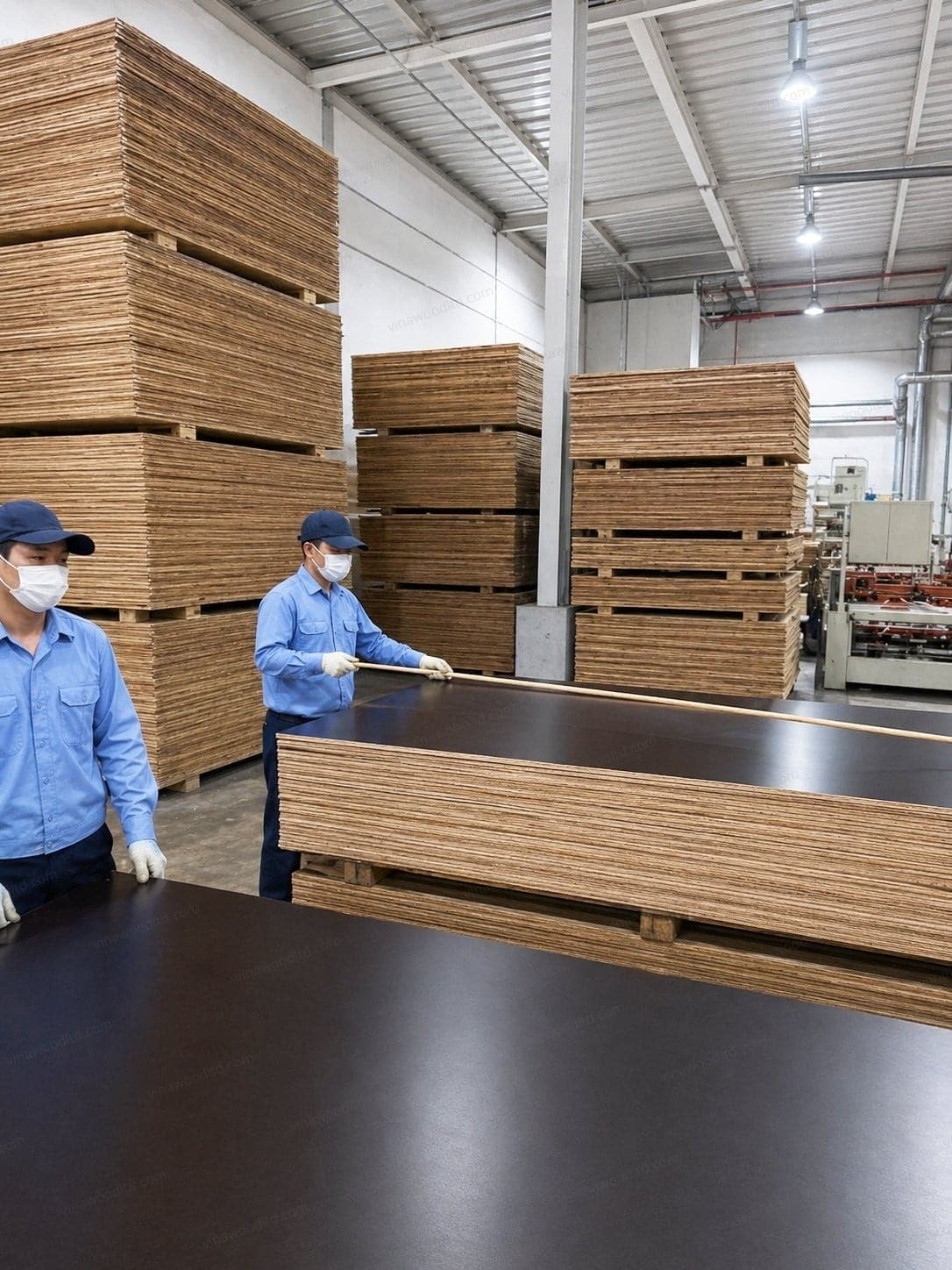
Film-faced, MDO and HDO name the surface system, and they usually sit on a WBP core. A phenolic film gives the dark-brown reusable casting face most concrete crews recognise. MDO (medium-density overlay) and HDO (high-density overlay) are resin-impregnated papers pressed onto the face; HDO's higher resin content targets a harder surface and more casting cycles. Reuse depends on film weight, edge sealing and site handling, so treat any cycle figure as a maximum, written as "up to N reuses" and confirmed on the mill's data sheet. An overlay name says nothing about the bond beneath it, so still confirm the glue class.
Structural, marine, commercial and packing
The unfaced families divide by service environment. Structural grades carry load as sheathing and hoarding and should be specified to a structural standard such as EN 636, with a use class for dry, humid or exterior service, or US PS 1. Marine grade combines a WBP bond with tighter veneer and void limits for sustained wet service; national marine specs such as India's IS 710 or BS 1088 set the bar, so name the standard rather than relying on the word "marine." Commercial grade is the interior furniture and joinery workhorse, usually MR-bonded and sold on face appearance. Packing grade is the economy tier for crates and pallets, where cosmetics do not matter. One point to watch: a smooth, branded interior face does not mean a panel is film-faced or exterior-bonded, so read the glue class rather than the marketing name.
How do I specify a grade across suppliers?
Because the same grade name means different things at different mills, an RFQ that pins the physical spec is what returns comparable quotes. Include:
- Glue class and bond standard, for example WBP to EN 314-2 class 3, not just "exterior."
- Face system, and for formwork a target film weight in g/m².
- Nominal thickness and panel size in mm, with imperial in parentheses for US work, commonly 1220 x 2440 mm (4 x 8 ft).
- Core species preference, since Acacia, Eucalyptus, Hevea and Styrax differ in density and stiffness.
- Formaldehyde class where it applies, such as EPA TSCA Title VI / CARB P2 for the United States or CE marking to EN 13986 for the EU.
- Any reuse expectation written as a maximum and verified on the certificate.
For SKU-level specs, panel sizes and pricing, compare a manufacturer's published range against these fields rather than trusting a grade name on its own.
Related guides
Frequently asked
Is WBP plywood waterproof?
No. WBP (weather and boil proof) is a bond-durability class produced with a phenolic glue and tested against boil regimes such as EN 314-2 class 3. It resists weather and moisture cycling, but the veneers still swell if the edges are unsealed. Treat it as water-resistant, not waterproof.
What is the difference between MDO and HDO?
Both are resin-impregnated overlay papers pressed onto the face. HDO (high-density overlay) carries more resin for a harder, smoother surface and more casting cycles, while MDO (medium-density overlay) is lighter and common on signage and paintable exterior surfaces. Neither name describes the glue class, so confirm the bond separately.
Does "melamine plywood" mean it has waterproof glue?
Not necessarily. Melamine can refer to a melamine-urea-formaldehyde (MUF) core resin, a melamine face film, or a decorative melamine laminate. Only the core-resin meaning affects the bond, so ask which layer the seller means before assuming anything about moisture performance.
Which grade should I use for concrete formwork?
A WBP-bonded film-faced panel is the standard choice. Specify film weight in g/m² and treat any reuse figure as a maximum confirmed on the mill certificate. HDO overlay suits higher-reuse or fair-face architectural casting.
How do I compare grades between two Vietnamese suppliers?
Specify glue class plus bond standard, face system, thickness and size in mm, core species and formaldehyde class, then compare like for like. Grade names such as "commercial" or "marine" are not standardised between mills, so a physical spec is the only reliable basis for comparison.
Related in the atlas
Continue reading
Same topic first, then what others on the atlas read most.
Grades
Plywood Standards Cross-Reference Matrix (EN, BS, IS, JAS, AS/NZS, ASTM)
A side-by-side reference that lines up plywood bond, durability and formaldehyde classes across EN, BS 1088, IS 710/303, JAS, AS/NZS and US PS 1, so a foreign spec can be translated into what a Vietnamese mill can build and certify.
Grades
Vietnam film faced plywood: origin, phenolic face, formwork
Vietnam film faced plywood is plantation-grown phenolic-film formwork plywood pressed in Vietnam. Origin, face vs glue, mill vs trader.
Grades
Formwork plywood: what it is, and how Vietnam-origin panels fit
Formwork plywood is the overlay sheet crews pour against, not a steel or aluminum formwork system. How Vietnam-origin panels fit that job, P-Form vs Pro Form, mill vs trader.
Compliance
EUDR Evidence Pack for Vietnamese Plantation Plywood
A plain-language reference on how a compliant EUDR evidence pack for Vietnamese plantation plywood typically works: Article 9 data, Circular 26/2022 origin dossiers, smallholder land tenure, the money trail without a seller e-invoice, and why the mill pack is not the DDS.