
Guides/Glossary
Plywood Grade-Stamp Decoder: How to Read the Marks
A key to reading export plywood stamps: mill code, PS 1, CE/EN 13986, CARB P2, FSC and PEFC, and how to verify each mark against the shipment paperwork.
A plywood stamp is a claim, not a guarantee. The mill code, standard reference, bond and emission class, and any certification marks each tell you something specific, but they only mean what the paperwork behind them supports. For a container of Vietnam-origin plywood, the useful skill is reading each mark, then checking it against the mill certificate, the Declaration of Performance or test report, and the certification database. This page is a visual key for doing exactly that.
What does a plywood stamp actually prove?
A stamp records the manufacturer's own claim about grade, bond, thickness, and origin, plus references to the standards the panel was built to. Some marks carry legal weight, like the CE mark under EN 13986 or a TSCA Title VI compliance statement. Others are trademark claims that only hold up if the mill's certificate is active, such as FSC or PEFC. None of them replace the shipment documents. A stamp tells you what to check. The certificate and test report tell you whether the claim is real.
On export plywood you will usually see two kinds of marking: a printed or stamped grade block on the panel face or edge, and separate ink-marks or a bundle label carrying certification logos and license codes. Read both together.
Mark to meaning to verification: the reference table
Metric values are primary, with imperial in parentheses. Treat every figure as a planning value until the mill certificate confirms it.
| Mark on the panel | What it means | How to verify it |
|---|---|---|
| Mill number / mill code | Identifies the producing mill for traceability. On APA-style stamps it appears as a mill identification number; on Vietnamese export panels it is often a mill code plus lot or batch. | Match the code to the mill named on the invoice and packing list. Ask the supplier which mill the code belongs to, then check it against the certificate holder on the FSC, PEFC, or CARB/EPA paperwork. |
| Product standard (PS 1, PS 2, EN 636) | The construction standard the panel claims to meet. PS 1 covers structural plywood and PS 2 the performance standard for wood structural panels; EN 636 classifies plywood by use environment in Europe. | Confirm the same standard is named on the mill test report. For structural claims, check the span rating and Performance Category are present, not just the standard number. |
| Bond / exposure class (Exterior, Exposure 1, EN 636-1/2/3) | How much moisture the glue line is built to survive. Exterior and Exposure 1 are the APA bond classes; EN 636-1 is dry, 636-2 humid, 636-3 exterior. | Cross-check against the glue type stated on the certificate. A WBP or phenolic bond claim should match the exposure class on the stamp. |
| Emission class (E1, E0, CARB P2, TSCA Title VI) | Formaldehyde emission level. E1 is the common European class; CARB Phase 2 and EPA TSCA Title VI set identical limits for hardwood plywood sold into the US. | Require a compliance statement plus the third-party certifier and a lot number. Match the lot on the label to the emission test report. |
| CE mark (EN 13986) | Declares the panel conforms to the European harmonised standard for wood-based panels in construction. Mandatory for construction plywood placed on the EU market. | Ask for the Declaration of Performance (DoP). The CE label carries the notified body number, manufacturer, year, and declared characteristics; the DoP must repeat them. |
| FSC or PEFC logo + license code | Chain-of-custody claim about controlled or certified fibre. FSC uses a trademark license code in the form FSC-C###### with a label type such as FSC Mix; PEFC uses a license number in the form PEFC/nn-nn-nn. | Search the license or certificate code in the public database (info.fsc.org for FSC; the PEFC register) and confirm the holder, scope, and expiry match your supplier and product. |
| Grade letters (A, B, C, BB, CP) | Veneer quality of face and back, best face first. Higher letters or B-grade faces mean fewer repairs and knots. | Compare against the grade you ordered and the grade written on the invoice. Open a bundle and check the face against the letter. |
| Thickness and size | Nominal panel dimensions, often 1220 x 2440 mm (4 x 8 ft) with a thickness in mm. | Measure with a caliper at several points. Thickness on the mark is usually near the lower tolerance, so confirm actual thickness against your tolerance. |
How do you read a structural (PS 1) stamp?
A PS 1 or APA-style grade block groups several claims. You will find a panel grade or veneer combination, a span rating shown as two numbers over a slash for roof and floor spacing, the exposure class, a thickness or Performance Category, the mill number, and the product standard. Vietnamese mills exporting to North America often print a PS 1-referenced block for sheathing and underlayment lines. The stamp is only the summary. The mill test report behind it should carry the same standard, span rating, and bond class before you accept the claim.
How do you read the CE mark on European-bound plywood?
Under EN 13986 the CE information block names the manufacturer, the last two digits of the year the mark was applied, the notified body number where one is involved, the standard reference, and the declared characteristics such as bonding class, formaldehyde class, and reaction to fire. The panel mark is a pointer. The Declaration of Performance is the legal document, and it must restate the same values. If a supplier shows a CE logo but cannot produce a matching DoP, treat the mark as unverified. For the full standard-by-standard detail, vinawoodltd.com keeps a certifications guide for Vietnam plywood exports.
How do you verify FSC and PEFC marks?
Certification logos are the easiest marks to fake and the easiest to check. An FSC on-product label shows the checkmark-tree logo, a label type (FSC 100%, FSC Mix, or FSC Recycled), and a trademark license code like FSC-C123456. PEFC shows its logo, a claim, and a license number like PEFC/nn-nn-nn. Take the code and search the public register: FSC at info.fsc.org, PEFC in its programme database. Confirm three things. The certificate holder should match your supplier or their named mill. The product scope should cover plywood. The certificate should be current, not expired. A logo with no valid, in-scope certificate behind it is a claim you cannot bank on.
How do you check a stamp against the shipment paperwork?
Run one loop per container. Read the panel marks and note the mill code, standard, bond class, emission class, and any license codes. Pull the documents the supplier sent: mill certificate, test reports, CE DoP where relevant, and the certification claim on the invoice. Then match line by line. Same mill. Same standard and bond. Same emission class and a lot number that ties the label to a test report. Certification codes that resolve to a live certificate in the right scope. Where the panel is stamped one way and the paperwork says another, stop and ask before the container ships. This is also where origin matters: a Vietnam-origin claim should be supported by the mill address and, for EU shipments, the due-diligence trail your importer is required to keep.
The atlas keeps these pages even-handed. A clean set of marks does not make one mill better than another, and a missing mark is sometimes just a different market's convention rather than a red flag. The point is to verify, not to assume.
Related guides
Grade-stamp decoder
PS 1 / PS 2 grade stamps — panel grade, span rating, exposure, mill number, emission compliance.
US / APA (PS 1) sheathing stamp
Frequently asked
Does a grade stamp guarantee the plywood meets the standard?
No. A stamp is the manufacturer's own claim. It tells you which standard, bond class, and emission class the panel is built to, but the mill certificate and test report are what actually support it. Always match the stamp to the documents.
How do I verify an FSC or PEFC mark on a plywood shipment?
Take the license code from the label, an FSC-C###### code for FSC or a PEFC/nn-nn-nn number for PEFC, and search the public register (info.fsc.org for FSC, the PEFC programme database). Confirm the certificate holder matches your supplier, the scope covers plywood, and the certificate is current.
What is the difference between the CE mark and a CE Declaration of Performance?
The CE mark on the panel is a short information block referencing EN 13986, the manufacturer, the year, and the declared characteristics. The Declaration of Performance is the separate legal document that restates those values. If a supplier shows a CE logo but no matching DoP, treat the mark as unverified.
What do E1, CARB P2, and TSCA Title VI mean on a stamp?
They are formaldehyde emission classes. E1 is the common European class. CARB Phase 2 and EPA TSCA Title VI set identical limits for hardwood plywood sold into the US. Require a compliance statement, the third-party certifier, and a lot number that ties the label to an emission test report.
How do I match a mill code to a real mill?
Ask the supplier which mill the code belongs to, then check that mill name and address against the invoice, packing list, and the certificate holder on the FSC, PEFC, or CARB/EPA paperwork. For Vietnam-origin panels the mill address also supports the origin claim your importer needs for due diligence.
Related in the atlas
Continue reading
Same topic first, then what others on the atlas read most.
Glossary
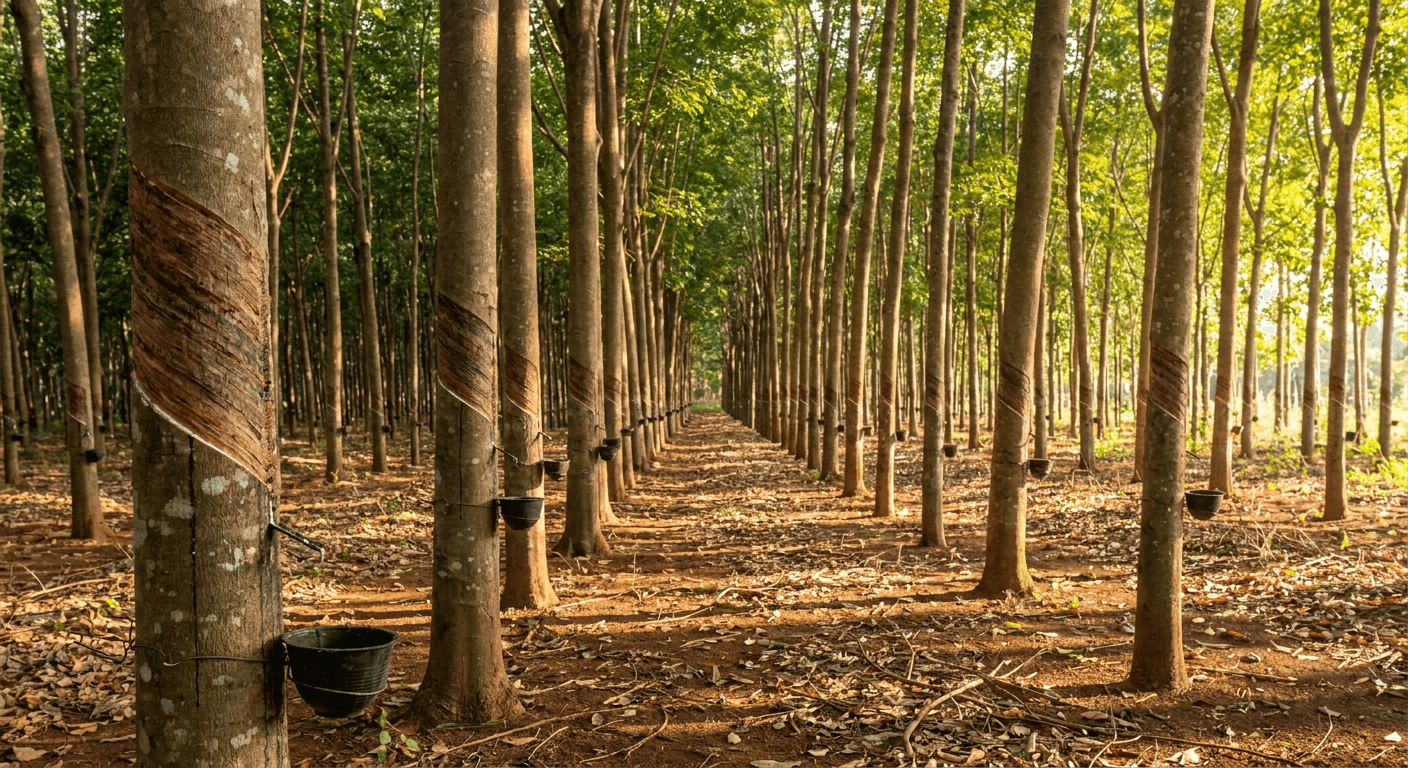
Rubberwood (Hevea) Plywood from Vietnam
How the rubber tree becomes plywood: rubberwood (Hevea) is a second harvest from Vietnam's latex estates, favoured for furniture and joinery for its density and pale, easy-to-finish grain.

Glossary
Eucalyptus Plywood from Vietnam: The Denser Core
Eucalyptus is Vietnam's denser plantation-grown plywood core, chosen when a panel needs more stiffness and screw-hold than acacia. Here is where it grows and how the extra weight changes its use.
Glossary
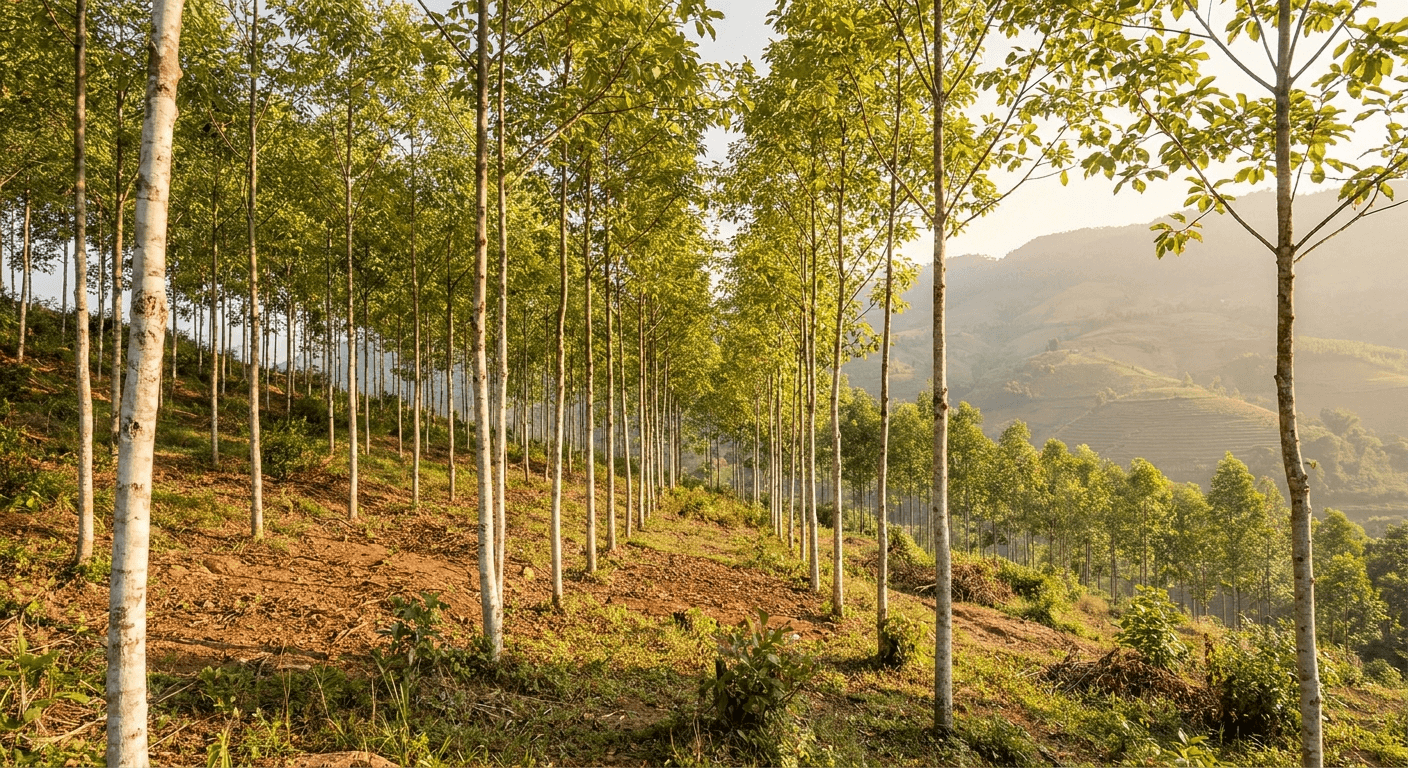
Styrax (Full-White Core) Plywood from Vietnam
Styrax (Styrax tonkinensis, known in Vietnam as bồ đề) is the pale, uniform "full white core" species Vietnamese mills use for painted and visible plywood. Where it grows, how it's farmed, and when to specify it over denser cores.

Glossary
Acacia Plywood from Vietnam: The Workhorse Core
Acacia is the plantation-grown core behind most Vietnamese plywood. How and where it is farmed, why it became the workhorse core, and where it is used.