
Guides/Compliance
Spotting Transshipped Chinese Plywood Sold as Vietnamese
How importers detect Chinese-origin plywood transshipped through Vietnam to dodge AD/CVD duties and EUDR, using the weight-per-CBM test and document checks.
You detect transshipped Chinese plywood two ways: a physical tell and a paper trail. The physical tell is weight. Chinese plywood is built mostly on light poplar cores, so a container declared as Vietnamese plywood that measures unusually high cubic volume against a full payload is carrying a light species, and that points to poplar rather than to Vietnam's denser plantation hardwoods. The paper trail is entity and species consistency across the mill certificate, the invoice, and the legality file. When the numbers and the documents disagree, you are likely looking at Chinese product wearing a Vietnamese label.
This matters because a small number of actors route Chinese hardwood plywood through Vietnam with little or no real processing, relabel it "Made in Vietnam," and pass it to unsuspecting importers. That is fraud. It exposes the buyer to retroactive duties and seizure, it undermines the EU Deforestation Regulation, and it damages the reputation of the many legitimate Vietnamese producers who do the real work. Reading this as a knock on Vietnam would be a mistake. The country's genuine mills are the victims here, alongside the importer left holding the customs bill.
What is plywood transshipment, and why does it carry duty risk?
Transshipment for duty evasion means moving finished or near-finished Chinese plywood into Vietnam, doing minimal work, and shipping it onward under a false Vietnamese origin. The goal is to escape the high US antidumping and countervailing duties on Chinese hardwood plywood and, going forward, to fake plantation origin so the load appears compliant with the EU Deforestation Regulation (Regulation (EU) 2023/1115).
US authorities have documented the pattern directly. In its 2023 final determination, the US Department of Commerce found that hardwood plywood completed in Vietnam using Chinese plywood inputs and components was circumventing the antidumping and countervailing duty orders on certain hardwood plywood from China (case A-570-051 / C-570-052, 88 FR 46740). Those China orders carry steep rates, and Commerce instructed Customs to collect cash deposits at the applicable antidumping and countervailing duty rates on affected entries. In a separate enforcement action, US Customs found a Vietnam-based importer had passed off Chinese-origin cabinet components as Vietnamese, with the affected goods exposed to retroactive duties.
Origin verification also matters for a newer reason. In July 2026, Commerce issued affirmative final antidumping and countervailing determinations on hardwood and decorative plywood from Vietnam itself (case A-552-851), separate from the China orders and scope-specific to hardwood and decorative panels. So the lesson is not that any single origin is automatically clean or automatically dutiable. The lesson is that true, documented origin now drives duty exposure in both directions, and guessing is expensive. Statements about duties should always be tied to a specific scope and case, never a blanket claim.
How does the weight-per-CBM test expose a light poplar core?
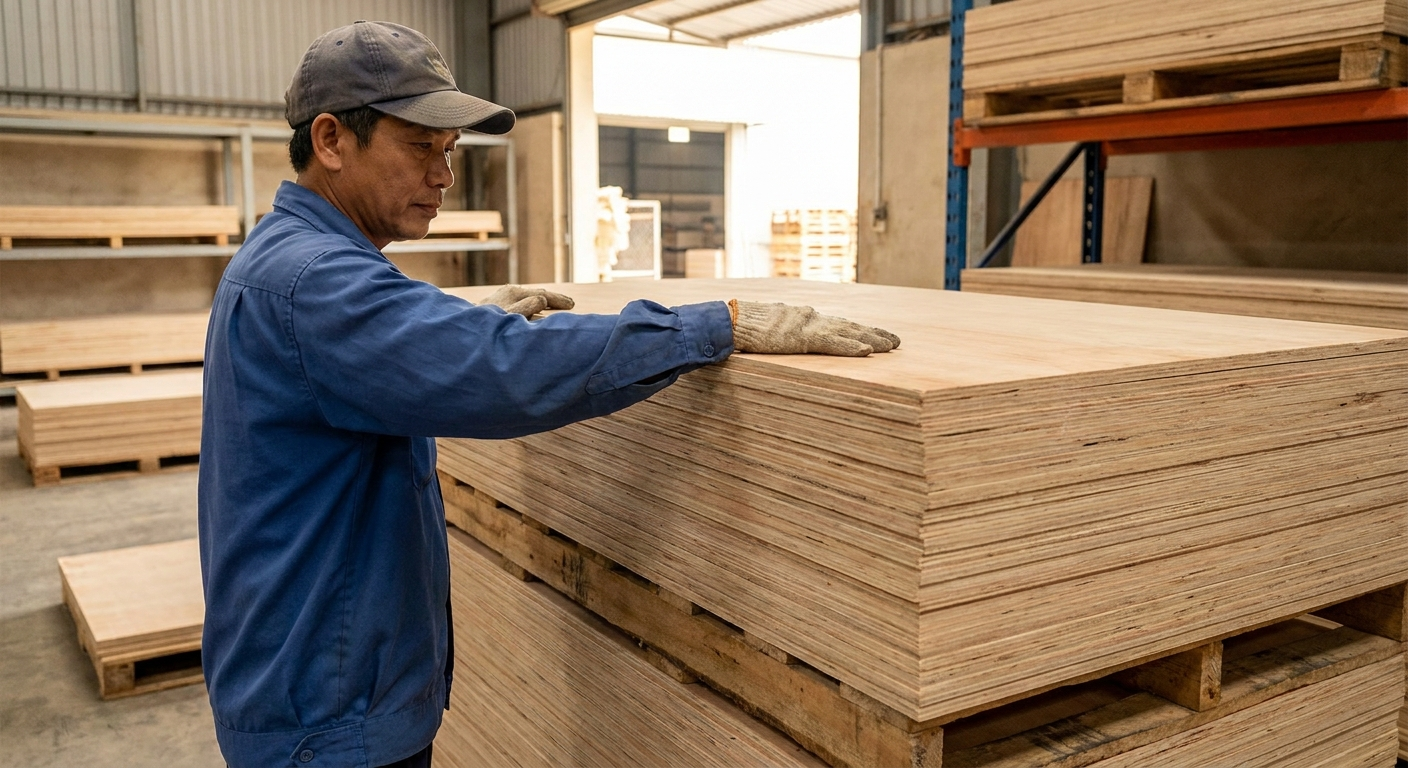
This is the strongest physical tell, and it costs nothing but a weighbridge ticket. Chinese plywood is predominantly poplar-cored. Solid poplar runs roughly 350 to 500 kg/m³ by wood-science references, and poplar plywood plans around 450 to 480 kg/m³. Genuine Vietnamese plywood is built on denser plantation species: acacia around 580, eucalyptus around 650, and rubberwood (Hevea) around 700 kg/m³. These are planning values that should be confirmed on the mill certificate for each shipment.
Density drives how a container loads. Dense hardwood plywood hits the container's weight ceiling long before it fills the volume, while light poplar lets a shipper pack far more cubic meters at the same weight. A 40ft high-cube container offers about 76 CBM of internal volume and a working payload near 26 to 27 tonnes. At a planning payload of about 26,300 kg, the weight-limited volume works out like this:
| Core species (declared) | Planning density (kg/m³) | Approx. weight-limited volume per 40HC |
|---|---|---|
| Poplar (typical Chinese core) | ~450 | ~58 CBM |
| Acacia (Vietnam plantation) | ~580 | ~45 CBM |
| Eucalyptus (Vietnam plantation) | ~650 | ~40 CBM |
| Rubberwood / Hevea (Vietnam plantation) | ~700 | ~38 CBM |
Read the pattern. A truthful Vietnamese hardwood load lands around 40 to 46 CBM in a 40HC because it runs out of weight first. Poplar can push toward 55 to 60 CBM at the same payload. So a "Vietnamese plywood" container arriving well above the normal hardwood ceiling is a flag. Around 45 CBM is already the practical hardwood limit; materially more than that, at full weight, means the average panel density is closer to poplar than to plantation hardwood. Put another way, the diagnostic is weight per CBM. Plantation hardwood loads carry roughly 580 to 700 kg per CBM. A load measuring closer to 450 kg per CBM is telling you the core is light, and light usually means poplar.
The test is simple to run. Weigh a sample container on a certified weighbridge, measure or read the loaded volume, and divide. If the answer sits far below the plantation-hardwood band, ask for the species declaration and density on the certificate of analysis, and treat a refusal as its own answer.
What documentary and behavioural red flags signal transshipment?
The weight test narrows suspicion. Documents confirm it. No single item below proves fraud, but two or three together justify a hold and an audit.
| Red flag | Why it matters |
|---|---|
| Entity mismatch across documents | The producing name on the mill certificate, the FSC or PEFC claim, and the commercial invoice do not match. Real production keeps one traceable entity from log to loading dock. |
| A "mill" that imports finished panels | The Vietnamese supplier buys finished plywood or full veneer platforms from China and does little real processing. That is assembly relabeling, not manufacture. |
| No plantation geolocation or legality file | Missing plot coordinates or a missing VNTLAS legality dossier means origin cannot be proven, which also fails EUDR due diligence. |
| Face or core species that do not fit Vietnam | Poplar or birch faces and light cores are inconsistent with Vietnam's acacia, eucalyptus, rubberwood, and styrax plantation base. |
| Implausibly low price | A quote well under the cost of genuine plantation-hardwood production can signal that duties are not being priced in. |
| Brand-new or shell "mills" | A supplier with no production history that appeared after tariff changes deserves extra scrutiny. |
| Refusal to allow a mill audit | A genuine manufacturer will host a visit or an inspection agency. A hard no is a signal. |
How can a buyer verify true Vietnamese origin?
Build verification into the purchase order rather than the dispute. A practical checklist:
- Weigh and measure a sample container and compute weight per CBM against the plantation-hardwood band.
- Require a species declaration and panel density on the certificate of analysis, and match them to the weight result.
- Demand plantation plot geolocation and the VNTLAS legality documents so the file is EUDR-ready before goods move.
- Verify certificate codes yourself on the public FSC and PEFC databases, and confirm CARB or TSCA Title VI claims independently.
- Commission a mill audit or a pre-shipment inspection through a third-party agency for new suppliers.
- Match the producing entity across the mill certificate, the certification claim, the invoice, and the packing list. One name, all the way through.
For the underlying species density figures and panel-weight math, see the manufacturer reference at vinawoodltd.com, which publishes planning densities and per-sheet weights you can hold a certificate against.
What happens to an importer who gets caught?
The importer of record carries the exposure, not the overseas seller. If Customs finds transshipment, the goods can face retroactive antidumping and countervailing duties back to the applicable entry date, plus penalties for the false origin claim. Shipments can be detained or seized. Under the EU Deforestation Regulation, an operator who relied on faked plantation origin can be non-compliant and can have filed a false due-diligence statement, with penalties that scale to the value of the goods. The reputational cost lands twice: on the importer whose supply chain failed, and on Vietnam's legitimate producers, whose honest plantation-hardwood plywood gets tainted by a minority who cheat. Verifying origin protects the buyer and the good actors at the same time.
Related guides
Frequently asked
What is the single most reliable physical test for transshipped plywood?
Weight per cubic meter. Weigh a sample container on a certified weighbridge, measure the loaded volume, and divide. Genuine Vietnamese plantation-hardwood plywood carries roughly 580 to 700 kg per CBM, so a load closer to 450 kg per CBM points to a light poplar core and possible Chinese origin. Confirm against the species and density stated on the mill certificate.
Why does light poplar let a shipper load more volume?
Dense hardwood plywood reaches a container's weight ceiling long before it fills the volume. A 40ft high-cube holds about 76 CBM but only about 26 to 27 tonnes of payload. At that weight, plantation hardwood fills roughly 40 to 46 CBM, while poplar at about 450 kg/m3 can reach 55 to 60 CBM. An unusually high CBM at full weight signals a light species.
Does the US Department of Commerce treat Vietnam assembly of Chinese plywood as circumvention?
Yes, in scope-specific terms. In its 2023 final determination (case A-570-051 / C-570-052, 88 FR 46740), Commerce found that hardwood plywood completed in Vietnam using Chinese plywood inputs was circumventing the antidumping and countervailing duty orders on certain hardwood plywood from China, and directed Customs to collect cash deposits at the applicable rates.
How does transshipment affect EUDR compliance?
The EU Deforestation Regulation (Regulation (EU) 2023/1115) requires operators to prove products are deforestation-free, with plantation plot geolocation and a due-diligence statement. Faked Vietnamese origin defeats that. An operator who relies on it can be non-compliant and can have filed a false due-diligence statement, with penalties scaled to the value of the goods.
Isn't calling this out unfair to Vietnamese suppliers?
No. Transshipment is fraud committed by a small minority, and its biggest losers are Vietnam's legitimate plantation-hardwood producers, whose honest product gets tainted, along with the importer who inherits the duty bill. Verifying true origin protects the buyer and rewards the many mills doing the real work.
Related in the atlas
Continue reading
Same topic first, then what others on the atlas read most.
Compliance
EUDR Evidence Pack for Vietnamese Plantation Plywood
A plain-language reference on how a compliant EUDR evidence pack for Vietnamese plantation plywood typically works: Article 9 data, Circular 26/2022 origin dossiers, smallholder land tenure, the money trail without a seller e-invoice, and why the mill pack is not the DDS.

Compliance
REACH and Vietnam Plywood: The EU Formaldehyde Restriction
How REACH's Annex XVII entry 77 formaldehyde restriction (Regulation (EU) 2023/1464) affects Vietnamese plywood sold in the EU, and what a mill must show to meet the 0.062 mg/m³ limit from 6 August 2026.
Compliance
Compliance atlas for Vietnam plywood
The compliance documents a Vietnamese mill actually produces, how origin and legality paperwork is generated in-country under VNTLAS, what Vietnam's EUDR low-risk status means, and how a buyer verifies a mill.
Compliance
EN 314-2 Plywood Bonding Classes: Class 1, 2, and 3 Explained
EN 314-2 sets three plywood bonding classes by end-use moisture: Class 1 dry, Class 2 humid/protected exterior, Class 3 unprotected exterior. Learn how EN 314-1 tests, EN 636 types, and Eurocode 5 service classes line up for importers reading certificates.