

Guides/Compliance
EUDR and Vietnam Plywood: Supplier Evidence, Forestry Law and Country Risk
What a Vietnamese mill must hand over for an EUDR due-diligence statement — plot geolocation, species, quantity, legality — plus the forestry law that generates it.
Vietnam sits in the low-risk band of the EU's country benchmarking under the EU Deforestation Regulation, Regulation (EU) 2023/1115. That status lightens the paperwork. It does not remove it. A Vietnamese mill still has to hand over plot geolocation and legality evidence for the wood in every panel it ships to the EU, and the difficult part is the smallholder acacia plot, not the rule itself.
This page is the Vietnam-origin reality of EUDR: where the country sits in the benchmark, exactly what a mill must supply for a due-diligence statement, and the Vietnamese forestry law that generates that evidence in the first place. For the generic mechanics of the regulation, see Vinawood's EUDR compliance guide for plywood importers.
Where does Vietnam sit in the EUDR country benchmark?
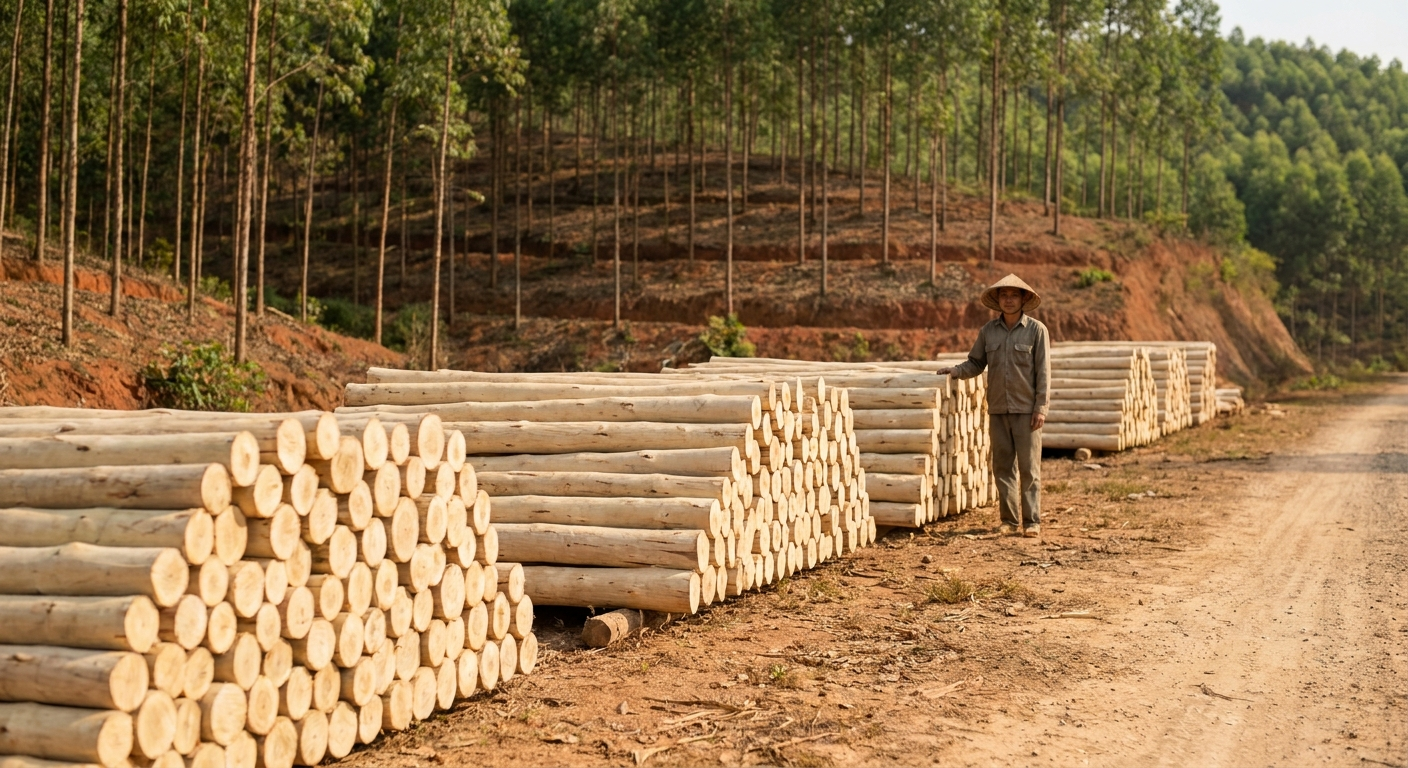
Low risk. The European Commission's first country benchmarking, adopted as Implementing Regulation (EU) 2025/1093 on 22 May 2025, sorted most of the world into three bands. Vietnam landed in the lowest one. Only four countries were classed high risk: Belarus, Myanmar, North Korea and Russia.
Low risk does not mean no obligation. It means an operator placing Vietnam-origin plywood on the EU market can use the simplified due diligence route under Article 13. You still collect the information and file a due-diligence statement, but you are exempt from the full risk-assessment and risk-mitigation steps that apply to standard-risk origins. Enforcement authorities also check fewer operators sourcing from low-risk countries.
| Risk band | Due diligence | Minimum operator checks/year |
|---|---|---|
| Low | Simplified (collect info + file DDS; no full risk assessment) | 1% |
| Standard | Full: information, risk assessment, risk mitigation | 3% |
| High | Full, with enhanced scrutiny | 9% |
One caveat worth flagging. Forest Trends has argued the benchmark can understate risk for processing and re-export hubs, because Vietnam imports several million cubic metres of raw material a year, some of it from higher-risk tropical sources. A low-risk badge on the country does not vouch for a specific consignment. Your evidence still has to trace the actual wood.
What changes on 30 December 2026, and who it hits?
After the December 2025 postponement and simplification, the application dates are set. Large and medium operators and traders must comply from 30 December 2026. Micro and small primary operators get until 30 June 2027, and they file a one-off simplified declaration rather than a statement per consignment.
The deforestation cutoff is fixed and does not move with the dates: the wood must come from land that was not subject to deforestation after 31 December 2020. Plantation blocks established or harvested on land cleared before that date are inside scope; land converted from natural forest after it is not. A further simplification means only the business first placing a product on the EU market carries the statement, so downstream distributors reference an existing DDS reference number instead of filing their own.
Exactly what must a Vietnamese supplier hand over for EUDR?
Start with who is on the hook. The EU operator, the business first placing the plywood on the EU market, files the due-diligence statement (DDS) in the EU Information System, TRACES, and carries the legal obligation. The Vietnamese mill files nothing in Brussels. What the mill does is supply the underlying dataset the operator needs to build that statement. No dataset, no DDS. A mill that cannot produce plot geolocation cannot support an EU sale, however clean the rest of its documentation looks.
Under Annex II of the regulation the statement pulls together a defined set of fields. Here is what the mill provides for each, and why the operator needs it.
| Data point | What it is | Why the operator needs it |
|---|---|---|
| Plot geolocation | Coordinates of every harvest plot the wood came from: a polygon tracing the block for plots of 4 ha or more, a single point (latitude/longitude) for plots under 4 ha, tied to the timber in the consignment | Lets the operator check each plot against deforestation data for the 31 December 2020 cutoff; this is the field most likely to be missing |
| Species | Common and scientific name of the wood: acacia (Acacia mangium and hybrids), eucalyptus (Eucalyptus urophylla), rubberwood (Hevea brasiliensis) | Confirms the commodity is in scope and plantation-grown; the DDS species field expects the botanical name for wood |
| Quantity | Volume or mass of timber in the shipment, with the HS or CN code | The DDS records quantity and tariff code per consignment |
| Country and region of production | Vietnam, down to the province where the wood was grown and harvested | Sets the country-of-production field and decides which risk benchmark applies |
| Legality evidence | Harvest and transport records, the land use rights certificate (the "red book"), and VNTLAS documentation for the wood | Shows the timber was harvested under Vietnamese law, which supports the operator's negligible-risk conclusion |
The geolocation format is where Vietnam-origin sourcing gets awkward. A plantation block of 4 hectares or more needs a polygon; anything smaller can be a single coordinate. Each coordinate set still has to point back to the specific timber in the container, and that is hard when veneer has been pooled across many small plots. The other four rows a Vietnamese mill produces as a matter of routine.
What plot-level evidence can a Vietnamese mill actually supply?
More than many buyers expect on the legality side, and less than they expect on wall-to-wall plot geolocation. Land use rights certificates are widely available for titled plantation land. The species declaration is standard and confirmed on the mill certificate. Harvest and transport legality records sit inside VNTLAS. FSC-COC or PEFC chain-of-custody certificates cover the volume that is certified, though not all volume is. The one item that does not come easily is geolocation across a large number of small plots, and that gap is structural rather than administrative.
Why the smallholder acacia plot is the real bottleneck
Vietnam has roughly 4.9 million hectares of planted forest, but only about 868,000 hectares carry sustainable-management certification. Acacia and rubberwood in particular come largely from household growers on small plots, and more than 60% of the country's rubber plantation area is smallholder-operated.
Small plots, many owners. A single container of plywood can draw veneer from wood pooled across dozens of plots, each a few hectares, each needing its own coordinate set. Provincial forest boundary databases and plot-level coordinates remain incomplete for smallholders, and Vietnamese authorities are targeting completion of provincial plantation-area identification by 31 December 2026. Until those datasets fill in, plot geolocation is an aggregation problem more than a compliance one.
The Vietnam forestry law behind that paperwork
The legality evidence a mill supplies does not appear from nowhere. A national system with a clear legal spine generates it.
The foundation is the Law on Forestry 2017 (Law No. 16/2017/QH14), passed by the National Assembly on 15 November 2017 and in force from 1 January 2019. It runs to 108 articles across 12 chapters and replaced the 2004 Forest Protection and Development Law. The law vests forest ownership in the State on behalf of the people, sorts forests into special-use, protection and production categories, and instructs the State to build and operate a Vietnam Timber Legality Assurance System and to classify the enterprises that harvest, transport, process and export wood.
That system was set up by Decree 102/2020/ND-CP, in force from 30 October 2020, which established VNTLAS under the EU-Vietnam FLEGT Voluntary Partnership Agreement. VNTLAS verifies legality from the forest or the point of import through to final sale or export, on a risk-based approach. Its legality definition splits the supply chain into two sectors: organizations, meaning companies, cooperatives and state entities, and households, meaning family growers, individuals and village communities. Each sector has its own documentary tests.
Exporters are then risk-tiered by the Organization Classification System (OCS). A company that meets the compliance, supply-chain-control and evidence requirements lands in Group 1 and is reassessed every two years. A company that falls short sits in Group 2, is reviewed annually, and faces heavier verification at export. A Group 1 classification tells a buyer the mill's paperwork has already cleared a national check.
For domestic plantation wood the records are light. A grower harvesting planted acacia, eucalyptus or rubberwood on titled land completes a harvest declaration and moves the logs on transport documents, and the wood counts as low legality risk because it is plantation-grown on land the grower holds a certificate for. The weight of the system falls on imported timber. Decree 102/2020 requires importers to conduct due diligence that any imported timber was legally harvested, produced and exported under the law of the country of harvest, with tighter obligations on higher-risk species and origins; Decree 120/2024/ND-CP later reinforced those import controls.
Here is the point buyers should hold onto. Vietnam's domestic plantation leg, the acacia, eucalyptus and rubberwood that make up most Vietnamese plywood cores, carries low legality risk and clean paperwork. The imported leg is the exposed one. Wood entering Vietnam from higher-risk origins, Chinese-origin material among them, is exactly where legality gaps, transshipment fraud and EUDR exposure meet. A panel built entirely from titled Vietnamese plantation wood makes a straightforward EUDR file. A panel carrying undocumented imported timber does not.
How a due-diligence statement for Vietnam-origin panels gets built
The statement itself is short. The work sits behind it. For a shipment of Vietnamese plywood the operator assembles the HS code and quantity, the country of production with geolocation for every plot the wood came from, the supplier and legality references under VNTLAS, and any FSC-COC or PEFC chain-of-custody claim. With that in hand, an operator on a low-risk origin can conclude negligible risk, file the DDS through the simplified route, and pass the reference number downstream. What separates a smooth file from a stalled one is whether the mill can map its wood back to titled, geolocated plantation land.
That imported leg carries a second compliance exposure beyond EUDR. Plywood relabelled from Chinese origin and sold as Vietnamese does not only risk anti-dumping and deforestation problems. The panel was pressed with resin the Vietnamese mill never controlled, so the formaldehyde-emission evidence an EU buyer needs under REACH and EN 13986 does not exist for it. The same transshipment that breaks an EUDR file tends to break the REACH file too. For the certifications that back a genuine Vietnamese file, see Vinawood's Vietnam plywood certifications guide, and to ask what a specific mill can document for your consignments, contact Vinawood.
Related guides
Frequently asked
Is Vietnam a low-risk or high-risk country under EUDR?
Low risk. The European Commission's country benchmarking, adopted 22 May 2025 as Implementing Regulation (EU) 2025/1093, placed Vietnam in the lowest of three bands. Only Belarus, Myanmar, North Korea and Russia were classed high risk. Low risk allows simplified due diligence but does not remove the duty to collect evidence and file a due-diligence statement.
What must a Vietnamese supplier hand over for an EUDR due-diligence statement?
The dataset that feeds the operator's DDS: plot geolocation (polygons for plots of 4 ha or more, point coordinates below that) tied to the timber, species by common and scientific name, quantity with HS code, country and region of production, and legality evidence such as harvest and transport records, the land use rights certificate and VNTLAS documentation. The EU operator files the DDS in TRACES; the mill supplies the underlying data.
Who files the due-diligence statement, the mill or the EU importer?
The EU operator, meaning the business first placing the plywood on the EU market, files the DDS in the EU Information System (TRACES) and carries the legal obligation. The Vietnamese mill files nothing in the EU. It supplies the geolocation, species, quantity and legality dataset the operator needs, so a mill that cannot produce plot geolocation cannot support an EU sale.
What Vietnamese law requires mills to document timber legality?
The Law on Forestry 2017 (Law No. 16/2017/QH14, in force 1 January 2019) directs the State to build a Vietnam Timber Legality Assurance System. Decree 102/2020/ND-CP established VNTLAS under the EU-Vietnam FLEGT VPA, defines legality for organizations and households, and risk-tiers exporters through the Organization Classification System (OCS). It also imposes a due-diligence duty on imported timber.
Why is imported timber the high-risk leg for Vietnamese plywood?
Domestic plantation acacia, eucalyptus and rubberwood grow on titled land with light harvest and transport records, so they carry low legality risk. Timber imported into Vietnam from higher-risk origins, including Chinese-origin wood, carries a heavier due-diligence duty under Decree 102/2020. That imported leg is where legality gaps, transshipment fraud and EUDR exposure meet.
Does a low-risk benchmark mean Vietnamese plywood is automatically EUDR-compliant?
No. The benchmark sets the level of due diligence, not compliance for a given shipment. Because Vietnam also imports and processes raw material from higher-risk origins, the actual wood in each consignment still has to be traced to legal, deforestation-free plots before an operator files the statement.
Related in the atlas
Continue reading
Same topic first, then what others on the atlas read most.
Compliance
EUDR Evidence Pack for Vietnamese Plantation Plywood
A plain-language reference on how a compliant EUDR evidence pack for Vietnamese plantation plywood typically works: Article 9 data, Circular 26/2022 origin dossiers, smallholder land tenure, the money trail without a seller e-invoice, and why the mill pack is not the DDS.

Compliance
REACH and Vietnam Plywood: The EU Formaldehyde Restriction
How REACH's Annex XVII entry 77 formaldehyde restriction (Regulation (EU) 2023/1464) affects Vietnamese plywood sold in the EU, and what a mill must show to meet the 0.062 mg/m³ limit from 6 August 2026.
Compliance
Compliance atlas for Vietnam plywood
The compliance documents a Vietnamese mill actually produces, how origin and legality paperwork is generated in-country under VNTLAS, what Vietnam's EUDR low-risk status means, and how a buyer verifies a mill.
Compliance
Spotting Transshipped Chinese Plywood Sold as Vietnamese
A buyer-protection guide to detecting Chinese-origin plywood illegally transshipped through Vietnam, using the weight-per-CBM density test and document checks to protect against duties, EUDR non-compliance, and seizure.