
Guides/Industry Education
Plywood Delamination Explained: Glue-Line Failure, Bond Tests and What Buyers Should Ask
Plywood delamination is a glue-line failure, not a wood defect. How PS 1 and EN 314 define and test it, and what bond evidence buyers should ask for.
Mention delamination to a formwork carpenter and he'll tell you about a specific stack, not a definition. Maybe it sat on a podium deck right through the monsoon. Maybe it was sheathing on a house whose roof went on three weeks late. Plenty of those sheets survived, scuffed and grubby. Then there were the odd ones with a puffy corner, where a chisel slid into the edge and lifted a ply off nearly bare, hardly a splinter of wood stuck to the glue. No rot. No snapped core. Just a glue line that gave up.
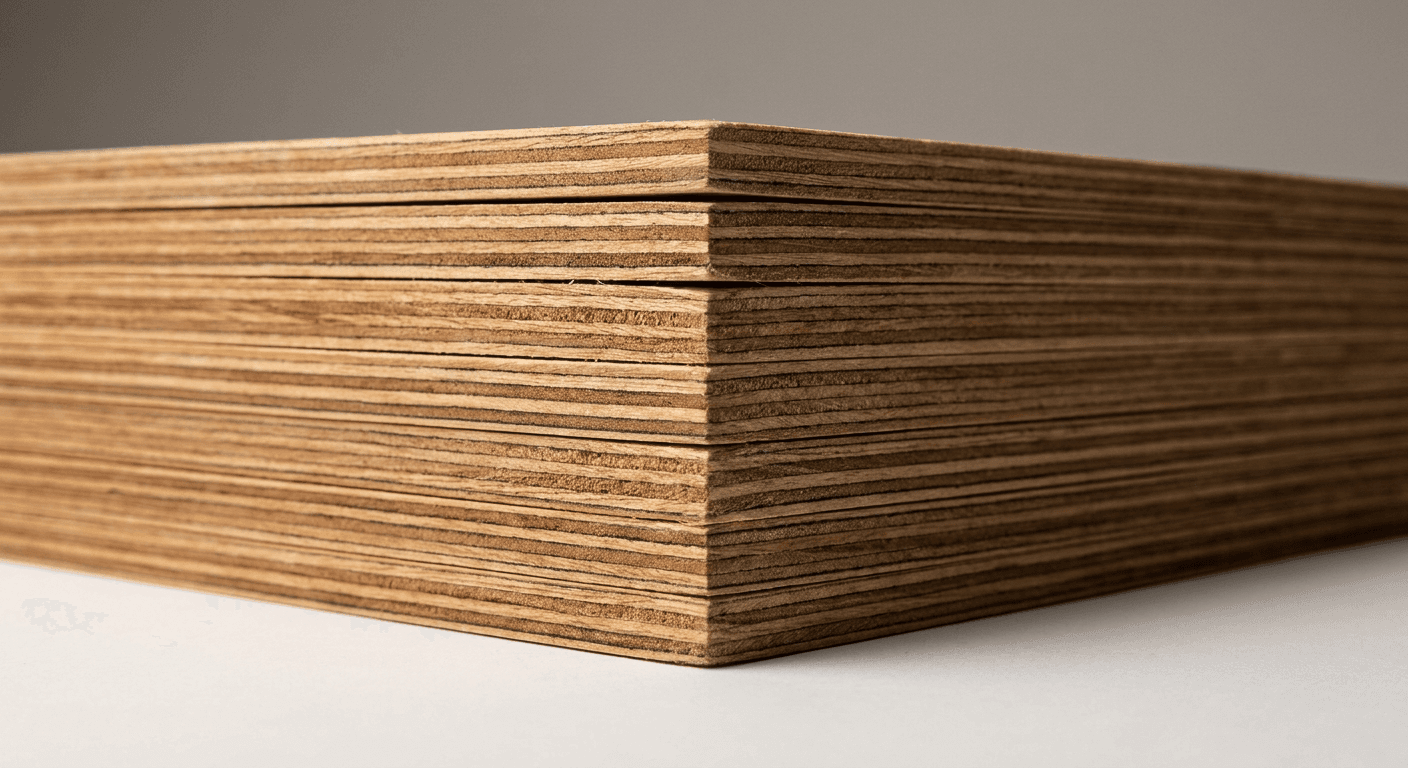
Why does that one interface get so much attention? Because plywood is basically a truce between veneers. Each layer is turned ninety degrees to the one below it, pressed hot, and from then on every ply stops its neighbour from moving when humidity changes. The glue is what enforces the truce. Pull it out, figuratively speaking, and the sheet goes back to being a pile of peeled veneer, which is why standards committees spend so many pages on bond testing and comparatively few on, say, colour.
What delamination means in the standard's own words
The clearest wording we've found is in PS 1-22, the US voluntary product standard for structural plywood that NIST publishes. It calls delamination a visible separation between plies that normally receive adhesive at their interface and are firmly contacted in the pressing operation. Then it adds the useful bit: checking, leafing, splitting and broken grain don't count. A crack running down a face veneer can look ugly, yet if it isn't at a pressed glue line, it isn't delamination in the standard's eyes.
Overlaid formwork sheets bring a second thing to keep apart. On film-faced and phenolic sheets, a resin-soaked paper film is bonded over the face veneer. That film can bubble up, peel at a corner or get worn through by a rough stripping crew, all while the core underneath is fine. Veneer checking is the other impostor: hairline splits along the grain that show up when a soaked face dries too fast. Site crews call all of it "delam". Claims go sideways that way, with a buyer and a mill arguing past each other about two different bonds, so it pays to name the symptom first.
| What you see | Where it starts | What it usually points to |
|---|---|---|
| Plies lifting apart at a cut edge, bare glue on both surfaces | Core glue line, often at an edge or corner | Bond class too low for the exposure, or an under-cured glue line |
| Hollow-sounding blister under the face veneer | Core glue line just below the face | Local press fault, wet or contaminated veneer at pressing |
| Film lifting, blistering or flaking off the face | Bond between overlay film and face veneer | Overlay bond, release practice, stripping damage |
| Fine cracks along the grain of the face | Inside the face veneer, not at a glue line | Veneer checking from drying; PS 1 does not count it as delamination |
Why glue lines give way
Water is nearly always behind it. Wood gets fatter across the grain when it's wet and thinner when it dries. Neighbouring plies run crosswise, so each soak-and-dry cycle drags the two sides of a glue line in different directions. A dry-room bond might shrug that off for a season, possibly two. After that it lets go. That's why the fit between bond type and real exposure matters more than any strength number printed on a brochure.
So the first suspect is a mismatch. Urea-formaldehyde glue lines are dry-use glue, full stop. When someone says "melamine" here they ought to mean the MUF core adhesive (melamine-urea-formaldehyde) between veneers, not the face film. MUF glue lines are commonly made to EN 314-2 Class 2, good for humid service and the occasional soaking. Phenol-formaldehyde glue that's meant to go through boiling tests sits a step above. If a job floods its panels every week and the order specified a dry-use bond, the failure was booked before the first pour.
Then there's what happens in the press. The glue spread has to be right, the platens have to squeeze hard enough, and the press has to stay hot long enough that the resin cures in the middle of the sheet and not just near the faces. Veneer moisture at pressing counts too. Too wet and it can trap steam pockets. Over-dried, dusty or oily veneer may never take the glue properly in the first place. You won't see any of this the day a container is loaded, which is the frustrating part. It shows up months later when water finds the weak spot.
On site, edges are the door water walks through. End grain drinks. A sealed face mostly doesn't. Leave a sheet standing in a puddle overnight and its outer glue lines get fed water for hours. Personally, I trust the broken edge more than any argument in a claim email. Bare, shiny glue on both halves points back toward the bond or the press. Torn wood fibre on both sides usually means impact or overload (or just a very hard life).
How bond tests find the weakness before a buyer does
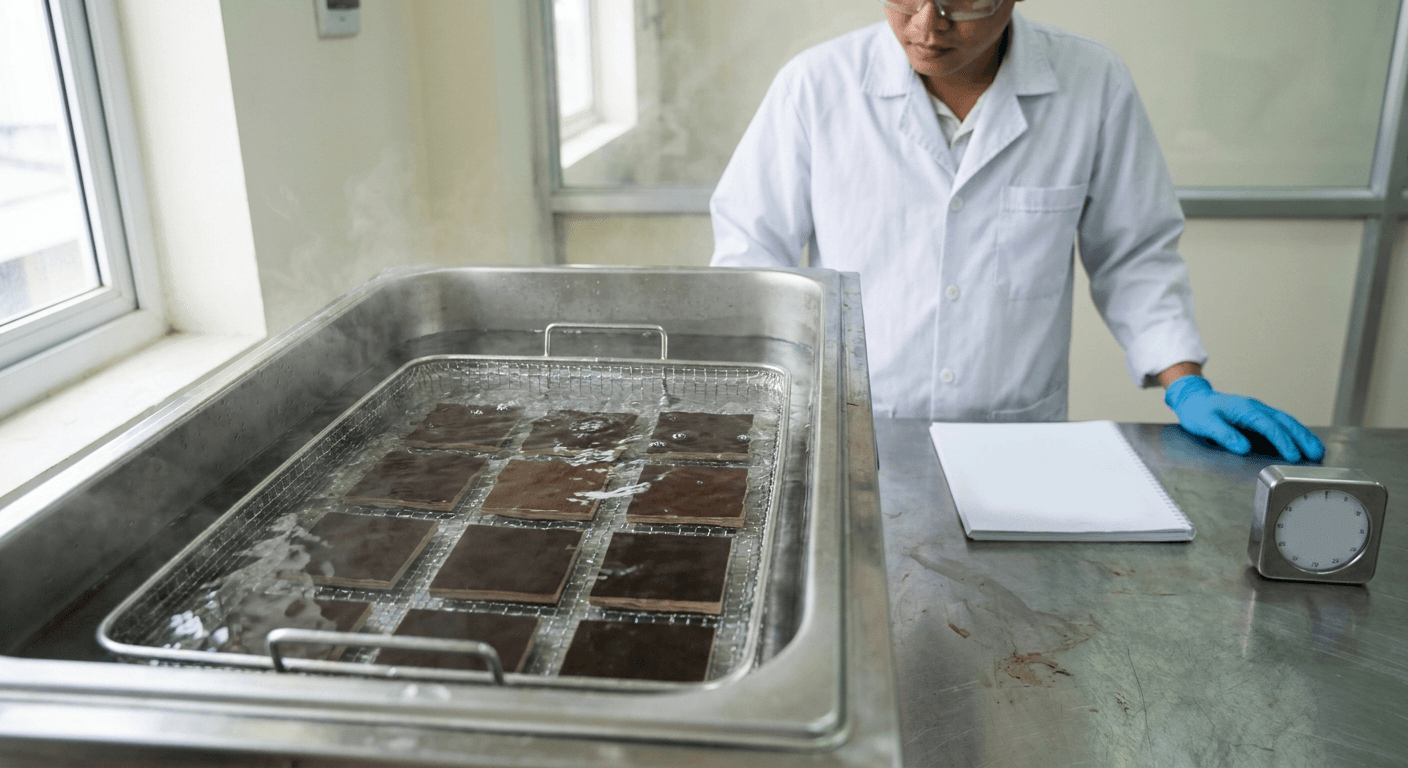
Nobody in a test lab waits for a wet season. Technicians saw little specimens out of sample panels, cook or soak them to fake years of weather in a day or three, and then rip each glue line apart in a shear rig to see what broke. Europe's method is EN 314-1, which lists four pretreatments: 24 hours in water at 20 °C; 6 hours in boiling water, then cooling; 4 hours boiling, 16 to 20 hours drying at 60 °C, and 4 more hours boiling; and finally a 72-hour boil. EN 314-2 sorts the outcomes into Class 1 for dry conditions, Class 2 for humid ones and Class 3 for exterior use. We cover the pass criteria in our guide to EN 314-2 bonding classes, so there's no need to redo those tables here.
The phrase that ties the US and European systems together is "wood failure", and it sounds backwards at first. After the shear test, someone looks at the two broken halves and estimates how much of the area is torn wood rather than bare glue. Lots of torn wood is good news. It means the wood gave up before the adhesive did, which is exactly how a sound bond should behave. EN 314-1 calls this apparent cohesive wood failure, while PS 1 defines it as the area of wood fibre left at the bond line after the shear test.
PS 1 uses a vacuum-pressure test and a boiling test. Exposure 1 specimens must average at least 80% wood failure (each test judged on its own), and Exterior panels need an 85% average. There's a visual cap too: in an Exposure 1 panel, delamination in any single bond line can't exceed 19.4 cm², or 3 sq in, apart from areas linked to grade features the standard allows, like knotholes. Any specimen that opens up more than 3.2 mm deep and 25.4 mm long scores zero. APA makes a point worth remembering here: bond classification is about how well the glue resists moisture, not how strong the panel is. For how those classes play out in real weather, see our Exposure 1 explainer and the page on WBP plywood.
Formwork faces add a second bond to watch
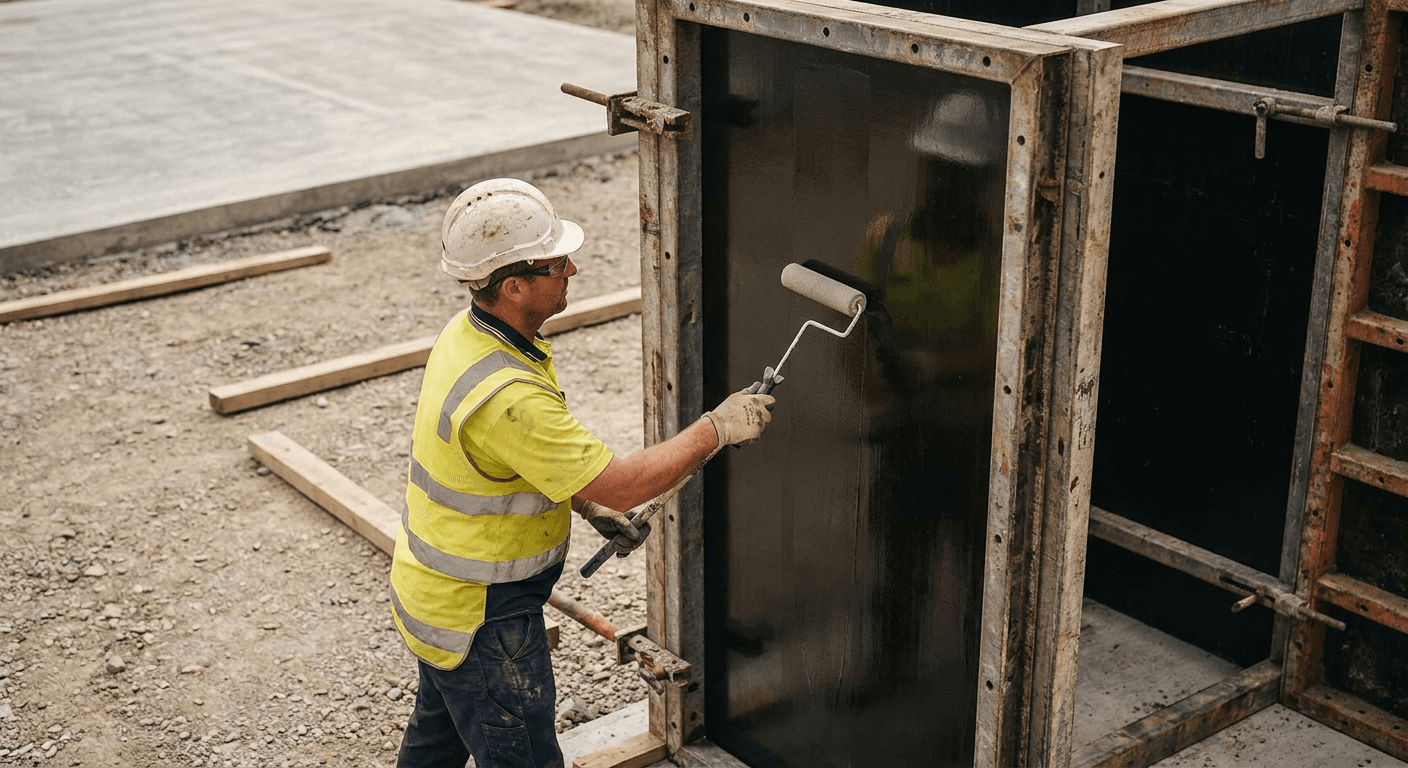
A film-faced or phenolic form panel is really two bonding jobs in one sheet. There are the core glue lines holding veneer to veneer, and there's the separate bond holding the resin film to the face. Concrete pressure, the poker vibrator, stripping and whatever release agent the crew sprays all work on that face bond, pour after pour. You can get a blistered face over a perfectly healthy core. You can also get a core that's opening up underneath a film that still looks new, and a decent test report for formwork should say something about both.
Both bonds fail first at the edge, more often than not. Chip a corner or cut a sheet to size, leave it raw, and water plus cement paste wick straight into the core; once the outer glue lines start to gap, the film over them has nothing solid to sit on. Sealing edges at the mill, and resealing cuts on site, is boring work that crews skip. It's also what decides whether a panel gets anywhere near the reuse figure on its data sheet, which is always written as up to N pours and assumes decent handling. Release chemistry plays a part as well, since diesel-type or solvent-heavy products can soften resin films; there's more on that in our page on form release agents. If you're comparing face systems, start with phenolic plywood, HDO plywood, MDO plywood and formply.
One last look-alike lives on the slab rather than in the panel. When the troweled top of a concrete floor comes away from the concrete underneath, that's concrete delamination, and it's usually about bleed water and finishing too early. Vinawood's mill blog covers that side in its post on concrete delamination. Short version: concrete delamination is a slab problem, and plywood delamination is a glue-line problem.
What a buyer can ask for before the order ships
You can't see bond quality on a new sheet. It looks the same whether it'll last ten pours or two, so the proof has to be on paper. Start with the bond class on the test report, stated in the terms your market uses, meaning EN 314-2 Class 1, 2 or 3 in Europe, or Exposure 1 or Exterior under PS 1 in North America. Next question: which pretreatment? Passing a cold soak and passing a 72-hour boil are wildly different achievements, though a certificate will happily print "pass" for either.
Push for actual numbers rather than a one-liner. Shear strength plus wood-failure percentage for each specimen group (by thickness, if the lab split it that way) will tell you much more than "complies". Find out what goes on the edges, and how. And get the lab's name and the test date; a report on a sample pressed back in 2021 doesn't say much about the panels in this month's container. If you want the resin families explained in plain commercial terms, Vinawood's mill explainer on plywood adhesives is a quick read.
Our guides on reading a Vietnam plywood test certificate and qualifying a Vietnam plywood mill go through that paperwork field by field. The point of all that paperwork is a fair prediction of how these particular glue lines will hold up in your weather. Once a ply is lifting on a job, the cause was locked in at the press months ago. Asking first is cheaper.
Frequently asked
What is plywood delamination?
Plywood delamination is a visible separation between two plies at a glue line that should have been bonded in the press. The US standard PS 1-22 defines it that way and says natural wood features such as checks, splits and broken grain do not count. It is a bond failure, not a wood defect, and it usually starts at an edge or corner where water gets in first.
What causes plywood to delaminate?
Delamination happens when the glue line meets more moisture, heat or stress than its bond class was designed for. Common causes are a dry-use adhesive in wet service, an under-cured glue line from short press time or low temperature, and veneer that was too wet or contaminated at pressing. On site, unsealed edges and repeated wet-dry cycling drive water into the weakest interfaces.
Does WBP or Class 3 plywood ever delaminate?
Yes, it can, although it is far less likely in normal service. WBP and EN 314-2 Class 3 describe glue lines that passed boil-type tests, which makes them water-resistant, not waterproof. A poorly pressed batch, damaged and unsealed edges, or exposure well beyond the design conditions can still open a Class 3 glue line, which is why buyers ask for current test results and not just the class name.
How do labs test plywood for delamination?
Labs cut small specimens from sample panels, put them through a soak or boil pretreatment, then shear each glue line and estimate the percentage of wood failure. EN 314-1 lists four pretreatments, from a 24-hour cold soak to a 72-hour boil, and EN 314-2 maps the results to Classes 1, 2 and 3. Under PS 1, Exposure 1 panels must average at least 80% wood failure in vacuum-pressure and boil tests, and visible delamination in a bond line is capped at 19.4 cm² (3 sq in).
Is film peeling on formwork plywood the same as delamination?
Not quite. Film peeling or blistering is a failure of the bond between the overlay film and the face veneer, while delamination in the standard's sense is a separation between plies in the core. The two can happen separately, and a formwork test report should address both the core bond class and the face overlay. Edge sealing and the right release agent help protect both bonds.
Is concrete delamination caused by the formwork panel?
Usually not. Concrete delamination is the troweled surface layer of a slab separating from the concrete beneath it, and it is mainly linked to bleed water and finishing timing. Plywood delamination is a separate glue-line problem inside the panel. The two share a name but have different causes and different fixes.
Related in the atlas
Continue reading
Same topic first, then what others on the atlas read most.
Industry Education
Form Release Agents Explained: How Release Chemistry Meets the Plywood Form Face
A concrete form release agent is the coat between wet concrete and the plywood form face. Here is how barrier and reactive chemistries differ, how VOC rules treat them, and why face type and release choice belong on the same RFQ line.
Grades
Plywood Standards Cross-Reference Matrix (EN, BS, IS, JAS, AS/NZS, ASTM)
A side-by-side reference that lines up plywood bond, durability and formaldehyde classes across EN, BS 1088, IS 710/303, JAS, AS/NZS and US PS 1, so a foreign spec can be translated into what a Vietnamese mill can build and certify.
Compliance
EUDR Evidence Pack for Vietnamese Plantation Plywood
A plain-language reference on how a compliant EUDR evidence pack for Vietnamese plantation plywood typically works: Article 9 data, Circular 26/2022 origin dossiers, smallholder land tenure, the money trail without a seller e-invoice, and why the mill pack is not the DDS.
Overview
The Vietnam Plywood Industry: A Complete Overview
A plain-English overview of Vietnam's plywood industry: its scale and growth, the plantation species base, the main export product types, certification, and where Vietnam sits among global plywood origins.