
Guides/Compliance
EU PPWR Explained: Packaging Compliance for Vietnam Plywood & EU Importers
Regulation (EU) 2025/40 hits shipment packaging around Vietnam plywood, not the panel. Timeline, Art. 18 importer duties, DoC/Annex VII. Applies 12 Aug 2026.
Direct answer: The Packaging and Packaging Waste Regulation (PPWR) is Regulation (EU) 2025/40. For Vietnam plywood trade into the EU, it hits shipment packaging that wraps, straps, edges, or unitises panels. It does not treat the plywood panel itself as packaging. The panel remains a construction product. Packaging conformity and timber diligence run as separate evidence lanes on the same container.
EU importers and Vietnam exporters need a shared checklist language before 12 August 2026, when most operator duties under the regulation apply. This guide explains the dates, definitions, roles, and Declaration of Conformity (DoC) stack. It is educational. It is not legal advice. For the commercial importer checklist on inbound shipment packaging, see Vinawood's mill companion PPWR 2026 for EU plywood importers.
What PPWR is, in one paragraph
PPWR replaces the older packaging-directive patchwork with a single EU regulation on packaging and packaging waste. It sets sustainability requirements, labelling duties, and operator obligations for packaging placed on the EU market. The legal text is on EUR-Lex as Regulation (EU) 2025/40. The LEGISSUM summary and the Commission guidance notice C/2026/3084 sit beside it. Industry toolkits such as EUROPEN's conformity-assessment site help structure files. They are not binding law.
Timeline: 11 February 2025, then 12 August 2026
The regulation entered into force on 11 February 2025. The date that matters for most operator work is 12 August 2026. From that day, sustainability and labelling-related duties, including conformity assessment and the EU DoC for packaging placed on the market, apply across Member States.
Later waves still matter for planning. Recyclability grades, recycled-content rules, and empty-space limits phase from 2030 onward. Harmonised material-composition labelling follows implementing acts, with secondary timelines often cited around 12 August 2028. Confirm labelling dates against the Official Journal text before you lock a packaging redesign. Do not let the 2030 pack bury the August 2026 hook.
Product vs packaging: why plywood panels are not the DoC target
Article 3 defines packaging by function. An item intended for containment, protection, handling, delivery, or presentation of products can be packaging. That includes sales packaging, grouped packaging, and transport packaging.
Transport packaging helps move sales units or groupings and prevents damage in transit. Road, rail, ship, and air freight containers themselves are excluded from that definition.
An item that is an integral part of a product, needed to contain or preserve it through its lifetime, and meant to be used or disposed of with the product, is not packaging under the Art. 3 / Recital 13 logic. Commission guidance stresses a functional test against Art. 3(1). An Annex I listing alone is not enough.
Applied to this trade: formwork and construction plywood sheets are products. PPWR does not ask for a packaging DoC on the panel. It asks about the wrap, strap, edge protector, pallet, or crate that travels with those sheets, when those items meet the packaging definition. PPWR packaging conformity is also separate from any construction-product CE file or REACH article restriction on the panel.
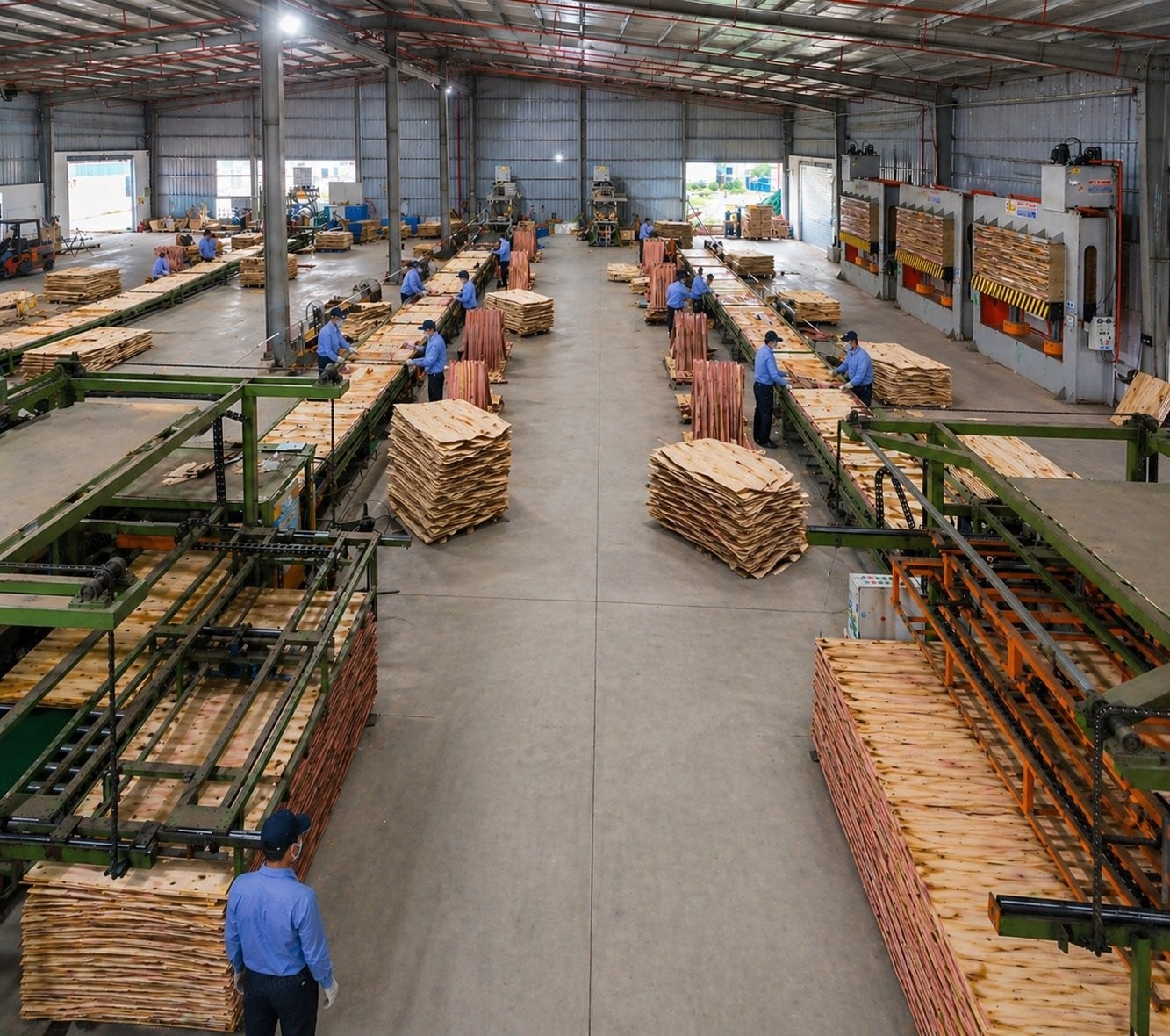
Shipment packaging taxonomy (generic, case-by-case)
Shipments of Vietnam-origin plywood often use a mix of unitising materials. Treat each category as a candidate for Art. 3 review, not as a blanket finding.
- Films and wraps. Plastic or other wraps that protect a bundle from weather or dust during storage and ocean transit.
- Straps and bands. Steel or plastic strapping that holds sheets in a unit load.
- Edge protectors. Corner or edge pieces that stop strap crush and handling damage.
- Palletisation and crates. Pallets, skids, or timber crates that unitise the load for forklift and container work. Assess each format against the packaging definition. Do not assume every wooden support is automatically in or out of scope.
This atlas will not invent film gauges, recycled-content percentages, pallet standards, or "PPWR-certified wrap" claims for any mill. Scope is fact-specific. Ask counsel or a packaging specialist when a format sits near the integral-part line.
The conformity stack: Arts. 5–12, then TD, then DoC
Think of three layers.
Requirements. Articles 5 to 12 set the sustainability and related packaging rules that apply to packaging placed on the market.
Technical documentation. Article 38 and Annex VII require conformity assessment under Module A (internal production control). The manufacturer prepares technical documentation (TD) that shows how the packaging meets the applicable Arts. 5–12 requirements.
EU Declaration of Conformity. Article 39 and Annex VIII require a written DoC in the Annex VIII model. The manufacturer draws it up and keeps it with the TD.
Retention clocks matter. Keep the TD and DoC for 5 years for single-use packaging and 10 years for reusable packaging, counted from the date the packaging is placed on the market. Market-surveillance authorities can make a reasoned request. Relevant documents are typically expected within about 10 days under manufacturer, importer, and authorised-representative pathways. Exact practice follows the regulation text and national enforcement.
Who does what: manufacturer, supplier, importer
Role labels in a plywood export chain do not always match who "places packaging on the market." Map the packaging unit, not only the panel invoice.
| Role | PPWR anchor | What it means in plain terms |
|---|---|---|
| Manufacturer of packaging | Article 15 | Runs conformity assessment, builds the Annex VII TD, draws up the Annex VIII DoC, and meets identification / contact markings. |
| Packaging or materials supplier | Article 16 | Supplies empty packaging or materials into the chain. Duties depend on what is supplied and how it is placed. |
| Importer | Article 18 | Before placing packaging on the EU market, verifies the manufacturer path, labelling, accompanying documents, and contact markings. Keeps a DoC copy and can produce the TD pathway. |
| Own-name or modify | Article 21 | An importer (or other actor) that places packaging under its own name or trademark, or modifies it in a way that could affect compliance, is treated as the manufacturer. |
Authorised representatives and distributors have further duties in the operator chapters. Fulfilment-service providers sit in the same operator map. The EUROPEN key-obligations page summarises Arts. 15–21 for navigation. It remains non-binding.
I have seen plywood purchase orders treat "manufacturer" as only the mill that pressed the sheet. Under PPWR, the manufacturer of each packaging unit can be a different legal person. Write that name down before August 2026.
Importer operating checklist (educational)
Use this as a shared language with Vietnam exporters and packaging suppliers. It does not replace counsel or Member State practice.
- List the packaging types on inbound plywood units (wrap, strap, edge protector, pallet or crate). Keep the list factual.
- Confirm a conformity assessment under Art. 38 exists for each in-scope packaging type or format.
- Confirm an Annex VIII DoC exists, and note the manufacturer identity on that DoC.
- Confirm who holds the Annex VII technical documentation and how you can get it on request.
- Check Art. 12 labelling expectations and Art. 15(5)/(6) manufacturer identification or contact markings, as reflected in Art. 18.
- Keep a copy of the EU DoC available to market surveillance. Track the 5-year or 10-year retention clock.
- Hold non-conforming packaging. Plan bring-into-conformity, withdraw, or recall ownership before a reasoned request arrives.
- Flag own-brand rewrap or any modification that could affect compliance. That path can trigger Art. 21 manufacturer duties.
PPWR beside EUDR, EUTR, and construction-product / REACH files
One container can carry several EU evidence packs. Do not merge them.
- EUDR / EUTR lane. Timber and wood-product diligence, geolocation, and due-diligence statements for the plywood as a wood product. Start with the atlas EUDR due-diligence guide and the plantation evidence pack.
- PPWR lane. Sustainability and conformity of shipment packaging around those panels. Separate TD and DoC. Separate retention clock. The mill commercial companion is PPWR 2026 for inbound plywood shipments.
- Construction-product / REACH lane. CE / EN 13986 performance for construction use, and REACH formaldehyde restrictions on articles. See REACH and formaldehyde and the certification map by destination.
Vietnam-origin plywood for EU programmes is typically plantation-grown (acacia, eucalyptus, Hevea, Styrax). That origin story feeds timber diligence. It does not answer packaging conformity. For what "Vietnam plywood" means as an origin claim, see what Vietnam plywood is.
Vietnam exporter prep (process only)
Exporters do not need a new marketing claim. They need a process.
- Ask packaging suppliers for composition and recyclability inputs that the manufacturer of each packaging unit will need for Arts. 5–12 evidence.
- Map who is the manufacturer of each packaging unit on the shipment: wrap supplier, strap supplier, pallet maker, or another party.
- Document the handoff so the EU importer can meet Art. 18: who holds the DoC, who holds the TD, and how a 10-day request gets answered.
- Keep panel product files (CE DoP, EUDR evidence, formaldehyde) in a separate folder from packaging files.
No mill packaging SKU, recycled-content percentage, or "PPWR-ready wrap" claim belongs on this atlas until verified. Soft reading on mill RFQ discipline sits on Vinawood's manufacturer page linked below.
Sources and how to use them
- EUR-Lex — Regulation (EU) 2025/40 (full text)
- EUR-Lex LEGISSUM — Packaging and packaging waste from 2026
- Commission Notice — Guidance for Regulation (EU) 2025/40 (C/2026/3084)
- EUROPEN PPWR Conformity Assessment Toolkit (non-binding)
- EUROPEN — Key obligations and features (Arts. 15–21)
- Vinawood — PPWR 2026 for EU plywood importers (inbound shipment packaging)
Disclaimer: This page is educational only. It is not legal advice. Operators must rely on the regulation text, Commission guidance and FAQs, counsel, and national market-surveillance practice. Implementing and delegated acts can still refine recyclability criteria, labelling pictograms, and empty-space methods.
About this atlas
Vietnam Plywood Atlas is written by Vinawood, a Vietnam plywood manufacturer founded in 1992. Editorial pages here explain trade and compliance concepts for importers and exporters. is Vinawood's official North American distribution partner. There is no common ownership to disclose.
Frequently asked
What is PPWR for Vietnam plywood exports to the EU?
PPWR is Regulation (EU) 2025/40 on packaging and packaging waste. For this trade it covers shipment packaging around plywood panels (wrap, strap, edge protectors, pallets/crates where Article 3 applies). It does not treat the plywood panel itself as packaging.
When does PPWR apply?
It entered into force on 11 February 2025 and applies from 12 August 2026 for most operator duties, including conformity assessment and the EU Declaration of Conformity for packaging placed on the market. Later recyclability and recycled-content waves phase from 2030.
Do plywood panels need a PPWR Declaration of Conformity?
No. Formwork and construction plywood sheets are products. PPWR DoC and Annex VII technical documentation attach to in-scope packaging used to wrap, protect, or unitise those sheets, not to the panel as a construction product.
What must an EU importer check under Article 18?
Before placing packaging on the market, verify that the manufacturer completed Article 38 conformity assessment and Annex VII technical documentation, that packaging is labelled under Article 12, that required documents accompany it, and that Article 15(5)/(6) manufacturer markings are met. Keep a DoC copy and ensure the TD can be produced on request.
How long must packaging DoC and technical documentation be kept?
Five years for single-use packaging and ten years for reusable packaging, from the date packaging is placed on the market. Authorities can make a reasoned request; relevant documents are typically expected within about ten days.
When does an importer become the packaging manufacturer?
Under Article 21, if an importer places packaging under its own name or trademark, or modifies packaging in a way that could affect compliance, it is treated as the manufacturer and takes on Article 15 duties.
Is PPWR the same as EUDR for plywood?
No. EUDR covers timber diligence for the wood product. PPWR covers packaging sustainability and conformity. Construction-product CE and REACH formaldehyde are further separate lanes. Keep separate evidence packs for the same shipment.
Related in the atlas
Continue reading
Same topic first, then what others on the atlas read most.

Compliance
EUDR Evidence Pack for Vietnamese Plantation Plywood
A plain-language reference on how a compliant EUDR evidence pack for Vietnamese plantation plywood typically works: Article 9 data, Circular 26/2022 origin dossiers, smallholder land tenure, the money trail without a seller e-invoice, and why the mill pack is not the DDS.

Compliance
REACH and Vietnam Plywood: The EU Formaldehyde Restriction
How REACH's Annex XVII entry 77 formaldehyde restriction (Regulation (EU) 2023/1464) affects Vietnamese plywood sold in the EU, and what a mill must show to meet the 0.062 mg/m³ limit from 6 August 2026.

Compliance
Spotting Transshipped Chinese Plywood Sold as Vietnamese
A buyer-protection guide to detecting Chinese-origin plywood illegally transshipped through Vietnam, using the weight-per-CBM density test and document checks to protect against duties, EUDR non-compliance, and seizure.
Compliance
EN 314-2 Plywood Bonding Classes: Class 1, 2, and 3 Explained
EN 314-2 sets three plywood bonding classes by end-use moisture: Class 1 dry, Class 2 humid/protected exterior, Class 3 unprotected exterior. Learn how EN 314-1 tests, EN 636 types, and Eurocode 5 service classes line up for importers reading certificates.