
Guides/Standards
CDX Plywood Explained: What C-D-X Means and Why It Is Not a Form Panel
CDX plywood means a C face, D back and Exposure 1 bond. Learn why X is not Exterior and why sheathing grade is the wrong panel for repeat concrete forms.
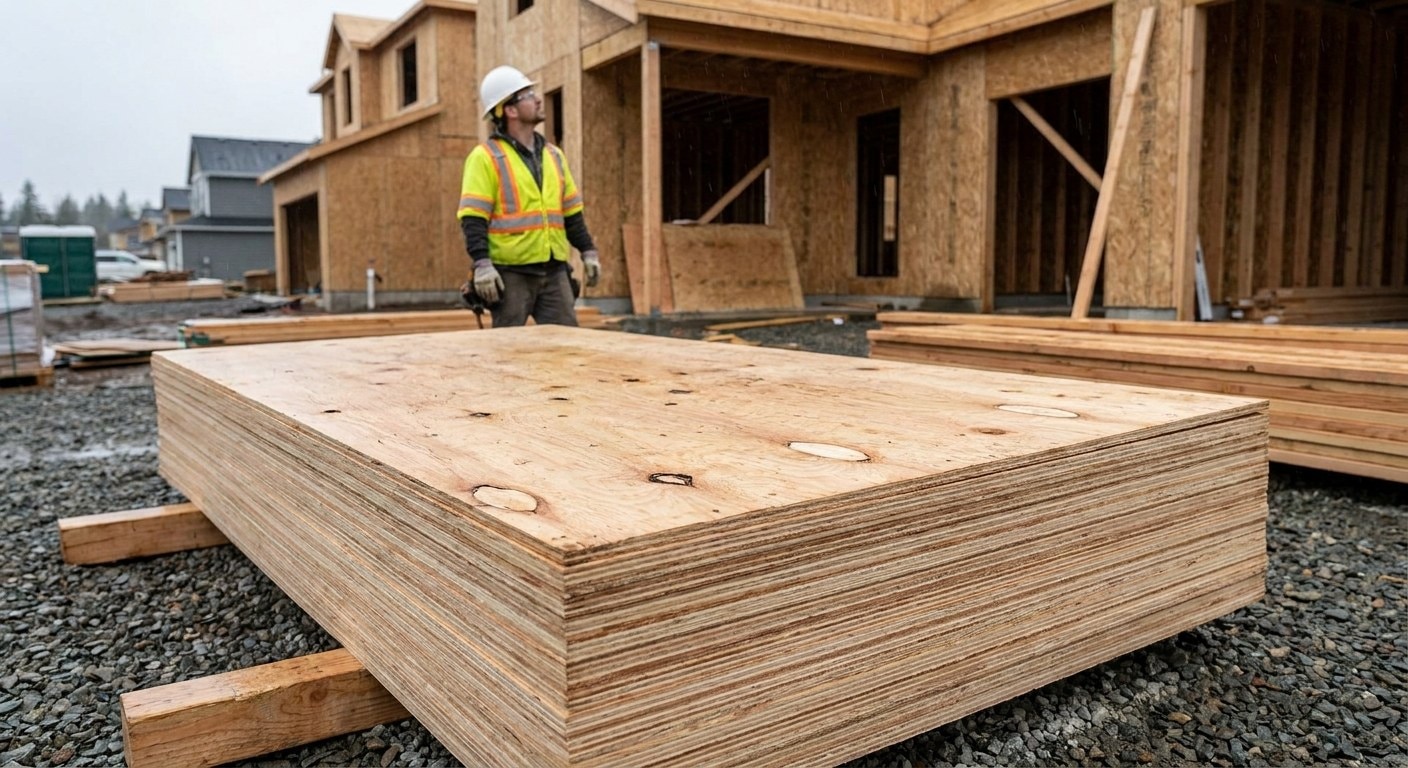
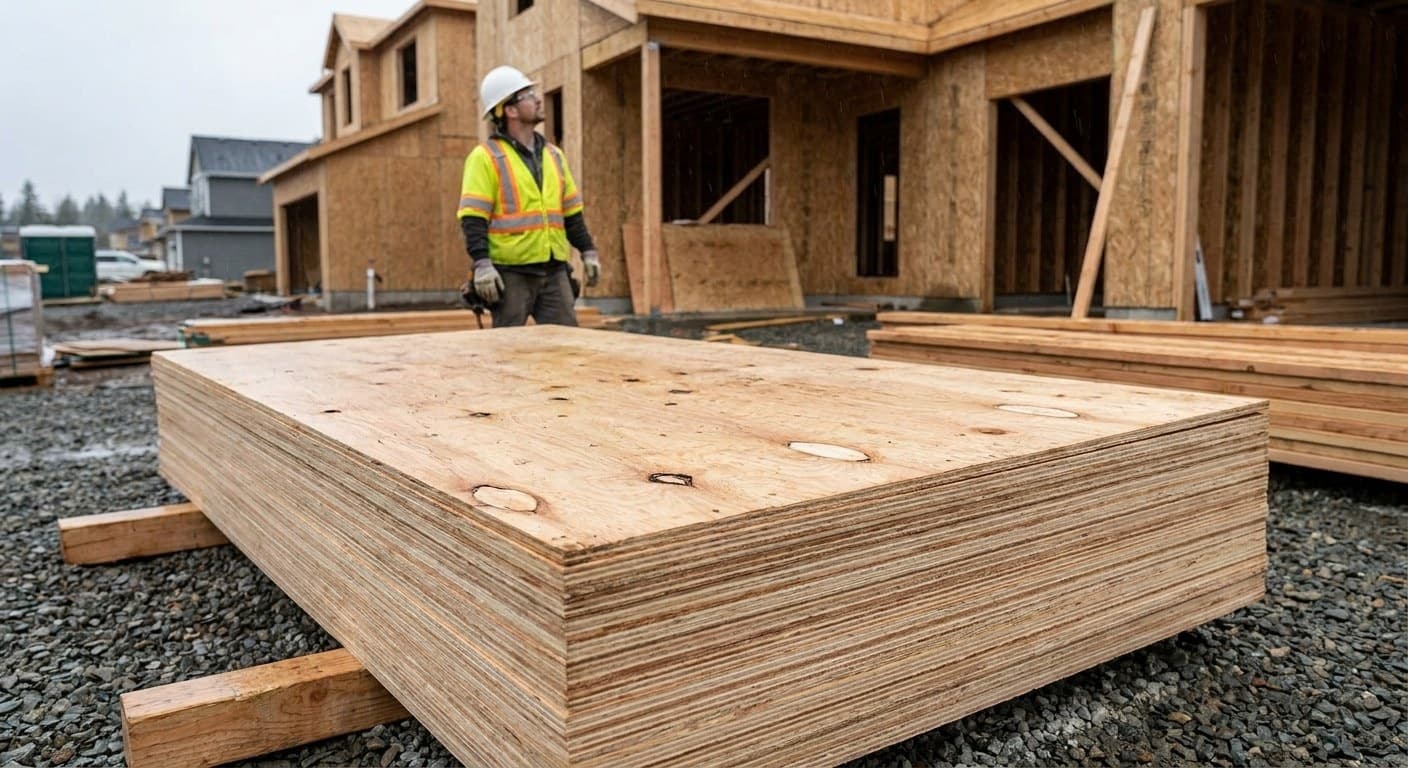
CDX plywood is North American trade shorthand for a sheathing panel with a C-grade face veneer, a D-grade back veneer and an Exposure 1 bond. The X is that bond. It's built to get through rain on an open roof deck, and it isn't an Exterior rating. None of the three letters says anything about an overlay or how many concrete pours a sheet will survive, which is why you'll see CDX on roof and wall take-offs while concrete forming specs ask for Plyform, HDO, MDO or film-faced panels instead.
Why a three-letter code still runs North American orders
Ask a US or Canadian lumberyard for "half-inch CDX" and nobody at the counter blinks. The nickname dates from the days when panels were sold by veneer grade and glue type, and it stuck. Estimators picked it up from yard staff, framers picked it up from estimators. The stamp on a modern sheathing panel reads quite differently, with a structural rating and a bond classification, yet purchase orders still say CDX.
That gap between nickname and stamp is exactly where overseas mills and first-time importers get caught out. A buyer in Ohio writes "CDX" on an RFQ and assumes it'll be read the American way. A mill that has never shipped into North America might take it as a loose quality grade and quote whatever sanded panel it has on hand. Both sides think there's a deal. The mismatch turns up weeks later, when the receiving yard looks at the stamp.
What C, D and X each tell you
The two letters come from the veneer grades in PS 1, the US product standard for structural plywood. Grades run from A, the smoothest face with neat repairs, down to D, which allows bigger knots and open defects. A C face has tight knots, a few splits and plugged repairs. Rough, but you can nail into it. D is the bottom of the scale, and APA notes that D-grade veneer is limited to panels meant for uses protected from long-term weather exposure.
The X trips people up more than anything else on the label. It stands for Exposure 1, and APA describes Exposure 1 panels, "including CDX", as resisting construction moisture while not being suitable for permanent outdoor exposure. Put simply, the glue is designed to survive a wet few weeks before the roof is closed in, then spend the rest of its life dry inside a wall or under shingles. There's more on the bond itself in our Exposure 1 explainer.
Where CDX sits in the APA grade family
You won't find "CDX" printed as such on a grade stamp. A panel the yard calls CDX will usually carry an APA Rated Sheathing mark, a span rating such as 32/16 (that pair tells a framer how far apart roof rafters and floor joists can be), a thickness or performance category, and the words Exposure 1. Span ratings come from structural testing and sit apart from the veneer letters. So two sheets can share the same C and D description and still carry different span ratings.
That's why careful buyers read the whole stamp rather than the nickname. The agency mark tells you who certified the panel and under which rule book. The bond line tells you how much wetting the glue was built for. Our grade stamp decoder walks through each field on a typical North American stamp.
The misreads that cost money
Reading X as Exterior is the classic one. Exterior is a separate, stricter classification in the APA family, aimed at long-term weather, and D-grade veneers aren't part of it. Leave CDX uncovered on a site through a whole season and you're asking it to do something it was never classified for. The face will check and the edges will swell well before the glue gives up.
The other common mistake is treating CDX as a marine or overlaid panel. Marine standards have their own rules on veneer quality and voids. Overlays like MDO, HDO or phenolic film are separate surfaces bonded onto the face, and CDX has none of them. It's an unsanded structural panel with a rough face, nothing more. European buyers shouldn't map it straight onto a WBP or EN 314-2 Class 3 claim either, which our WBP explainer goes into.
Why CDX makes a poor repeat-pour form panel
A form face has two jobs. It has to let go of cured concrete cleanly, and it has to leave a surface the engineer will accept. A rough C face with knots and plugs struggles with both. Concrete grabs the open grain, the face tears a little on every strip, and each knot and patch shows up in the finished wall. With no factory release coating and no sealed edges, the sheet also drinks water from the pour and starts to swell and delaminate at the edges.
APA's forming guidance points elsewhere. It says virtually any Exterior type APA panel can be used for formwork, recommends Plyform, the industry's purpose-made forming panel, for most general work, and lists MDO and HDO panels marked "Concrete Form" for smoother finishes. CDX is Exposure 1, so it falls outside that first sentence. Crews do sometimes knock up a buried footing form from leftover sheathing, and for one hidden pour that may be fine. It's an on-site improvisation, not a forming spec. Our concrete forming plywood guide lays out the panel families forming specs actually name.
CDX next to the panels that forming specs name
| Panel | Face | Bond | Overlay | Typical job |
|---|---|---|---|---|
| CDX (Rated Sheathing) | Rough, unsanded C face | Exposure 1 | None | Roof, wall and subfloor sheathing under a finish |
| B-B Plyform | Sanded B faces both sides | Exterior | None, mill release agent | General concrete forming |
| HDO | Hard resin-fibre overlay | Exterior | High density overlay | Smooth architectural finishes, high-reuse forms |
| MDO | Matte resin-paper overlay | Exterior | Medium density overlay | Flat, matte concrete finishes and signs |
| Film-faced | Phenolic film face | Depends on glue class | Phenolic film | Slab and wall formwork in many export markets |
We've kept the table qualitative on purpose. Reuse depends on the overlay and the release agent, and just as much on the crew and the finish the engineer will accept, so be wary of any reuse number that comes without a named test or a job record. The overlay families get fuller treatment in our HDO and MDO explainers.
What an importer should check before accepting "CDX"
Whether an imported panel comes from Vietnam or anywhere else, check the offer against the request and not against the nickname. If we could add one habit to every North American sheathing RFQ, it'd be asking for a photo of the stamp before the deposit goes out. These three questions settle most arguments before a container is loaded.
- Which agency and standard are on the stamp? A yard or code official will look for a recognised certification agency mark and a product standard such as PS 1 or PS 2. An invoice that just says "CDX" isn't the same thing.
- Is the bond Exposure 1, and who verified it? Ask how the bond classification was tested and by whom. Don't accept an EN class or "WBP" as a stand-in without checking what the receiving engineer will audit.
- Does the buyer actually need a form panel? If the end use is concrete forming, CDX is the wrong request. Steer the order toward Plyform, an overlaid panel or film-faced plywood with a stated glue class.
Vinawood's mill blog has a separate, uses-focused piece on CDX plywood and where it's commonly installed, which covers the job-site side of the panel in more detail than this reference page.
Frequently asked
What does CDX stand for on plywood?
CDX describes a sheathing panel with a C-grade face veneer, a D-grade back veneer and an Exposure 1 bond, which is the X. The letters come from veneer grading and glue durability, not from strength testing. CDX is a lumberyard nickname, so the stamp itself will usually show a panel grade, a span rating and the words Exposure 1.
Does the X in CDX mean exterior?
No. The X stands for Exposure 1, a bond classification for panels that need to resist moisture during construction but are not meant for permanent outdoor exposure. Exterior is a separate, stricter classification in the APA family, and D-grade veneers are limited to panels protected from long-term weather.
Can CDX plywood be used for concrete forms?
It can be used for a rough, one-off form that will be buried, but it is a poor choice for repeat pours or any visible concrete. The rough C face has no overlay or release coating, so it sticks to concrete and prints knots and patches into the surface. APA guidance points forming work toward Exterior panels such as Plyform or overlaid MDO and HDO panels marked for concrete form use.
Is CDX the same as Exposure 1 plywood?
CDX is one kind of Exposure 1 plywood, not a synonym for the whole class. Exposure 1 describes the bond, and many panels with different face grades, thicknesses and span ratings carry it. CDX adds the C face and D back to that bond description.
What should an importer check when a North American quote asks for CDX?
Check that the offered panel carries a recognised agency stamp with a product standard such as PS 1 or PS 2, an Exposure 1 bond with test evidence and the span rating the buyer needs. A mill invoice that only says CDX is not enough. If the buyer actually plans to form concrete, steer the order to a forming panel instead.
Related in the atlas
Continue reading
Same topic first, then what others on the atlas read most.
Standards
Plywood Exposure 1 Explained: APA Moisture Durability vs Exterior
Exposure 1 plywood is an APA bond/moisture-durability class for construction delays—not Exterior long-term weather, not a face grade, and not a waterproof claim.
Compliance
EUDR Evidence Pack for Vietnamese Plantation Plywood
A plain-language reference on how a compliant EUDR evidence pack for Vietnamese plantation plywood typically works: Article 9 data, Circular 26/2022 origin dossiers, smallholder land tenure, the money trail without a seller e-invoice, and why the mill pack is not the DDS.
Grades
Plywood Standards Cross-Reference Matrix (EN, BS, IS, JAS, AS/NZS, ASTM)
A side-by-side reference that lines up plywood bond, durability and formaldehyde classes across EN, BS 1088, IS 710/303, JAS, AS/NZS and US PS 1, so a foreign spec can be translated into what a Vietnamese mill can build and certify.
Overview
The Vietnam Plywood Industry: A Complete Overview
A plain-English overview of Vietnam's plywood industry: its scale and growth, the plantation species base, the main export product types, certification, and where Vietnam sits among global plywood origins.