
Guides/Import
Incoterms and Container Loading for Vietnam Plywood
How to choose FOB, CIF, CFR, EXW or DAP when buying plywood from Vietnam, plus how container yield works: CBM, weight limits, panels per 20ft/40ft.
For most plywood orders leaving Vietnam, the choice comes down to how much of the shipping chain you want the mill to handle. FOB Hai Phong or FOB Ho Chi Minh City is the common default: the mill delivers the loaded container onto the vessel and clears export, and you own the ocean freight and everything past the Vietnamese port. The rest of this page walks through when a different Incoterm makes sense, and how to read container yield so a quote in cubic metres turns into a real number of panels per box.
Which Incoterm should you use when buying plywood from Vietnam?
Incoterms 2020, published by the International Chamber of Commerce, are the rulebook that says where the seller's job ends and yours begins. Five come up again and again on Vietnamese plywood contracts. FOB, CFR and CIF are sea-freight rules written for containerised cargo out of Hai Phong and the Ho Chi Minh City terminals. EXW and DAP sit at the two extremes, one leaving almost everything to you, the other leaving almost nothing.
| Rule | Export clearance | Ocean freight paid by | Marine insurance | Risk passes to buyer |
|---|---|---|---|---|
| EXW (Ex Works) | Buyer | Buyer | Buyer | At the mill gate |
| FOB (Free on Board) | Seller | Buyer | Buyer | Once loaded on the vessel |
| CFR (Cost and Freight) | Seller | Seller | Buyer | Once loaded on the vessel |
| CIF (Cost, Insurance and Freight) | Seller | Seller | Seller (minimum cover) | Once loaded on the vessel |
| DAP (Delivered at Place) | Seller | Seller | Buyer | At your named destination, before unloading |
Read the risk column carefully. Under CFR and CIF the mill pays the freight, but risk still passes to you the moment the panels are on board in Vietnam. If a box goes over the side mid-ocean on a CIF contract, you are claiming against the insurance, not the mill.
What each rule changes for a plywood buyer
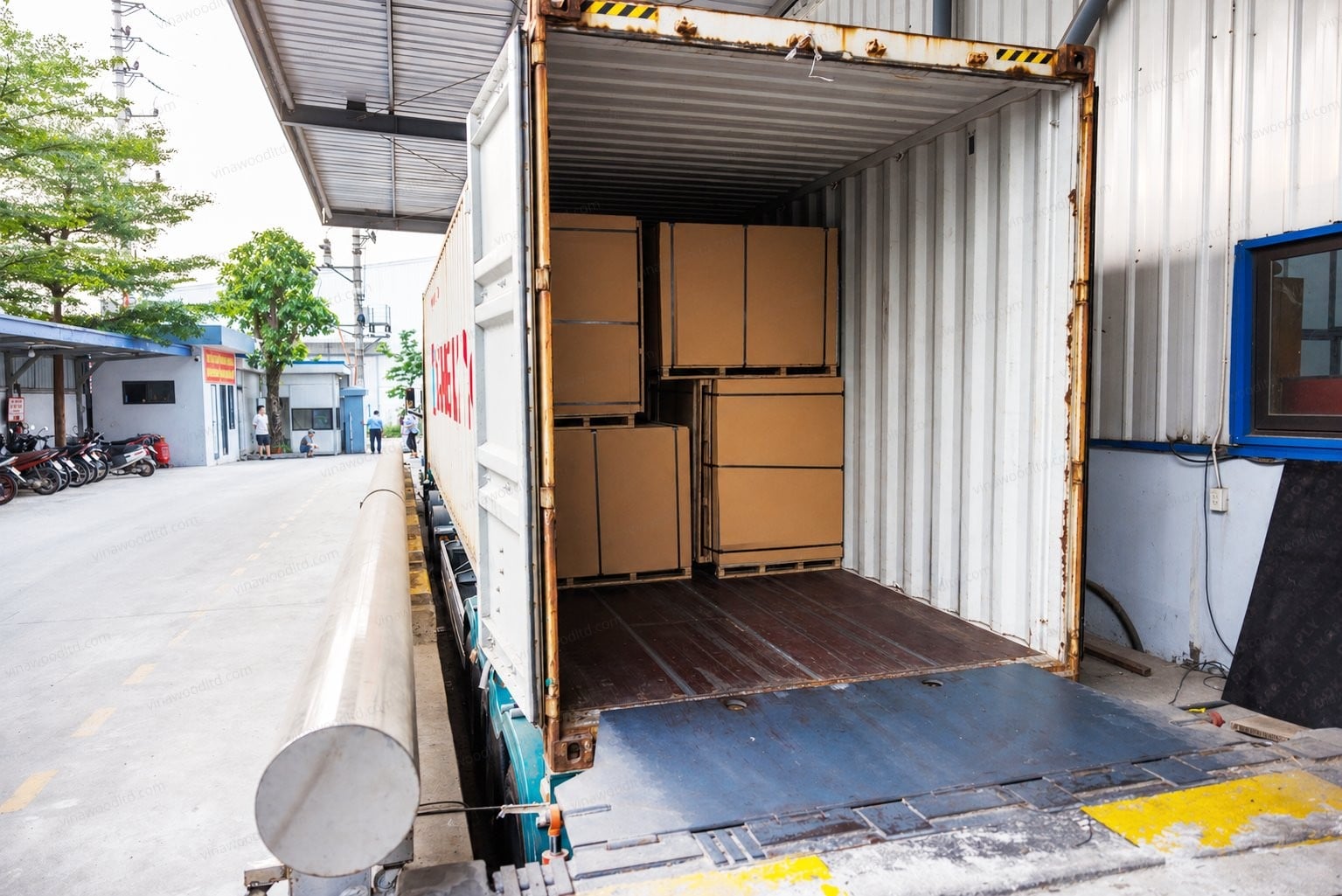
EXW puts the container collection, Vietnamese export paperwork and port haulage on you or your forwarder. It reads cheap on the invoice because none of that is priced in. Unless you have a strong agent on the ground in Vietnam, it usually costs more than it looks.
FOB is the workhorse. The mill loads and clears; you book the ocean leg with a carrier or forwarder you trust and control the freight rate yourself. That last part matters when ocean rates swing, which they do. Most buyers who ship more than a few containers a year settle here.
CFR and CIF hand the freight booking back to the mill. Handy for a first order or a buyer without a freight desk. The trade-off is that you lose visibility on the rate and the routing, and on CIF the seller only has to buy minimum cover, which is thin for a full container of panels. Many importers upgrade the policy on their own account.
DAP is the far end: the mill arranges everything to your yard or warehouse and you handle only import customs and duty at your side. Simple to receive, but you are trusting the seller's forwarder for the whole chain, and the price folds in margins you cannot see. It suits smaller or one-off buyers more than regular importers.
Does plywood cube out or weight out in a container?
This is the yield question that trips up first-time buyers, and the answer is different for a 20ft and a 40ft. Plywood is dense. Vietnamese plantation species run roughly 580 kg/m³ for acacia, 650 for eucalyptus, 700 for rubberwood (hevea) and about 500 for styrax. Treat those as planning values and confirm the real figure on the mill certificate, since core mix and glue line change the number. A single 18 mm sheet at 1220 × 2440 mm (4 × 8 ft) lands near 30 to 34 kg.
Now put that against the box. A 40ft or 40HC caps out around 26.5 tonnes of payload. Fill either one solid with plywood and the wood would weigh far more than that long before you run out of space, so a 40-footer weights out: you hit the tonnage limit with the container maybe two-thirds full. A 20ft is the opposite. It carries a similar payload ceiling but holds only about 33 CBM, so you run out of room before you run out of weight. A 20ft cubes out.
| Container | Internal volume (approx) | Max payload (approx) | Plywood usually limited by |
|---|---|---|---|
| 20ft standard | 33 CBM | 28,000 kg | Volume (cubes out) |
| 40ft standard | 67 CBM | 26,500 kg | Weight (weights out) |
| 40ft high cube (40HC) | 76 CBM | 26,330 kg | Weight (weights out) |
The practical upshot: for panels, the extra head height of a 40HC over a plain 40ft buys you almost nothing, because you were never going to fill that space anyway. You reach the weight ceiling first. Order thinner stock and the load gets lighter per cubic metre, so a thin-panel order can start to cube out even on a 40ft. Confirm every load against tonnage, not just volume.
How many panels fit in a container?
Because plywood weights out, the panel count on a 40ft is set by tonnage divided by sheet weight, not by how many sheets geometrically fit. Take 18 mm sheets near 32 kg each against roughly 26.5 tonnes of payload and you are in the region of 800 to 830 panels before you hit the limit. Thicker stock means fewer, heavier sheets; thinner stock means more, lighter ones, up to the point where the box cubes out instead. Species matters too, since a rubberwood-core panel weighs more than the same sheet in styrax.
These are planning figures for a rough count and a first sanity check on a quote, not a loading plan. Run your own thickness, panel size and species through the CBM and container-loading calculators on vinawoodltd.com/tools to get the yield for your exact order, rather than working it by hand here. The mill's packing list is the number that binds.
Does it matter whether you load in Hai Phong or Ho Chi Minh City?
Where your order loads follows where it is made. Northern mills in the Hai Duong, Bac Ninh and Bac Giang belt feed Hai Phong, Vietnam's main northern gateway. Southern and central production moves through the Ho Chi Minh City terminals, mainly Cat Lai. On an FOB contract that load port is part of the term itself, written as FOB Hai Phong or FOB Ho Chi Minh City, and it sets which inland trucking and terminal charges sit inside the mill's price.
For you as the buyer the port mostly changes sailing schedules, transit time and the carriers that call there, so it is worth confirming which port a mill ships from before you compare two FOB quotes as if they were identical. The panels themselves do not change. For where these mills sit and what each region tends to make, see the manufacturing-regions guide below.
Related guides
Frequently asked
What is the best Incoterm for importing plywood from Vietnam?
For most regular importers, FOB Hai Phong or FOB Ho Chi Minh City works best. The mill loads the container and clears export, while you book and control the ocean freight. CFR or CIF suits a first order or a buyer without a freight desk, since the mill arranges the sea leg, though you lose control of the rate and on CIF the seller only buys minimum insurance cover.
Does plywood cube out or weight out in a shipping container?
It depends on the container. A 40ft or 40HC weights out: plywood is dense enough that you hit the roughly 26.5-tonne payload limit with the box only about two-thirds full. A 20ft cubes out: it holds only around 33 CBM, so you run out of space before you reach the weight ceiling. Always confirm a load by tonnage, not volume alone.
How many sheets of plywood fit in a 40ft container?
Because a 40ft weights out, the count is set by payload divided by sheet weight. With 18 mm sheets near 32 kg each against about 26.5 tonnes, you are in the region of 800 to 830 panels. Thicker or denser stock lowers that number; thinner stock raises it until the container cubes out instead. Use the mill's packing list as the binding figure.
Is a 40HC better than a 40ft for shipping plywood?
For panels, not usually. The extra head height of a high cube adds volume you cannot use, because a plywood load reaches its weight limit long before it fills the space. Both a 40ft and a 40HC carry a similar payload ceiling near 26.5 tonnes, so the high cube rarely lets you load more plywood by weight.
What is the difference between CFR and CIF for a plywood shipment?
Under both rules the mill pays the ocean freight and risk passes to you once the panels are on board in Vietnam. The difference is insurance: CIF requires the seller to arrange marine cover, though only at the minimum level, while CFR leaves insurance entirely to you. Many buyers on CIF still upgrade the policy on their own account for a full container of panels.
Related in the atlas
Continue reading
Same topic first, then what others on the atlas read most.
Import
Importing plywood from Vietnam
The end-to-end importer's guide to sourcing plywood from Vietnam: vet a mill, lock the spec, agree Incoterms, watch QC, assemble the legality file, then load and clear the container.

Import
Vietnam Plywood HS Codes: The HS 4412 Breakdown
How Vietnam-origin plywood classifies across the HS 4412 subheadings by construction, ply thickness, and face species, and the import documentation each code triggers.
Import
How to Qualify a Vietnamese Plywood Manufacturer
A practical framework for vetting a Vietnamese plywood manufacturer: verifying real capacity, QC-lab test evidence, certificates tied to the actual mill, and the red flags that signal transshipment.
Import
Vietnam Plywood Lead Times, MOQ and Payment Terms
What normal looks like when sourcing plywood from Vietnam: one-container MOQs, a few weeks of production plus sea transit, and TT-deposit or letter-of-credit payment terms.