
Guides/Markets
Where Vietnam's Plywood Ships: Export Markets Overview
Where Vietnam's plywood (HS 4412) actually goes: Korea, US, Malaysia, Japan and beyond, with rough shares, trends and what the mix means for buyers.
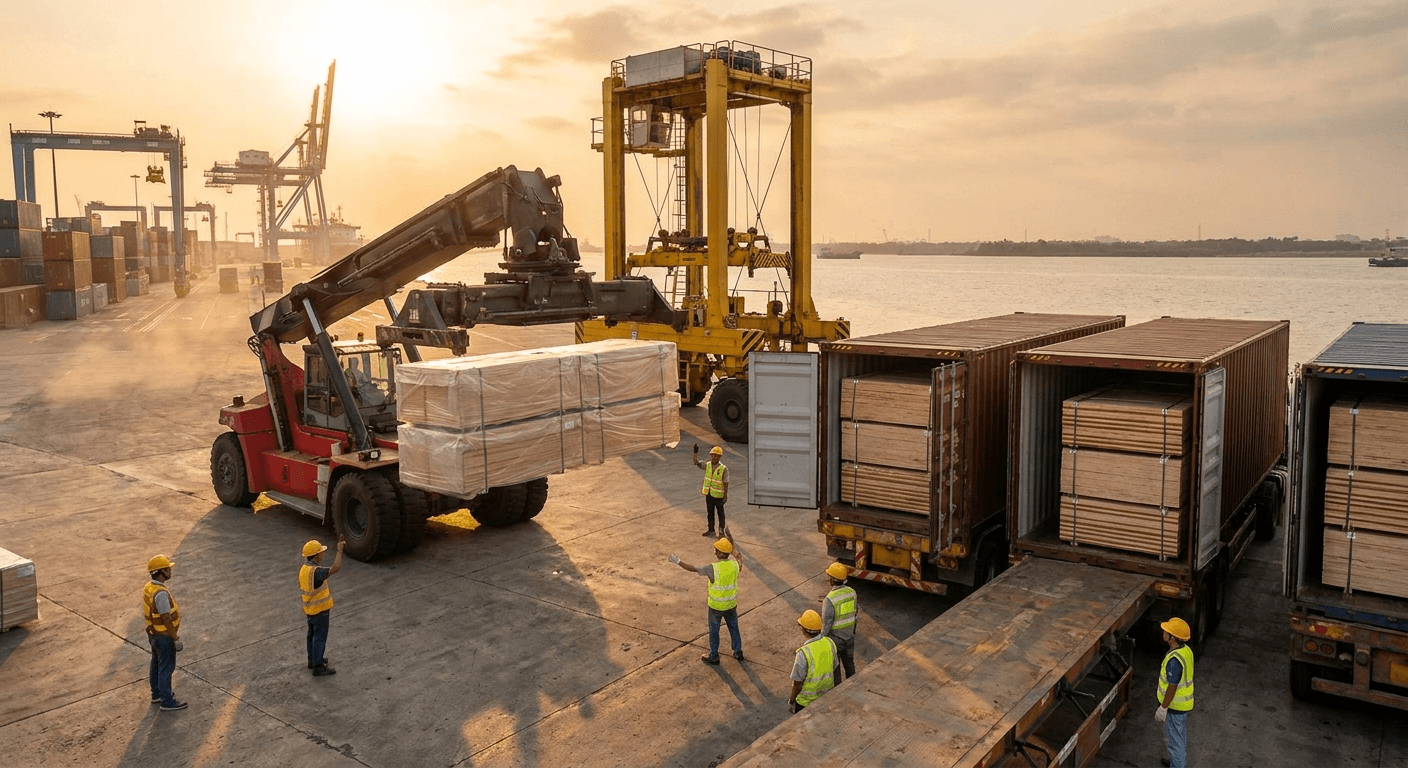
Most of Vietnam's plywood goes to four markets: South Korea, the United States, Malaysia, and Japan. Those four took close to three-quarters of export volume in the first half of 2024, and everything else spreads thin across more than 70 other countries. For a buyer, that concentration is worth knowing. It shapes how much competition you face for mill capacity, and how exposed a given supplier is to one market's policy swings.
Vietnam shipped roughly US$1.1 billion of plywood (HS 4412) in 2022, and industry estimates put 2025 near US$1.4 billion. That makes it the world's fifth-largest plywood exporter, behind China, Indonesia, Russia, and Brazil. The mills reach 77 destinations. The money is lopsided.
Where does Vietnam's plywood actually go?
The table below uses first-half 2024 figures compiled from International Trade Centre and VIFOREST data, the most granular public breakdown available. Shares shift quarter to quarter, so treat them as directional rather than fixed.
| Market | Rough share & recent trend | Note for buyers |
|---|---|---|
| South Korea | ~22% by value, ~27% by volume (largest by volume). Steady growth. | High-volume commercial and packing grades. Price-sensitive. KS mark expected. |
| United States | ~30% by value, ~19% by volume (largest by value). Volume up ~29% YoY in H1 2024. | Higher-grade structural and underlayment panels. Hardwood plywood faces US trade scrutiny (see below). |
| Malaysia | ~14% by value, ~17% by volume. Growing. | Regional processing and re-export hub. Often intermediate rather than final demand. |
| Japan | ~8% by value, ~9% by volume. Steady. | Coated concrete-form panels and structural use. JAS/JIS documentation matters. |
| EU | Small share, strong growth in 2025. | Green-certified demand. CE marking (EN 13986), FSC/PEFC, and EUDR readiness gate entry. |
| UK | Small. Steady. | UKCA conformity post-Brexit; overlaps heavily with EU-grade documentation. |
| Australia & others | Long tail across 70+ countries. | Structural (AS/NZS), Middle East formwork, scattered distributor demand. |
Read the value and volume columns side by side and the picture sharpens. Korea buys the most cubic metres but pays less per sheet, because it leans on commercial and packing grades. The US buys fewer cubic metres but spends more, because it takes higher-specification panels. Same country, different position on the price ladder.
Why doesn't this match Vietnam's overall wood exports?
You will see headlines saying the US takes 55% of Vietnam's wood exports. That number is real, but it describes the whole US$17 billion wood sector, which furniture dominates. Plywood is a different product with a different map. For plywood specifically, Korea and Malaysia loom far larger than they do in the furniture-heavy top line, and the US share drops well below that 55% figure. If you are sizing plywood supply, use plywood data, not the sector average. Mixing the two overstates how much US demand competes for the exact panels you want.
Which destinations are growing, and what does it mean for supply?
US-bound volume rose about 29% year on year in the first half of 2024, which is the kind of swing that tightens lead times across the board when it hits. Korea has grown at a steadier single-digit pace. Malaysia keeps climbing. The most interesting shift is Europe: Vietnam Briefing, citing VIFOREST and Vietnam Customs, reported some EU wood-product import values up more than 60% in 2025 as green-certified demand picked up.
For a buyer, growth cuts both ways. A market pulling hard on Vietnamese capacity means more competition for the same production slots. It also means the supplier base is healthy and investing. The mills selling into Europe and Japan tend to run tighter certification and documentation, since those markets demand it, and that discipline usually shows up in the product.
What should a buyer read into the US anti-dumping picture?
Vietnam-origin plywood is not uniformly duty-free into the US, and the detail matters. In July 2023 the US Department of Commerce issued a final circumvention determination: certain hardwood and decorative plywood assembled in Vietnam from Chinese-origin veneers or cores was found to circumvent the existing antidumping and countervailing duty orders on China, and is subject to those duties. Plywood made from genuine Vietnamese-origin veneers falls outside that finding. The order targets hardwood and decorative plywood; it is not a blanket ruling on softwood structural or film-faced formwork panels.
The practical takeaway: origin of the veneer, not just the country of assembly, drives US duty exposure on hardwood grades. Ask any supplier for input-origin documentation and a chain-of-custody trail. Vinawood, for example, publishes its certification set (EPA TSCA Title VI / CARB P2 for the US, CE for Europe, KS for Korea) on its market pages, which is the level of paperwork a compliance-minded buyer should expect.
How concentrated is the demand, and does that threaten supply stability?
Concentration is the real story for anyone assessing supply. Four markets absorbing roughly three-quarters of volume means Vietnamese capacity broadly tracks Korean and US demand. When one of those spikes, as US orders did in early 2024, slots fill and lead times stretch. A mill whose order book is spread across Korea, Japan, the EU, and Australia is less whipsawed by any single buyer than one riding a single market. When you qualify a supplier, ask where its book actually sits. A diversified destination mix is a quiet signal of resilience, and it tells you how many other buyers are chasing the same containers you are.
Related guides
Frequently asked
What is Vietnam's largest plywood export market?
It depends how you measure. By volume, South Korea is the largest single destination, taking roughly a quarter of Vietnamese plywood cubic metres. By value, the United States leads, because it buys higher-specification grades. Malaysia and Japan follow. Together these four took close to three-quarters of export volume in the first half of 2024.
How much plywood does Vietnam export?
Vietnam exported roughly US$1.1 billion of plywood (HS 4412) in 2022, and industry estimates put 2025 near US$1.4 billion. That makes it the world's fifth-largest plywood exporter, behind China, Indonesia, Russia, and Brazil, shipping to about 77 countries.
Is Vietnamese plywood subject to US anti-dumping duties?
Not uniformly. A July 2023 US Commerce determination found that certain hardwood and decorative plywood assembled in Vietnam from Chinese-origin veneers or cores circumvents the antidumping and countervailing duty orders on China and is subject to those duties. Plywood made from genuine Vietnamese-origin veneers falls outside that finding. Veneer origin, not just assembly country, drives duty exposure on hardwood grades.
Why does the plywood market mix differ from Vietnam's overall wood exports?
The often-quoted 55% US share covers Vietnam's whole wood sector, which furniture dominates. Plywood is a different product. For plywood specifically, Korea and Malaysia are much larger destinations and the US share is lower than the sector average. Use plywood-specific data when sizing supply.
How does export concentration affect plywood supply stability?
With four markets absorbing about three-quarters of volume, Vietnamese capacity broadly tracks Korean and US demand. A spike in one market, as US orders showed in early 2024, tightens lead times. A supplier whose order book spreads across several regions is less exposed to any single market's swings, which is worth checking during qualification.
Related in the atlas
Continue reading
Same topic first, then what others on the atlas read most.
Markets
Vietnam vs China Plywood: An Origin Comparison
An even-handed, origin-level comparison of Vietnam and China plywood across forestry base, scale, quality, certification, and the US antidumping duties that reshaped sourcing after 2018.
Markets
North America buyer path
Contractors and wholesalers: when to buy local stock via OnePly vs when a mill program with Vinawood makes sense.
Markets
Vietnam vs Indonesia and Malaysia Plywood
An even-handed comparison of the three main Southeast Asian plywood origins on species base, timber-legality systems, mill capacity and market positioning.
Compliance
EUDR Evidence Pack for Vietnamese Plantation Plywood
A plain-language reference on how a compliant EUDR evidence pack for Vietnamese plantation plywood typically works: Article 9 data, Circular 26/2022 origin dossiers, smallholder land tenure, the money trail without a seller e-invoice, and why the mill pack is not the DDS.