
Guides/Industry Education
Fire-Rated Plywood Explained: Flame Spread, FRT Treatment and Why Panels Are Not Fireproof
What fire-rated plywood really means: ASTM E84 Class A/B/C flame spread, FRT treated panels, rated assemblies, Euroclass, and the paperwork importers need.
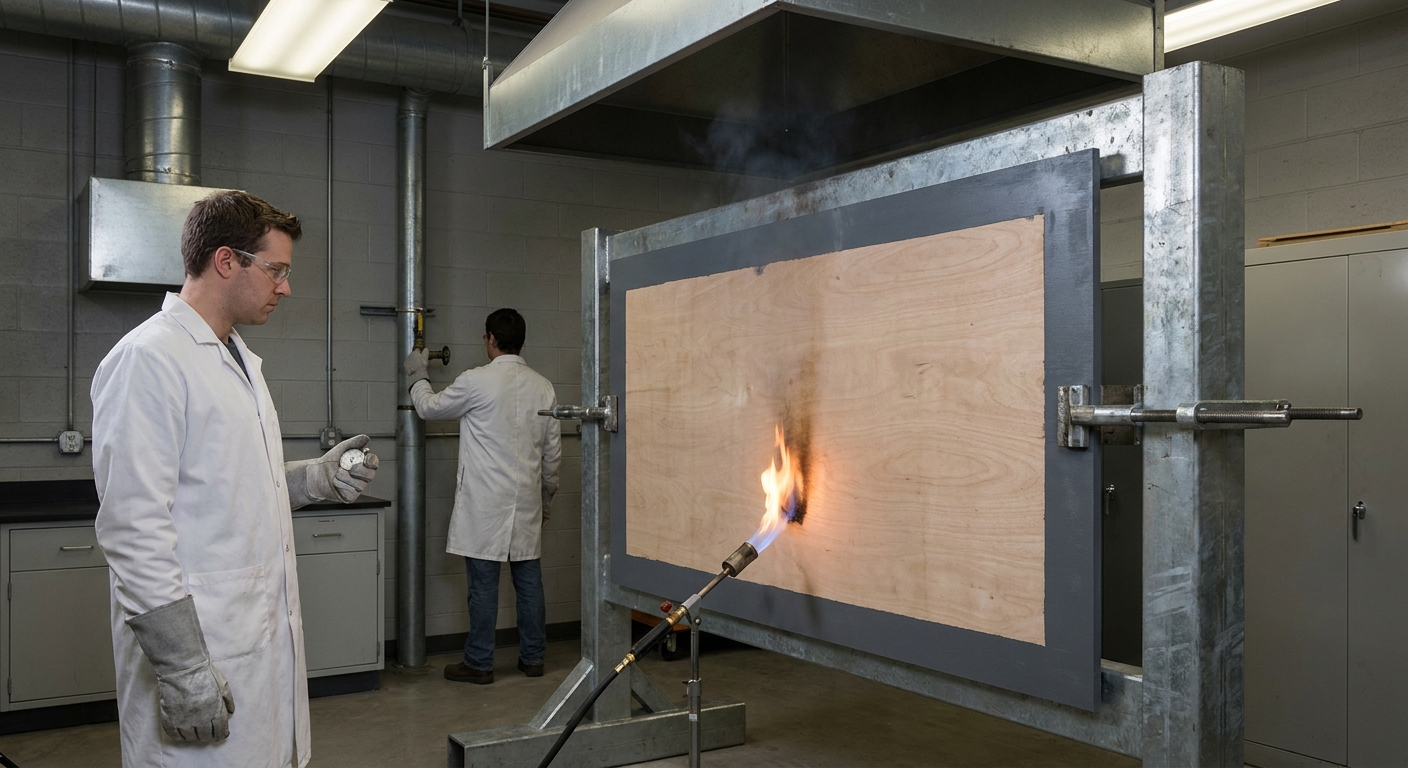
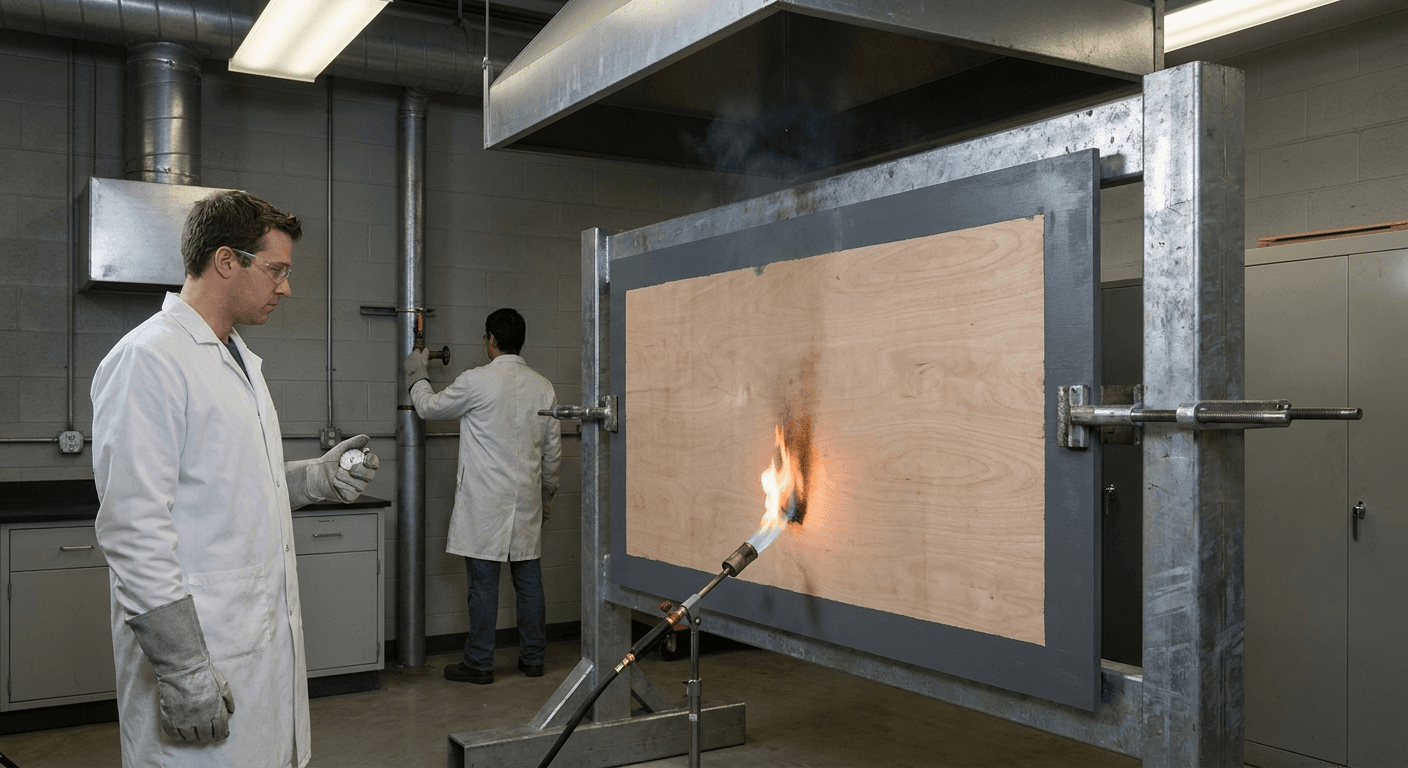
The fire question tends to show up late. The plywood's been priced, the container's booked, and then somebody on the project, often the fire engineer and sometimes the inspector, asks whether the panels are "fire rated." On one job that means Class A wall finish. On another it means treated roof sheathing. Every so often it means a one-hour wall, and someone assumes the plywood has to carry the hour by itself. Those aren't the same request, and answering the wrong one is how a perfectly decent shipment fails an inspection.
Search results blur all of this together, and so do a lot of sales sheets. So we're going to pull the phrase apart. The North American system comes first, since most of the vocabulary started there. After that there's a short detour through Europe and India, and then the documents an importer can actually ask for. And one thing up front, because it saves arguments later: no plywood is fireproof. Wood burns. Every rating below is about how slowly it burns, or how predictably.
Three different questions hiding inside one phrase
When fire and plywood turn up on the same line of a spec, the writer usually wants one of three things, and they need different answers. The first is about the face of the sheet. How quickly does flame run across it? That matters for walls and ceilings people pass on the way out of a building. The second is whether the wood's been chemically treated so it does better than plain wood in that same test. The third has nothing to do with a single sheet at all. It's about how long a finished wall or floor can hold a fire back, and it's counted in minutes or hours.
| What the spec is really asking | Typical wording | How it is measured (US) | Who it belongs to |
|---|---|---|---|
| Surface flame spread | "Class A / B / C interior finish" | ASTM E84 or UL 723 tunnel test, flame spread index | The panel surface as tested |
| Fire-retardant treatment | "FRT plywood", "fire-retardant-treated wood" | Extended ASTM E84 test plus treating and labelling rules in the building code | The treated panel and its treater |
| Fire resistance in time | "1-hour rated wall", "2-hour floor" | ASTM E119 furnace test of a full assembly | The whole build-up: studs, gypsum, insulation, sheathing |
It's worth keeping that table handy. A buyer asking for Class A finish might genuinely need treated plywood. A buyer asking for a one-hour wall might be fine with ordinary sheathing, as long as the right gypsum goes on in front of it. Same two words, very different orders.
How a 25-foot tunnel sorts panels into classes
US flame spread classes come out of a long, low furnace written up in ASTM E84 (UL 723 is Underwriters Laboratories' twin of it). The American Wood Council's DCA 1 guide gives the size: about 25 feet long, a bit under 18 inches wide, a foot high, with gas burners at one end. The sample is fixed as the tunnel's ceiling. For ten minutes, flame gets pushed along it under steady airflow, and how far and how fast the flame front travels becomes the flame spread index. Red oak flooring is the yardstick at 100. Fiber cement board sits at 0.
The building code turns that number into a letter. Under the International Building Code, Class A is an index from 0 to 25, Class B goes up to 75, and Class C goes up to 200. The same run also gives a smoke-developed index, and interior finishes generally have to stay at 450 or below. Then the code says which class goes where. In AWC's example for business and retail buildings without sprinklers, exit stairs need Class A and exit corridors need Class B, while ordinary rooms accept Class C. So a sheet that's fine in an office can be wrong for the stairwell next to it.
Moisture plays a bigger part than people expect. Samples are conditioned at roughly 73°F and 50% humidity before the burn, so the result describes a panel at normal indoor moisture rather than one that's just come out of a damp container. Small detail. It's also why a decent test report always tells you how the samples were conditioned.
Where ordinary plywood lands, and why the species matters
Untreated plywood doesn't have one fire number. APA's technical topic on flame spread says its trademarked wood structural panels, tested in 2016, came in with flame spread indices between 35 and 110 and smoke figures between 50 and 175. Put that against the code bands and you're in Class B or Class C. AWC says much the same, just more bluntly: lumber, plywood and other wood-based materials typically fall into Class B or C.
The DCA 1 tables are where it gets useful for importers. Douglas-fir plywood at 23/32 inch is listed at 35, which is Class B. Southern pine plywood at 15/32 inch is listed at 95, so Class C. Most of the hardwood plywood rows (birch, maple and mahogany faces over all sorts of cores) end up in Class C. Face species moves the result, and so does the core, which is why AWC notes that the way the plies are arranged can change surface flame spread.
And here's the gap nobody likes to mention. Those published tables cover North American softwoods and familiar hardwood faces. You won't find plantation-grown acacia or eucalyptus plywood from Vietnam in them, and borrowing a Douglas-fir result for a different panel isn't honest. If a project needs a flame spread class for imported hardwood plywood, what it needs is a test report on that product, at that thickness. "Probably Class C" is a guess.
What pressure treatment changes, and what it leaves alone
Fire-retardant-treated plywood, almost always shortened to FRT, is regular plywood that's been forced full of fire-retardant chemicals under pressure. APA's technical note K320 sets out why anyone bothers. Because FRT plywood has low flame spread and smoke development, codes let it go into some places where untreated wood isn't allowed, including uses in building types that would otherwise call for noncombustible materials. Roughly speaking, the chemicals change how wood chars and gives off flammable gas as it heats up, and that slows the flame.
The code sets a tougher test for the FRT label than for a plain Class A finish. To count as fire-retardant-treated wood, a product has to score 25 or less in a version of the E84 test that runs 30 minutes instead of ten, and the flame isn't allowed to creep past a set distance during that time. A coating brushed on afterwards is something else. AWC says coated products that reach Class A must be evaluated as a system, and the code doesn't treat them as FRT wood.
Treatment has costs the fire result won't show you. K320 has sections on fasteners for FRT plywood and on the design capacity of treated wood, because some treatments knock down strength, particularly where panels run hot, as roof sheathing does. Interior and exterior FRT aren't interchangeable either, since some formulations pull in moisture and shouldn't sit out in the weather. We'd put this at the top of the list, honestly, because it's the part importers skip and the first thing an engineer asks about. Those adjustments come from the treater's literature, not the plywood mill's brochure.
Even after all that, codes still call FRT wood combustible. It burns slower and more predictably, which is the whole point. It isn't fireproof, and a supplier who says otherwise is overselling.
Hours belong to walls and floors, not to sheets
A one-hour or two-hour rating comes from a completely different test. Under ASTM E119, a whole assembly goes into a furnace that follows a standard time and temperature curve. It keeps its rating for as long as it keeps carrying load and stops heat and flame from getting through to the far side. The assembly earns the rating, not any one layer. In a typical rated wood-frame wall the gypsum board does most of the protecting, with the studs and sheathing behind it doing their share.
APA's overview of fire-rated systems and AWC's DCA 3 both describe tested walls, floors and roofs that include wood structural panels, and in plenty of them ordinary untreated plywood is a listed part. The catch is that the rating only holds if you build it exactly as listed. Swap the gypsum type or the panel thickness and you may have voided it. So when a drawing calls for a rated wall, ask which listed assembly the designer used and what panel it names. Asking whether "the plywood is one-hour rated" won't get you a useful answer.
Europe and India measure fire differently
In Europe and the UK, reaction to fire is described with Euroclasses under EN 13501-1. They run from A1 down to F, with extra codes for smoke (s1 to s3) and for flaming droplets (d0 to d2). The tests aren't the same as ASTM E84, so a US Class A doesn't map onto a particular Euroclass and it doesn't work the other way round either. Wood-based panels sold under the harmonised standard EN 13986 declare their class on the Declaration of Performance, and untreated plywood is commonly declared at Euroclass D. Anything better takes treatment and its own testing.
India has its own specification for this, IS 5509, covering fire-retardant plywood. The Bureau of Indian Standards describes it as plywood made to IS 303 and then treated with listed chemicals, and it checks things like flammability and rate of burning. Comparing an IS 5509 panel with a US FRT panel means comparing two separate test families. Read each against its own market's rules.
The paper trail an importer should ask for
Once the spec says which of the three questions it's asking, the paperwork mostly sorts itself out. For a flame spread class, get the ASTM E84 or UL 723 report for the same species mix and thickness you're buying, and look at the conditioning and the date. For FRT plywood, ask for the treating company's label with its third-party inspection mark, the treater's published design-value adjustments, and a clear line on whether it's an interior or exterior treatment. For a rated assembly, get the listed assembly number from the designer. Then match the panel to it.
Fire paperwork travels with the rest of a shipment's documents. It doesn't replace any of them. Formaldehyde under TSCA Title VI is its own obligation, and structural identity under PS 1 or PS 2 is another one, covered in structural plywood explained. If you want the bigger picture of which certificates each destination expects, there's certification requirements by destination. And to check that a lab report actually belongs to your product, read the guide on reading a plywood test certificate.
Vinawood's mill blog, which sits alongside this atlas, has a buyer-side companion on fire-rated plywood written from the purchasing desk. This page is the standards map. Whichever you start with, put the actual fire requirement in the RFQ before anyone talks price, because "fire rated" on its own isn't a spec.
Frequently asked
What does fire-rated plywood mean?
It usually means one of three different things, so the first job is to find out which one the spec wants. It can mean a flame spread class from the ASTM E84 tunnel test, fire-retardant-treated (FRT) plywood, or a wall or floor assembly rated in hours. Each is tested differently and calls for different paperwork.
Is plywood fireproof?
No. All plywood is wood and will burn, including fire-retardant-treated plywood, which building codes still classify as combustible. Ratings describe how slowly or predictably a panel or assembly burns, not whether it burns at all.
What is FRT plywood?
FRT plywood is plywood impregnated with fire-retardant chemicals under pressure so that it spreads flame much more slowly. Under the International Building Code it has to reach a flame spread index of 25 or less in an extended 30-minute ASTM E84 test. Treatment can affect strength and fastener choice, so the treater's design adjustments and labels matter as much as the fire result.
What flame-spread class is regular plywood?
Untreated plywood typically falls into Class B or Class C under the IBC. APA reports flame spread indices of 35 to 110 for its trademarked structural panels, and AWC's DCA 1 tables put most hardwood plywood in Class C. Species, thickness and core all move the result, so imported panels need their own test report.
Is a one-hour fire rating about the plywood sheet or the wall assembly?
It is about the assembly. ASTM E119 tests a complete wall, floor or roof build-up, and the rating only holds if that listed assembly is built exactly as described. Plywood is often one listed component, but the sheet on its own does not carry an hour rating.
What paperwork should an importer ask for on fire-retardant plywood?
Ask for the treating company's label with its third-party inspection mark, the ASTM E84 report for the treated product, and the treater's published design-value and fastener guidance. Confirm whether the treatment is an interior or exterior type. Keep those separate from formaldehyde and structural certificates, which answer different questions.
Related in the atlas
Continue reading
Same topic first, then what others on the atlas read most.
Industry Education
Form Release Agents Explained: How Release Chemistry Meets the Plywood Form Face
A concrete form release agent is the coat between wet concrete and the plywood form face. Here is how barrier and reactive chemistries differ, how VOC rules treat them, and why face type and release choice belong on the same RFQ line.
Industry Education
MR Plywood Explained: Moisture-Resistant Grades vs BWR, BWP and WBP
MR plywood is the moisture-resistant, general-purpose interior grade in India's IS 303. Here is how the 2024 revision changed the MR, BWR and BWP ladder, and why MR does not map onto WBP, EN 314-2 or Exposure 1.
Industry Education
Plywood Delamination Explained: Glue-Line Failure, Bond Tests and What Buyers Should Ask
Plywood delamination is a glue line letting go between plies. Here is how PS 1 and EN 314 define and test it, how it differs from film peeling and veneer checks, and what bond evidence a buyer should ask a mill for.
Industry Education
Structural Plywood Explained: AS/NZS 2269 F-Grades, PS 1/PS 2 Span Ratings and EN 636 S
Structural plywood is a certified load-bearing claim, not a quality adjective. Here is what it means under AS/NZS 2269, PS 1/PS 2 and EN 636, where formwork fits, and what an importer should check before a panel goes on a roof.