
Guides/Formwork
Fair-Faced Concrete Explained: Architectural Finish Classes, Specs and the Form Face
What fair-faced concrete means, how NSCS, ACI Class A and CSC, Sichtbeton SB1-SB4 and AS 3610 grade it, and what each class asks of the form face.
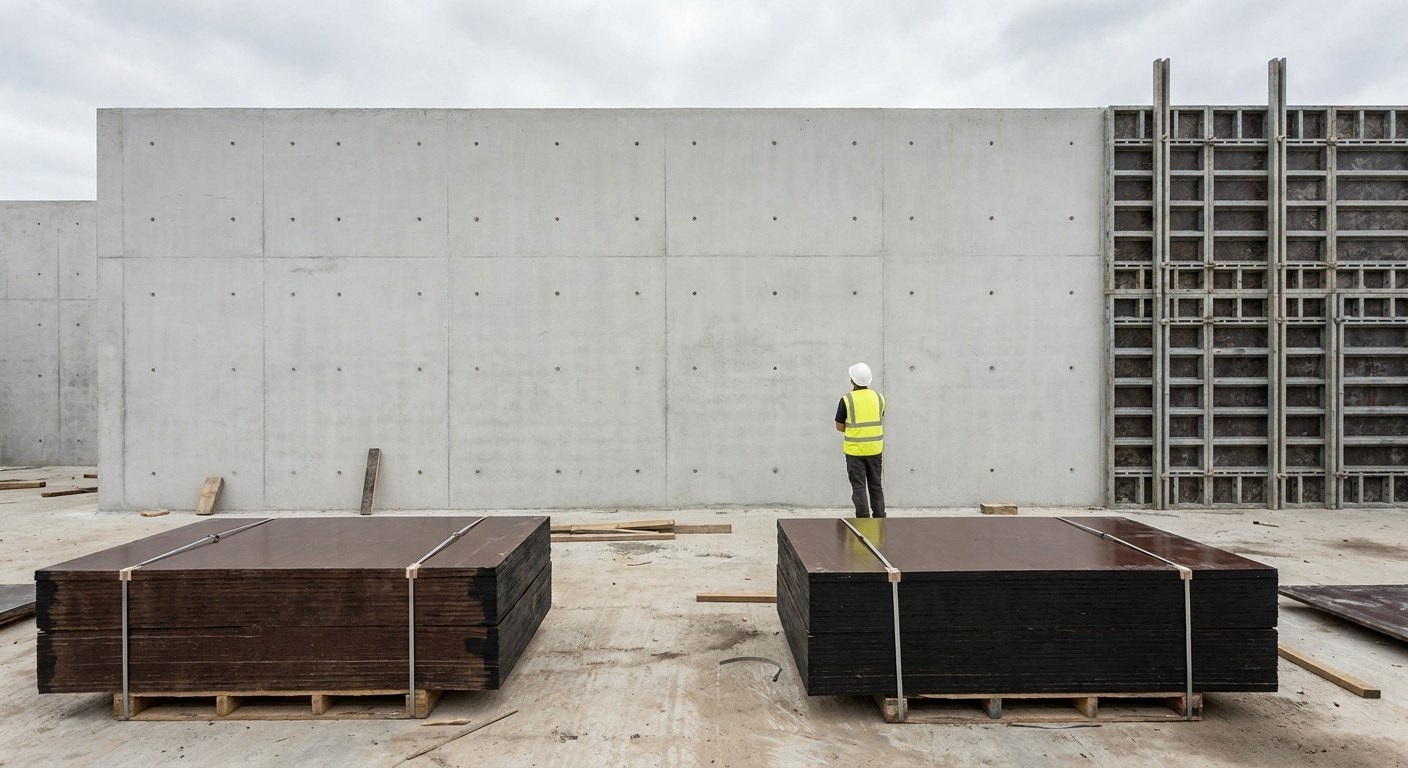
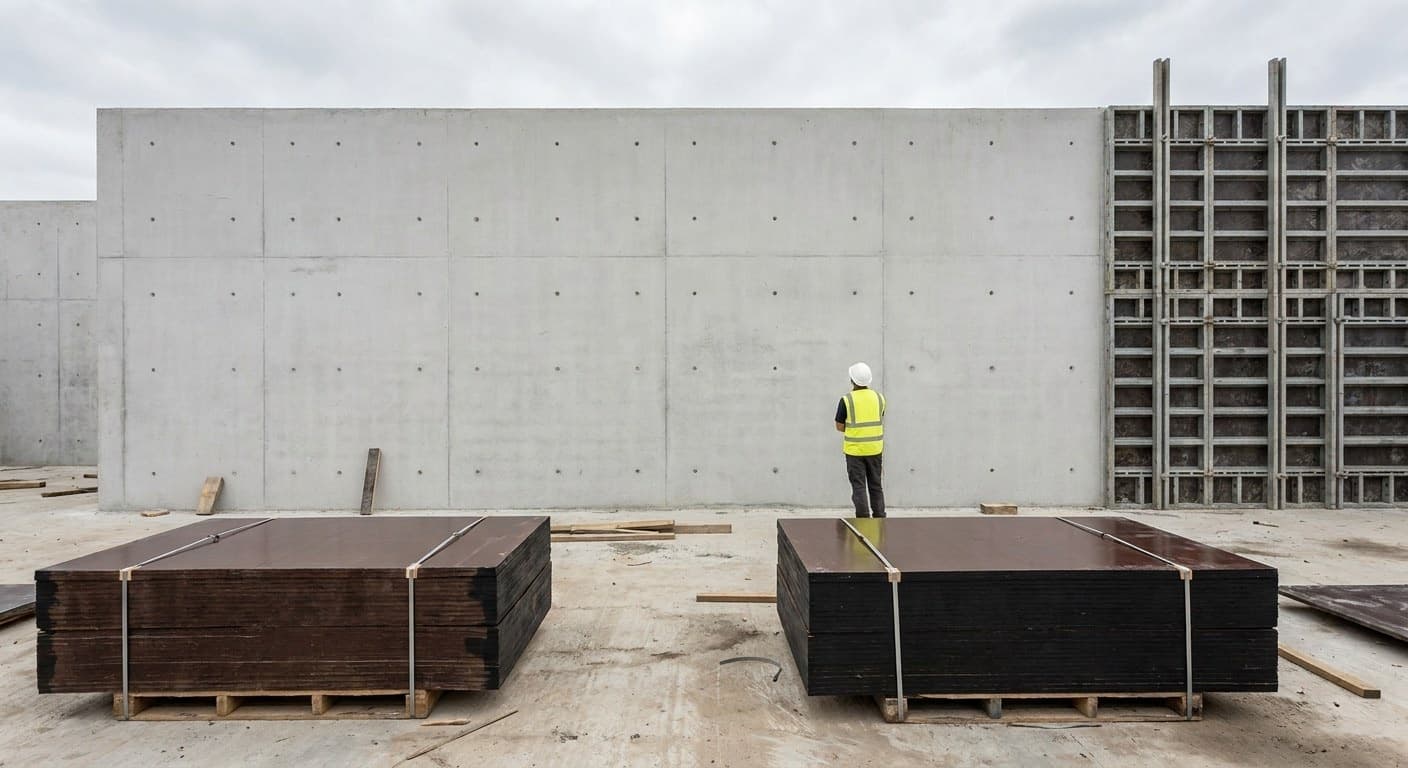
Walk past a new museum or a school extension and there's a fair chance the walls are bare concrete. No render. No cladding, no paint either. The architect liked the stuff and wanted it on show. Lovely, unless you're the formwork crew, because now whatever your form face looked like on pour day is the finished wall. Joints, tie holes, the lot.
And the specs for this work? Full of words that look simple and aren't. "Fair-faced." "Class A." "SB3." "Plain finish." Price a job in Leeds and you get one vocabulary, Denver another, Munich and Brisbane two more, and each sets its own bar for the panels, the release agent and whoever strips the forms. We'll go market by market, then look at what all of it means for the form face.
Concrete that is left as it comes out of the form
Fair-faced concrete is concrete left exactly as it comes off the formwork, so the struck surface is the finished surface. Nothing goes on top to hide a step at a joint or a patch of bugholes. Germans say Sichtbeton ("visible concrete"). In the US you'll read architectural or exposed concrete; Australians say off-form. Same idea under four names.
Funny thing, though. In Britain the term doesn't officially exist. The Concrete Society notes that "fair-faced" isn't a recognised specification term, and CP110, the old code of practice, was already telling engineers to steer clear of it in 1972. Pretty much any formed finish better than the bottom one could wear the label. Fine for a chat or a sketch. For a tender you need a class out of an actual standard, or nobody can price it and nobody can check it.
It's easy to see how this goes sideways. Owner has a magazine photo of a silky grey wall in mind, drawings say "fair-faced," contractor prices an ordinary finish. Six months on, there's a meeting in front of the wall.
How the United Kingdom grades a formed finish
UK building jobs mostly run on the National Structural Concrete Specification (NSCS), and its formed finishes match the names in the European execution standard BS EN 13670: Basic, Ordinary, Plain, Special. Say nothing in the project spec and you get Ordinary by default.
Basic is hardly a finish. Compact the concrete, hit your cover and tolerances, finished. Ordinary asks for a well-compacted surface without major blemishes or honeycombing, allows steps of up to 5 mm where form panels meet, and makes no promise about colour. It's meant for surfaces that will be covered or simply don't matter much to look at.
Plain is where it gets serious. You're now expected to choose the mix and release agent with care, use good formwork, keep surfaces true and arrises clean, hold a consistent colour, and set out panels and tie-bolt holes in a regular pattern. Steps at joints drop to a maximum of 3 mm, and the expectation is that no making good will be needed. The Concrete Centre's own guidance describes Plain as close to "as struck," but not a top-end architectural finish. Anything beyond that is a Special finish, where the project specification spells out the detail and a sample panel is required.
Class A in an American spec is about tolerance
Search for "Class A concrete finish" and you'll find people using it to mean a really good-looking wall. That isn't quite what the letter means. In ACI 117, the American tolerance specification, Classes A to D are limits on how far a formed surface may wander, measured against a 5-foot straightedge or within an inch of an abrupt offset. For Class A the limit is 1/8 inch. B doubles that to 1/4, C is 1/2, and D lets you off with a whole inch. ACI 347, the formwork guide, uses the same letters.
So a Class A wall is flat and true to within tight limits. It can still be blotchy, full of bugholes or patterned with mismatched panels, because the class doesn't measure colour or texture. ACI 301, the general structural concrete specification, adds named formed finishes, rough-form and smooth-form among them, but those still leave a lot to interpretation.
That gap is why ACI 347.3R-13, the Guide to Formed Concrete Surfaces, exists. Its four concrete surface categories run from CSC1 up to CSC4, and each gets graded on texture, surface void ratio, colour, flatness, joints and what the form facing is made of. The guide's own examples put basement walls at CSC1, commercial building exteriors at CSC3 and monumental or landmark structures at CSC4. It also leans hard on mockups and a reference area agreed on site, which is the American take on a sample panel.
Sichtbeton classes in Germany, Austria and Switzerland
German-speaking markets have probably the most detailed system of the lot. The DBV/VDZ Merkblatt Sichtbeton, a guidance sheet from the German concrete and cement associations, defines four exposed-concrete classes, SB1 to SB4. SB1 covers low design demands such as basement walls and mainly commercial areas. SB2 is normal demand, think stairwells or retaining walls. SB3 is high demand, facades for example, and SB4 is reserved for particularly high demands on representative parts of a building.
Each class is really a bundle of smaller ones. Texture, porosity, colour uniformity, construction and panel joints, flatness, and a formwork skin class all get their own grade, and the porosity limit even changes depending on whether the form face absorbs water or not. That's a detail worth noticing. A film-faced panel and an absorbent board are expected to leave different pore patterns, and the Merkblatt writes that difference straight into the class.
Trial panels also scale with the class. They're optional at SB1, recommended at SB2, strongly recommended at SB3, and required at SB4, with at least two trials expected at the top end. Once everyone signs off on one trial as the yardstick, it's called a Referenzfläche, and the real walls get judged against it.
Off-form classes under AS 3610 in Australia
Down under it's AS 3610.1, the formwork specification, grading off-form surfaces Class 1 (best) to Class 5. The first three are for work people will look at. Classes 4 and 5 are for surfaces that are hidden or where the finish isn't critical, and their limits are mostly governed by structural requirements in AS 3600.
Class 1 is the one people over-specify. Cement Concrete & Aggregates Australia advises keeping it to small elements cast in a single pour, never whole facades, because it's so costly and hard to achieve across a large area. Class 2 is the usual choice for exposed concrete that people can inspect up close, and Class 3 suits structures seen as a whole, like car parks and civil works. There's also an "X" suffix, as in Class 2X, for relaxing some tolerances on less critical faces.
One more point from the standard's scope. AS 3610 deals with plain surfaces as they leave the form, before any coating or treatment. Polish it, sandblast it or acid-etch it, and you're outside AS 3610.
| Market | Standard or guide | Class names | What gets judged | Typical top-end use |
|---|---|---|---|---|
| UK and Ireland | NSCS, in line with BS EN 13670 | Basic, Ordinary, Plain, Special | Blemishes, colour, joint steps (5 mm Ordinary, 3 mm Plain), panel and tie layout | Special, with a sample panel |
| United States | ACI 117 and ACI 347 | Class A to D | Surface irregularity only, 1/8 in for Class A | Class A on exposed work |
| United States | ACI 347.3R-13 | CSC1 to CSC4 | Texture, void ratio, colour, flatness, joints, form facing | CSC4 for landmark structures |
| Germany, Austria, Switzerland | DBV/VDZ Merkblatt Sichtbeton | SB1 to SB4 | Texture, porosity, colour, joints, flatness, formwork skin class | SB4, trial panels required |
| Australia | AS 3610.1 | Class 1 to 5 | Visual quality, tolerances, colour on Classes 1 to 3 | Class 1 for small single-pour features |
What a higher class asks of the form face
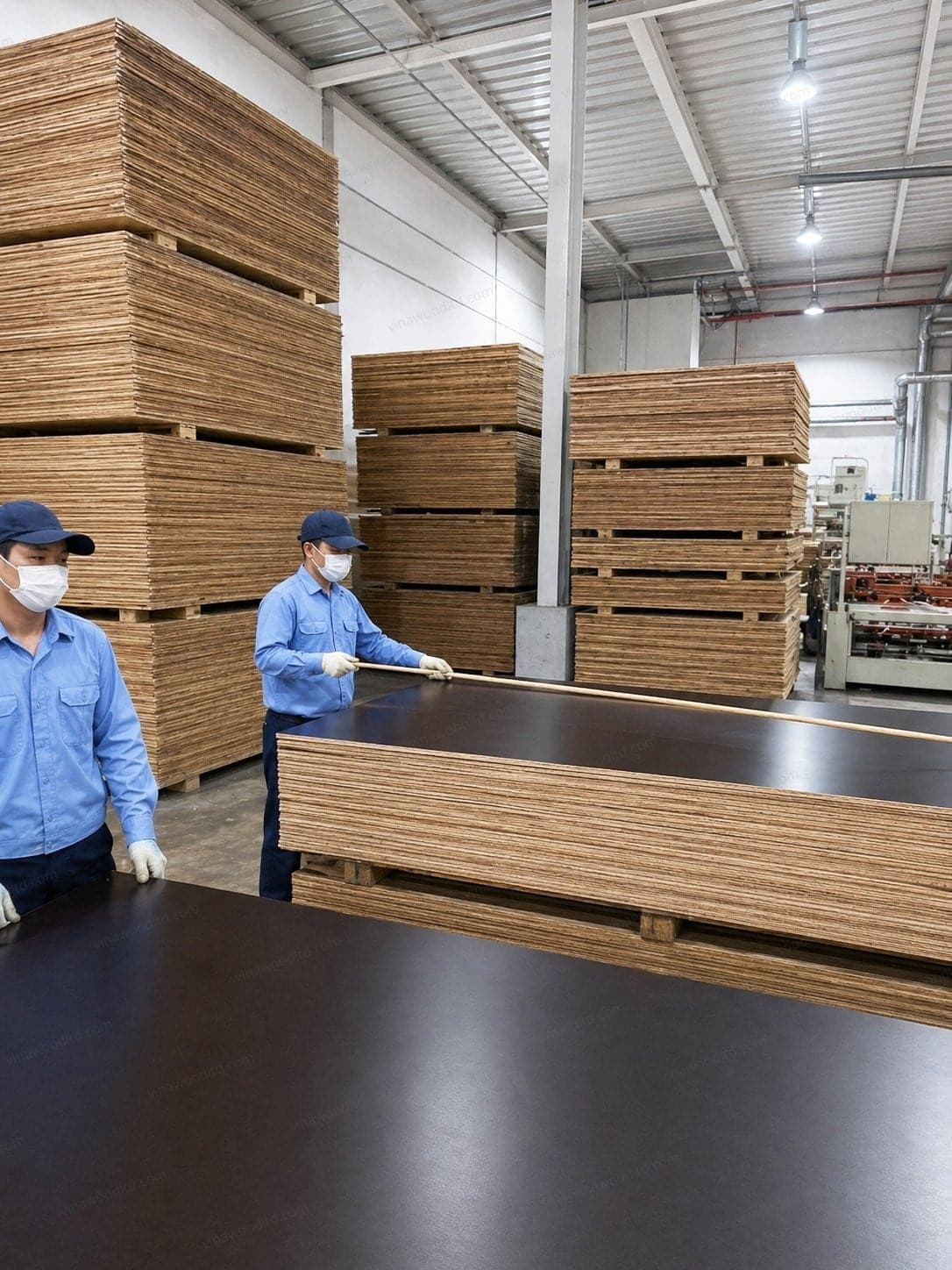
Put the four systems side by side and they keep asking for the same few things. Even colour comes first, so the form face can't be drinking water out of the fresh concrete in some spots and not others. Unsealed timber does exactly that. It swells in patches and you get grain marks and dark stains printed on the wall. A resin film face gives a far more uniform surface, and that's a big part of why film-faced plywood is the standard skin for smooth off-form work.
The type of film matters too. A phenolic film behaves differently from a melamine-based one on repeated pours, and our phenolic plywood explainer and melamine faced plywood guide lay out that difference. American crews often reach for overlays like HDO on high-grade work. No face is automatically "the SB3 one" or "the Class 2 one," mind you. What matters is how evenly it behaves, and how worn it is by the time it meets the wall everyone will stare at.
Wear is easy to forget. A panel on its first pour and the same panel on a much later pour won't leave identical surfaces, so crews working to a Plain, SB3 or Class 2 spec often keep the freshest faces for the elevations people will look at. Edges matter as well. A swollen or chipped panel edge opens the joint and lets grout bleed through, which leaves exactly the kind of fin or dark line the higher classes forbid. Our concrete forming plywood guide covers the panel basics behind all of this.
Then there's layout. NSCS Plain wants a regular pattern of panels and tie holes. The Sichtbeton classes grade panel joints separately. On a top-class job the architect may draw every panel and tie position on the elevation, and the formwork has to match it.
Sample panels, release agents and the weather
Every one of these systems ends up relying on a physical sample at the higher end, and for good reason. Words like "consistent colour" or "minor blemishes" mean different things to different people. A sample panel built on site, with the real concrete mix, the real formwork and the real crew, gives everyone something to point at. It also shows problems early, while there's still time to change the mix or the release agent.
Release agents leave their own fingerprint. Too much and you can get staining or dusty patches; too little and the concrete may tear at the face when the panel comes off. The NSCS Plain finish calls out discolouration from the release agent by name, which tells you how often it goes wrong. Our guide to form release agents explains the main types and how they're applied.
Weather plays its part too. Hot, dry or windy days change how quickly the surface sets against the form, and cold weather can slow it right down, so two pours from the same truck and the same panels can come out a shade apart. That's one reason the standards talk about colour within limits rather than colour that matches exactly.
If you buy or specify the panels for this kind of work, Vinawood's mill blog has a supplier-side piece on fair-faced concrete and panel choice. The Vietnam Plywood Atlas is published by Vinawood with a transparent mill affiliation, and this page sticks to how the industry grades the finish.
Frequently asked
What is fair-faced concrete?
Fair-faced concrete is concrete left as it comes off the formwork, with no render, cladding or paint on top, so the struck surface is the finished surface. It is also called as-struck, exposed or architectural concrete, Sichtbeton in German and off-form concrete in Australia. Because the form face prints directly onto the wall, the formwork, release agent and workmanship decide how it looks.
What does Class A concrete finish mean?
In US practice Class A usually refers to the ACI 117 and ACI 347 tolerance classes for formed surfaces. Class A allows irregularities of up to 1/8 inch, measured with a 5-foot straightedge or within an inch of an abrupt offset, while Classes B, C and D allow progressively more. It is a flatness limit, not a description of colour or texture, so architectural specs often add ACI 347.3R surface categories or a mockup.
What are SB1 to SB4 in Sichtbeton?
SB1 to SB4 are the exposed-concrete classes in the DBV/VDZ Merkblatt Sichtbeton used in Germany and neighbouring markets. SB1 covers low design demands such as basement walls, SB2 normal demands such as stairwells, SB3 high demands such as facades and SB4 particularly high demands on representative elements. Each class bundles separate grades for texture, porosity, colour, joints, flatness and formwork skin, and trial panels become more strongly expected as the class rises.
Can film-faced plywood produce a fair-faced finish?
Yes, film-faced plywood is one of the most common form faces for smooth fair-faced work because its resin film absorbs little water and gives an even surface. The result still depends on the film type, how worn the panels are, joint and tie layout, release agent and concrete mix. For high classes, crews usually test the actual panels on a sample panel before pouring the visible walls.
Why does fair-faced concrete show panel joints?
Every joint between form panels leaves a line on the concrete, and any step, gap or swollen edge there is copied into the wall. Standards limit these steps, for example to 5 mm for an NSCS Ordinary finish and 3 mm for Plain. Tight, well-sealed panel edges and a planned joint pattern keep the lines regular rather than ragged.
Is fair-faced concrete the same as polished concrete?
No. Fair-faced concrete is a formed surface left as struck, usually a wall, column or soffit, while polished concrete is a surface, usually a slab, that has been ground and polished after it hardens. Standards such as AS 3610 cover off-form surfaces only and exclude polished, sandblasted or acid-etched finishes.
Related in the atlas
Continue reading
Same topic first, then what others on the atlas read most.
Formwork
Formply Explained: Australian F-Grade Formwork Plywood and AS 6669
Formply is the Australian and New Zealand trade name for concrete-formwork plywood ordered by F-stress grades such as F17 under AS 6669—not a waterproof claim and not APA MDO.
Formwork
MDO Plywood Explained: Medium Density Overlay for Concrete Form
MDO plywood (Medium Density Overlay) is a resin-fiber face class used in North American Concrete Form talk for matte pour finishes—not a glue class and not a waterproof certificate.
Formwork
Concrete Forming Plywood Explained: US Forming Language and Overlay Families
Concrete forming plywood is structural plywood used as the temporary mold face for wet concrete—not sheathing and not a gang frame. Here is the US naming map and overlay checklist.
Formwork
HDO Plywood Explained: High Density Overlay for Concrete Form
HDO plywood (High Density Overlay) is a denser resin-fiber face class used in North American Concrete Form talk—not a glue class and not a waterproof certificate.