
Guides/Industry Education
Melamine Faced Plywood Explained: Melamine Film vs Phenolic Film vs MUF Glue
Melamine faced plywood can mean a decorative paper face, a budget form film or MUF glue in the core. How each differs from phenolic film and what to ask.
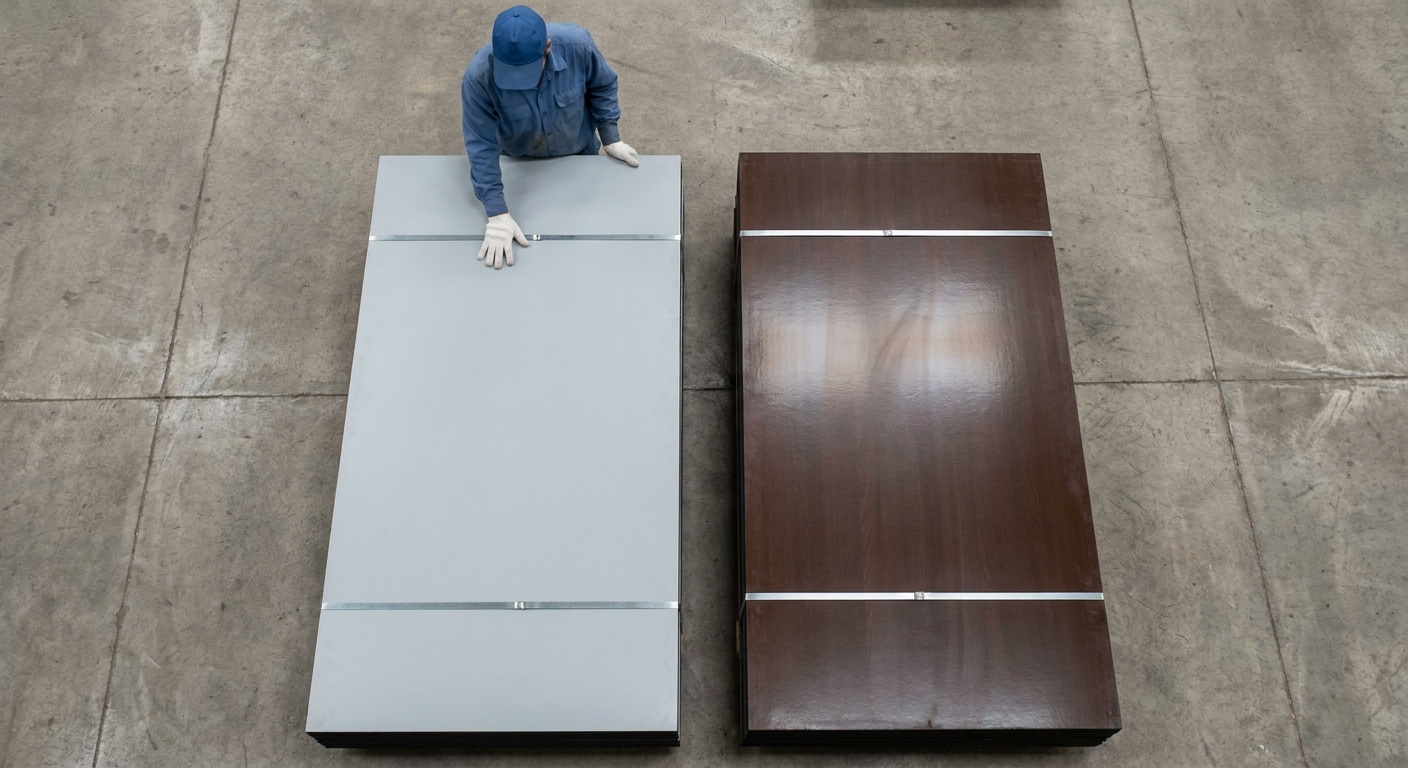
Type "melamine plywood" into Google and you'll mostly get kitchen cabinets. White shelves, flat-pack wardrobes, the odd shop counter. Ask a panel trader the same thing from a site office, though, and the answer may come back as a grey-faced concrete form sheet, or a quote for plywood glued with a melamine-based resin. Same word. Three different products, and they don't swap.
We see this go wrong on RFQs fairly often. A contractor hears "melamine," thinks of kitchen doors, and turns down a form panel that would have done the job fine. Or a distributor reads it as a casting face and ends up with a container of sheets that were only ever meant for cupboards. So this page pulls the word apart: what it means in each corner of the trade, how the faces get made, how a melamine film stacks up against phenolic on a pour, and why the glue you can't see usually matters more than the face you can.
One resin, three places it can hide
Melamine itself is a resin. Cook it with formaldehyde and it cures into a hard, clear, heat-tolerant plastic, and panel makers use it in three quite separate spots. When two people argue about "melamine plywood," odds are one of them is talking about the surface and the other about the glue.
Spot one is decoration. A printed paper, plain white or a fake oak grain, gets soaked in melamine resin and pressed onto a board, and you get that wipe-clean finish on kitchen carcasses. Most of it ends up on particleboard and MDF (the stuff Europeans call MFC), but plywood gets the same treatment for cabinets and shopfitting. There's even a European standard for these boards, EN 14322. Its title says "for interior uses," which tells you most of what you need to know.
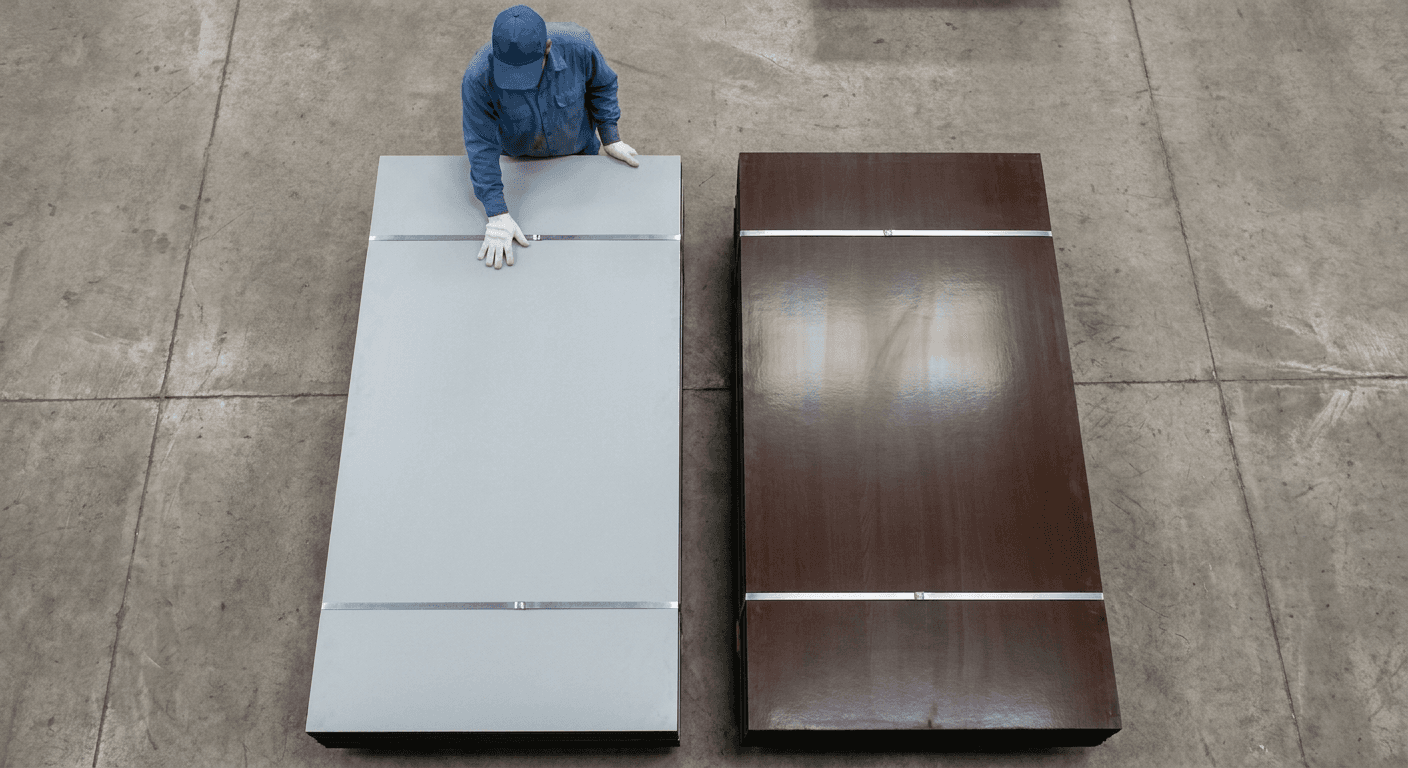
Spot two is the concrete form. Some cheaper form panels wear a resin paper that's melamine-based, or a blend, instead of the dark brown phenolic film you'd normally expect. They tend to look paler. Greyish, sometimes. And traders will happily list them under "film faced" right next to phenolic sheets.
Spot three you can't see at all. MUF is melamine-urea-formaldehyde, a glue that holds the veneers together inside the core. Put a phenolic film on an MUF-glued panel and it looks identical, from the outside, to one glued with phenolic. So "melamine" on a quote might be the skin. Might be the glue. Might be both.
| When someone says "melamine" | Where it sits | What it's usually for |
|---|---|---|
| Decorative melamine paper | On the face and back | Cabinets, furniture, shop interiors |
| Melamine-based form film | On the face and back | Short-run concrete forms, budget end |
| MUF glue | In every glue line | Core bond in plenty of film-faced and general panels |
From paper roll to panel face
All three faces start life the same way. Paper comes off a roll, runs through a bath of liquid resin, gets dried to a set resin content and cut into sheets. At that stage it's stiff and slightly tacky. Not a surface yet.
The hot press does the rest. Heat and pressure melt the resin, push it down into the top veneer and cure it into one continuous skin, and what comes out is thin. Really thin. More like a coat of paint than an extra ply, which is why you'll never see the film as its own layer when you look at a cut edge.
Suppliers quote film by weight, grams per square metre, and a heavier paper carries more resin. Fair enough. But that number only compares like with like. A heavy melamine film isn't a stand-in for a light phenolic one just because the gram weights sit close on a price list, since it's the resin chemistry that decides how the face copes with wet cement, release oil and a crew stripping forms in a hurry.
Melamine cures hard and stays pale, so decorators love it: you can print on it, colour-match it, keep it bright. Phenolic cures brown, and close to black on the heavier films. Nobody picks it for looks. It's on form panels because of how it behaves once the concrete shows up.
Melamine film vs phenolic film when the concrete arrives
Wet concrete is alkaline and heavy, and it sits against the form face for hours, sometimes days. Then someone strips the panel, knocks it about, cleans it and sends it back for the next pour. Over and over. Phenolic film became the default face for that kind of abuse across most formwork markets, from Australian formply to the film-faced sheets sold through Gulf and European distributors.
Melamine-based form films still turn up, mostly at the low-price end and mostly pitched at short programmes. Data sheets we've seen generally put them below phenolic faces on expected reuse, which makes sense when you remember they're a different resin. Treat that as a pattern, though, not a test result. For any specific panel ask for the supplier's reuse figure, written as "up to" a number of pours, and ask how they got it.
Honestly? Site habits often matter more than the film. Unsealed cut edges let water straight into the core, and a crowbar under a panel lip will finish off any face. Sealing every cut and using a decent form release agent can shift reuse more than a few extra grams of film. If you're planning a long run of fair-face pours, our phenolic plywood explainer separates the phenolic face from phenolic glue, and the HDO guide covers the heavier overlay American forming crews use.
Vinawood's mill blog runs the buyer-side version of this comparison, tying glue class and pour counts to its own grade ladder, in melamine vs phenolic film-faced plywood. Here we'll stick to the general picture.
Why the glue line usually beats the face
A worn face is obvious. You can see it going, pour by pour. A failing glue line isn't, right up until water gets past a chipped edge or a tie hole and the veneers start to blister apart. That's why people who've bought a lot of form ply look at the bond class first and the film second.
In Europe that bond is graded under EN 314-2. Class 1 covers dry interiors, Class 2 humid or covered exterior conditions, Class 3 full exterior exposure, and each class has its own soak-or-boil pre-treatment followed by a shear test. MUF glues are commonly tested to Class 2. Phenol-formaldehyde is the usual road to Class 3. Some high-melamine MUF blends do better than the basic ones, which is exactly why the class printed on the test report beats the glue name in a brochure. Our EN 314-2 guide goes through the tests in detail.
Then there's WBP. It's an old British label, weather and boil proof, and sellers stick it on both phenolic and MUF glue lines. Don't take it as an answer. Take it as your cue to ask for the EN 314-2 class or an equivalent report, and see the WBP explainer for the history.
Put it together and the "melamine" family splits further than you'd think. A decorative board on urea glue, a melamine-film form panel on MUF, a phenolic-film panel on MUF and a phenolic-film panel on phenolic glue are four different things. Only a bond test tells the last two apart.
Pinning down which melamine is on the quote
Start with the face. Get the supplier to write down whether it's decorative melamine paper, a melamine or blended form film, or phenolic film, plus the film weight on each side. If they can't answer quickly, that's an answer of sorts.
Next, the glue. MUF, phenol-formaldehyde or something else? Which EN 314-2 class does the test report show, or which PS 1 exposure rating if you're buying for the US market? And check that the report matches the actual product and thickness you're ordering, because a certificate for a different line proves nothing about yours.
The rest is practical. How are edges sealed? Which plantation-grown species are in the core, acacia, eucalyptus, a mix? For form work, what reuse range will the supplier put in writing, and for what kind of site? You don't need an engineering degree to ask any of this. Clear answers turn a fuzzy word into a product you can actually compare, and our concrete forming plywood guide shows where these fields usually sit on a spec.
Frequently asked
Is melamine faced plywood suitable for wet or outdoor use?
Not as a rule. Decorative melamine faced plywood is made for interiors, and its moisture tolerance depends far more on the glue line than on the face. A melamine face sheds splashes, but water that gets in through edges or screw holes reaches the core. For damp or exterior work, ask for the EN 314-2 bond class rather than relying on the word melamine.
Can melamine plywood be used for concrete formwork?
Some form panels do carry melamine-based films, and they are usually sold for short programmes at the lower-price end. Decorative melamine plywood made for cabinets is a different product and is not meant for casting concrete. For repeated pours most formwork markets use phenolic film over a Class 2 or Class 3 glue line, so check the face type and bond class before ordering.
Melamine vs phenolic film: which lasts longer on a concrete form?
Phenolic film generally does. Supplier data sheets tend to put melamine-based form films below phenolic faces on expected reuse, because the two resins react differently to wet alkaline concrete and repeated stripping. Edge sealing, release agent and handling also change the result a lot, so ask each supplier for a written reuse figure quoted as up to a number of pours.
What is MUF plywood?
MUF plywood is plywood whose veneers are bonded with melamine-urea-formaldehyde glue. MUF is a core adhesive, not a face, so an MUF panel can wear a phenolic film and look identical to a phenolic-glued sheet. MUF bonds are commonly tested to EN 314-2 Class 2, while phenol-formaldehyde is the usual route to Class 3.
Is melamine board the same as melamine plywood?
No. Melamine board usually means particleboard or MDF with a decorative melamine paper face, often called MFC, and it is covered in Europe by EN 14322 for interior uses. Melamine plywood has a plywood core of cross-laminated veneers under a similar face. The plywood core is stiffer and holds screws better, but the face itself does a similar job on both.
Related in the atlas
Continue reading
Same topic first, then what others on the atlas read most.
Industry Education
Plywood Delamination Explained: Glue-Line Failure, Bond Tests and What Buyers Should Ask
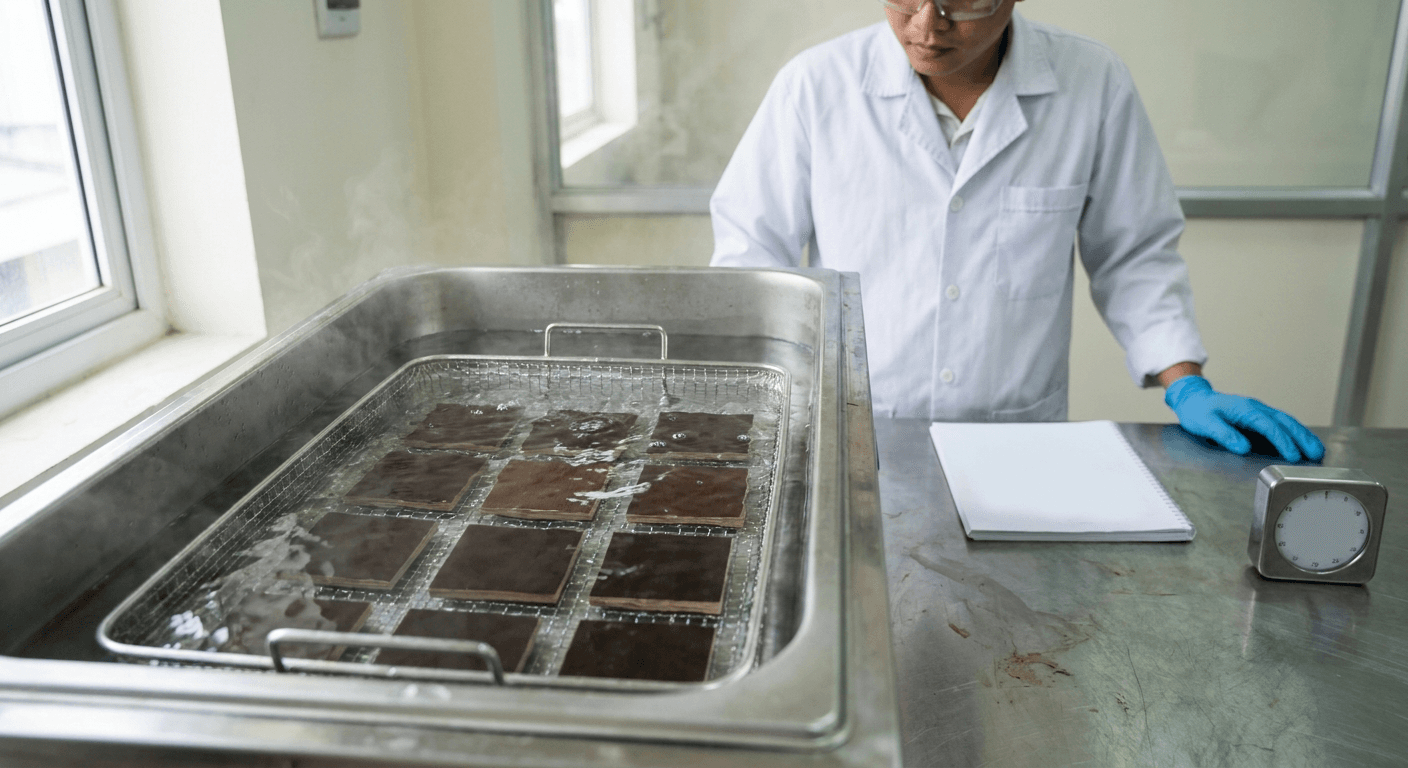
Plywood delamination is a glue line letting go between plies. Here is how PS 1 and EN 314 define and test it, how it differs from film peeling and veneer checks, and what bond evidence a buyer should ask a mill for.
Industry Education
Fire-Rated Plywood Explained: Flame Spread, FRT Treatment and Why Panels Are Not Fireproof
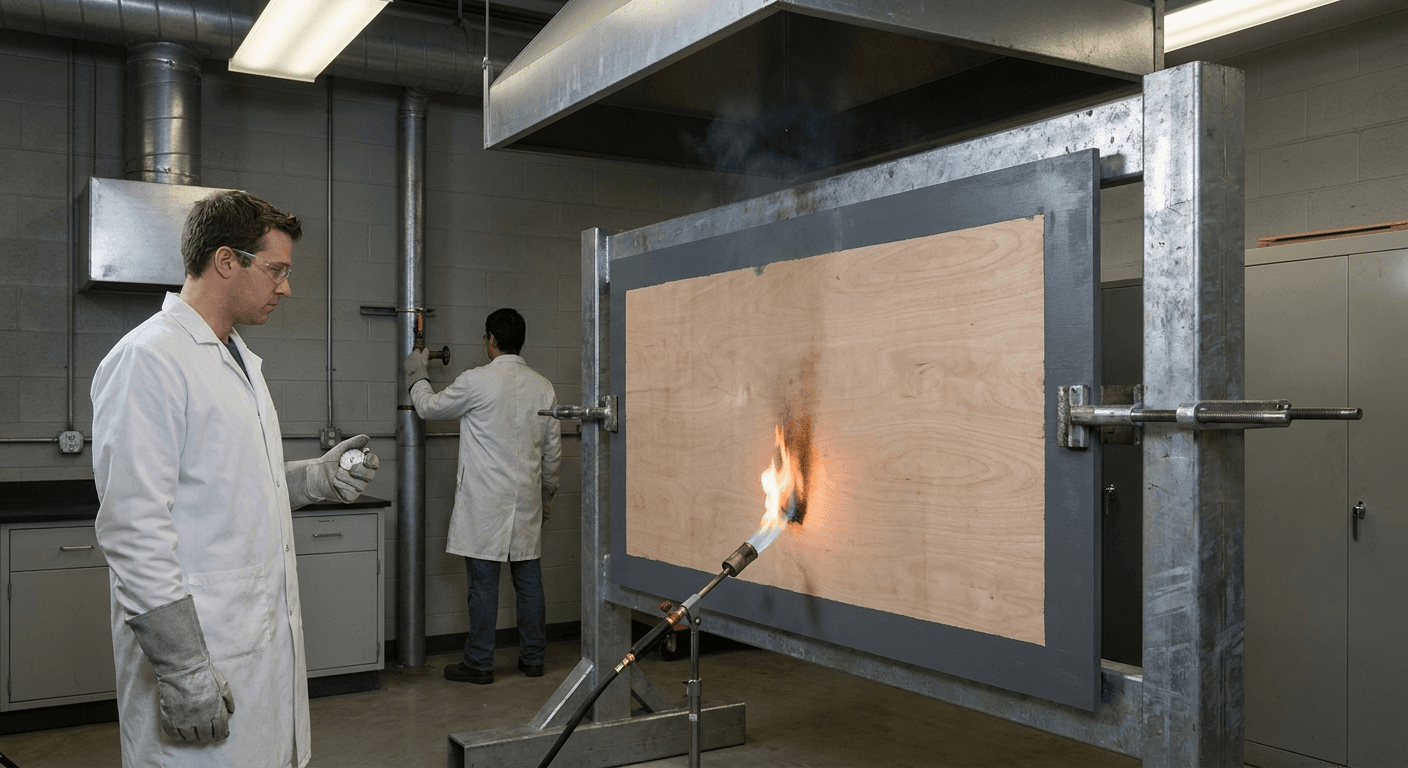
"Fire rated plywood" can mean a flame spread class, a pressure-treated FRT panel or a rated wall assembly. Here is how each one is tested, where untreated plywood lands, and what importers should ask for.

Industry Education
Form Release Agents Explained: How Release Chemistry Meets the Plywood Form Face
A concrete form release agent is the coat between wet concrete and the plywood form face. Here is how barrier and reactive chemistries differ, how VOC rules treat them, and why face type and release choice belong on the same RFQ line.

Industry Education
MR Plywood Explained: Moisture-Resistant Grades vs BWR, BWP and WBP
MR plywood is the moisture-resistant, general-purpose interior grade in India's IS 303. Here is how the 2024 revision changed the MR, BWR and BWP ladder, and why MR does not map onto WBP, EN 314-2 or Exposure 1.